

Tl;Dr: Scroll to bottom to see the summary flowchart. Here’s a Claude shame therapy bot I made, but keep in mind it isn’t for people who have done terrible crimes, and it may catastrophize as usual with AI.
People Are Struggling To Overcome Shame
A friend of mine recently shared this reddit post with me on dealing with shame. It had a useful basic self-acceptance script. Shamefully, though, the r/CPTSD moderators removed the post for some unknown reason, as well as many comments.
This well-meaning script was powerfully shaped by the foundational 1980s work of John Bradshaw. In his seminal book, Healing the Shame That Binds You, Bradshaw defined this “toxic shame” as a core identity, or a state of being where one feels flawed and defective. His solution, which became the blueprint for much of modern therapy, is a process of externalization: separating your innocent “inner child” from the toxic shame that binds it.
The problem is, while revolutionary, this framework cemented the idea that the “I am bad” feeling is a pathology to be excised. By labeling the shame as “toxic” and foreign, we inadvertently declare war on a part of our own biology, trying to rescue the child from the emotion rather than teaching the child how to understand it.
What is shame and is it bad?
Shame is not just guilt over doing something wrong, but it’s the sense that you as a person are bad (maybe due to multiple tendencies), and specifically, almost always, bad in the eyes of society (or it could be in the eyes of God, or the eyes of yourself or anyone). There’s a sense that you are at risk of rejection, exposure, or humiliation, or that you are stuck on a wrong path and incapable of fixing your life.
Daniel Sznycer, who developed the information threat theory of shame, proposes that shame is an emergency brake, designed to minimize the spread of negative information about the self and the likelihood and costs of being socially devalued by others. When we perceive a drop in our social standing (rejection, scorn), our threat system activates, and our first response is to freeze (hide) or submit (withdraw) to prevent further attack or expulsion. We feel an immediate, hot, sinking feeling like when we are publicly scorned, caught in a lie, or realize we’ve violated a core social norm.
This suggests shame is not a faulty kink or a bug, but a precisely calibrated defense mechanism, like physical pain. Its function is to make you care about your social standing as much as the group does, forcing you to align with its norms to avoid being devalued, which is the why behind the “emergency brake.” Shame is a calibrated response to perceived social conditions, not a character flaw.
Shame can sometimes be a secondary emotion, covering over another emotion that you don’t feel safe to feel. Even joy could make you feel shame if you sense that you are not supposed to be experiencing joy at that time, according to others (happy at a funeral?). And sometimes shame is a cover for more shame underneath! For example, I have a friend who uses fent, not to get high, but to feel shameful, because he’s ashamed about his lack of social connections (loneliness), and he feels that causing himself to feel shameful about something other than that can be like a punishment + distraction for/from the underlying shame of being lonely.
As Internal Family Systems therapy explains, every emotion can be either adaptive (beneficial, redemptive) or maladaptive (toxic, stigmatizing). Toxic shame is when you either wrongly label yourself as bad/unworthy, or you rightly label yourself but in a static, judgmental, and harsh way, rather than as an impetus to improve.
To illustrate how shame can sometimes flip from stigmatizing to redemptive, I’ll share a personal story:
The most intense shame I ever experienced began at age 5, due to engaging in sexual play with my 5 year-old playmate (went all the way), and later realizing I couldn’t tell anyone about it because people would think it is taboo in some way. Luckily, I actually did have very understanding parents, and once I opened up to my mom about it at age 17, I felt like the weight of an elephant come off my chest! I hope the girl also found someone understanding to talk to.
On the one hand, we could say I suffered from toxic shame, since I was actually not bad, and many might say I didn’t even do anything wrong. I was just being a kid, exploring my sexuality with a playmate. But on the other hand, we could say it was adaptive shame, because even though, from some objective perspective, perhaps I did nothing wrong, from my own perspective at the time, I felt it probably was something that society would judge as wrong, and I needed to confess it. By confessing it, I actually gained a new confidence in the ability of loved ones to understand and accept me, so this shame ended up being super adaptive and helpful! I just wish I had not suffered for 12 years before opening up.
Leapfrogging Past the Blame Pendulum
On one side of the psychological blame pendulum lie prescriptive “Western” psychological models, exemplified by John Bradshaw, which differentiate adaptive guilt (“I made a terrible mistake”) from toxic shame (“I am bad”). On the other side of the blame pendulum, in more traditional cultures, adaptive shame is understood as a pillar of society. But Eastern therapy systems, such as Japanese Morita Therapy (which has a Western analog called Acceptance and Commitment Therapy), are in some sense no better, as they simply ignore the individual’s strife.
The Evolutionary Logic of Shame
I argue that the sensation of shame itself—the “I am bad” feeling that Bradshaw and others defined as intrinsically toxic—is not intrinsically pathological. Research by social psychologist Ilanit de Hooge on the social side of shame found that shame, but not guilt, ultimately motivates social approach and reconciliation. I also posit that it motivates the same among one’s inner-parts. While behavioral change may be a result of this process, the pot of gold at the end of the rainbow is a greater sense of trust and belonging. 🌈
Evolutionary psychology, as usual, gives us valuable perspective. Shame is not just a faulty kink in our neural wiring due to trauma. It can be that, especially these days, but it evolved for a valuable purpose, which is to align ourselves with the community/collective by motivating us to confess our sins and seek forgiveness and understanding.
To truly forgive, it is helpful to adopt the perspective that we are all a product of our conditions: everyone is always doing the best they know how. This isn’t excusing harm, but rather exposing the conditions that produce it so we can change them. Maybe you heard the expression, “Hurt people hurt people; healed people heal people.” I recently told a friend this and he vehemently disagreed, saying that he was very hurt, but he didn’t hurt other people. Indeed, the nuance there is that internalizers continue to primarily hurt themselves (which sabotages them and their relationships), while externalizers “intentionally” hurt others (which also sabotages them and their relationships).
Nobody freely chooses to be a horrible person, just like nobody freely chooses to be a wonderful person. Yes, we make choices, but those choices happen due to conditions. For example, a child raised in an environment of chronic violence and scarcity will be adapted to survival of the fittest, violence and crime. This child will probably “choose” to become a criminal (unless some other factors are at play). But if luck intervenes after he goes to prison, then instead of receiving stigmatizing shame, he might receive redemptive shame via a restorative justice program, or the Bible leading him into a spiritual rebirth. Then he may “choose” to repent from his sinful ways and become a beacon of love:
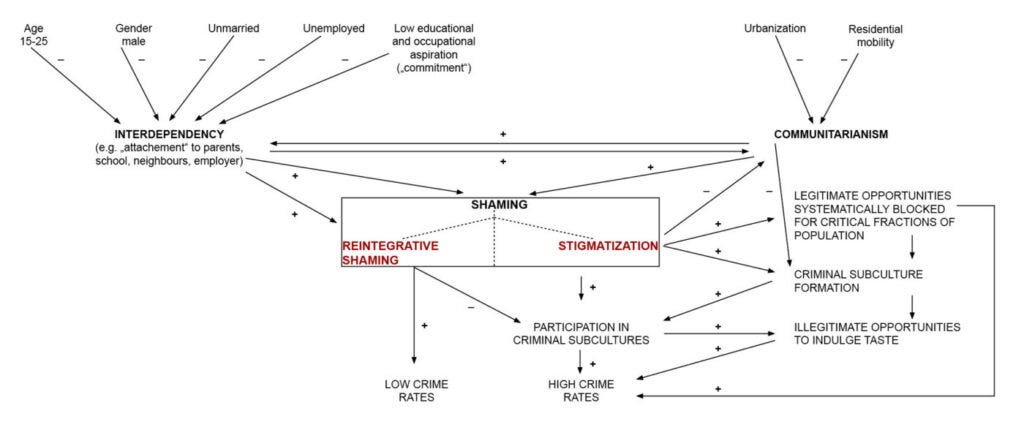
Once we really deeply understand that we are just a bunch of conditions playing out, we can honestly and deeply forgive ourselves for every mistake, and every wrong choice we’ve made, and then we can begin making wiser and more compassionate choices. And once we succeed at forgiving ourself, we can forgive everyone else as well, which will actually heal our heart directly, and then spill over to influence others’ healing automatically.
Community Creates The Conditions To Forgive and Heal
That child I mentioned in the violent upbringing would actually be maladapted to his conditions if he became an angel or a saint. He would just get beaten up relentlessly. What he needs is the proper environment that supports his transformation into a good person and rewards him for it.
While many of us did have the luck to grow up in nicer neighborhoods, unfortunately, we usually don’t have any kind of true, good community, since most of us are not living in tribes. The Catholic confession booth is the best we get, unless we are addicted to drugs, then we can go to a 12 Step Program.
In many tribes, they have special gatherings for addressing bad behaviors and helping offenders to reconcile and heal along with the tribe (research). This process works because a genuine display of shame functions as a powerful, non-transactional “apology.” While a guilt-based apology (“I did a bad thing”) can be seen as just a promise to fix a behavior, an expression of shame (“I am bad”) is often perceived as true sorriness.
Research on intergroup conflict has found that apologies expressing shame are more effective at eliciting forgiveness and rebuilding trust than those expressing only guilt. The community sees the individual’s shame as a sincere signal that they accept the group’s norms and feel the pain of their misalignment, which makes reintegration and redemption possible (Nunney & Manstead, 2021).
It’s also important not to idealize and stereotype tribal life. Many small-scale societies are high-shame/honor cultures, where the “reconciliation” is not always restorative. It can be coercive, violent, or based on rigid conformity. Tribes also have their own problems due to being a moral echo chamber. Children often go thru some kind of trauma during their coming-of-age ceremonies, including rape, circumcision, or drug overdoses (said to be lethal if grave sins are not confessed). But adaptive shame really does make sense when seen from this traditional context.
Think about when you were a child. You would (hopefully!) feel guilt when you realized you did something you shouldn’t have done--or when this was pointed out by a parent or other loved one. Then, if you kept feeling guilty about doing many bad things, you would develop shame. This is actually a sign of mental health, because it is what allows you to change. But, in order to change, you would most likely need your loved one (parent usually if you had a good parent) to encourage you, to tell you that you are deeply good inside, and these problems you have can be corrected step by step with their guidance as you mature.
From Tribal Healing to Modern Isolation
So, what can we do now, as adults, without a tribe to help us? One option is we can try to find our tribe. That takes work, but it’s really worth it if you can find it. On the other hand, many people mistake narrow-interest echo chambers (e.g. MGTOW) for a tribe. A tribe is a bit of an echo chamber, but an echo chamber is not a tribe. A tribe is a life-affirming community that supports each member to feel they are in harmony with this human life. The best modern folks can hope for is an intentional community (or at least eco-village), which can loosely approximate a tribe, but can’t ever fully fulfill that role for people, since everyone is coming from different backgrounds.
But heck, even if you could just find one or more true friends that you could really open up to, that would be better than going it alone and just trying to intellectually understand that you are not truly alone from some higher perspective.
True Friends Have These Qualities:
Non-judgmental presence (they listen without disgust)
Honest reflection (they gently challenge your blind spots)
Consistent availability (they show up over time)
Shared values (their ethics align with yours)
This differs from an echo chamber (which validates without challenging) and from enabling relationships (which support without accountability).
One free resource I took advantage of in my youth, which you may be able to find locally, is a Re-evaluation Co-counseling (RC) community. It does have a few minor cultish qualities, but it can be really helpful to develop a bit of a caring, therapeutic community, even while living in a city, and they have chapters worldwide.
The key is finding people who can hold both truths: your shame isn’t the whole story, but it might be telling you something important.
If you can’t find any human, you can try the shame chatbot I made, but don’t tell it criminal secrets, and keep in mind AI guardrails will often catastrophize and try to get you to call 911.
Most Effective Existing Therapy Models
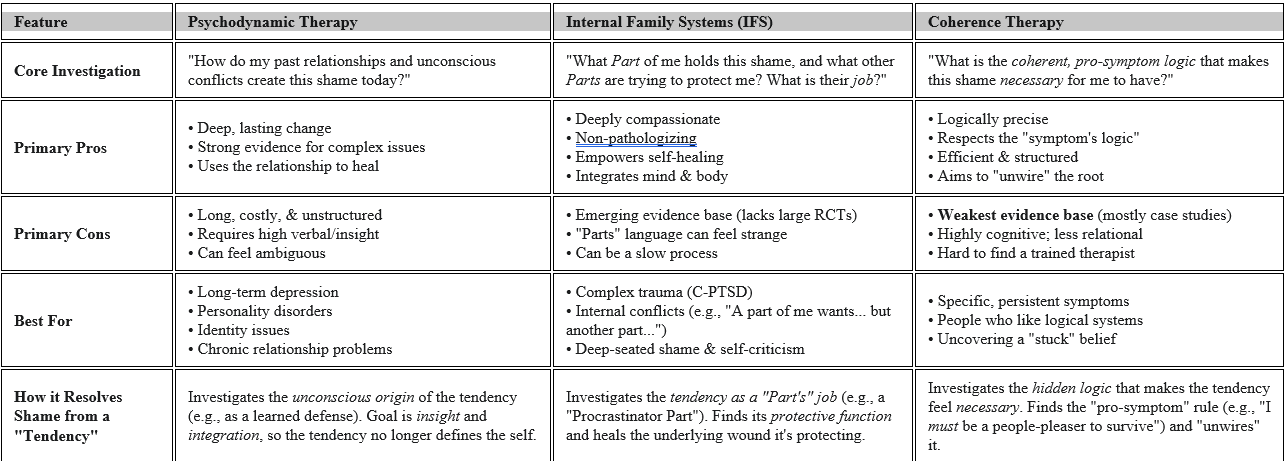
Some people in the reddit post mentioned that they find Internal Family Systems (IFS) therapy to be a more all-encompassing framework for healing the child parts of you that are wounded, with the help of adult parts. One thing that I really like about IFS (as opposed to a more streamlined, validated, prescriptive, internal “parts” therapy system like Schema Therapy) is that it is investigational. So the shame is not automatically seen as a malfunction to fix or reduce.
On the other hand, some folks feel that IFS is too cultish and almost gaslights the client by categorizing all of their concerns as coming not from themself but from some part of themself. So, you can’t say you don’t like IFS — because that’s just some part of you which doesn’t like it.
The one thing that I do appreciate uniquely in IFS is actually one of the more controversial parts of it, called “unattached burdens (UB) theory.” UB basically acknowledges that not all of the bad parts in you are actually part of you, some are just demons you need to get rid of, although I don’t think the rituals it prescribes for that are as effective as sending love to the demons, in my experience.
A few other noteworthy alternative therapy frameworks for investigating shame include Psychodynamic Therapy (the evolution of Freud’s work), which is more validated, but less structured and more long-term, and the newer Coherence Therapy, which is more targeted, logically-oriented, but less validated and harder to find a human therapist:
Ok, so there are some therapy systems that help modern lost and broken people investigate their shame and properly address it, and even AI is helping. But I’m curious to know more in general about this emotion and the purpose it might serve.
Beyond External Validation?
Many people today are sick of trying to find real friends, and they are wondering if it’s even healthy to seek external validation at all. Well, it certainly was healthy for us to do that, but these days, it often isn’t! Why would we seek validation from those who don’t share our values, don’t truly know us or care to know us? We’re in a radically new period now where we sometimes need to go against millions of years of evolution that have made us feel the way we are feeling.
We might sometimes have to become our own parents, our own community, and our own spiritual shepherds. We must love and reparent our inner child—but with a crucial update to the 1980s model.
Instead of trying to “fix” the child or banish the shame, we adopt the role of a curious leader. We validate the shame as a sincere survival signal, thanking the inner child for trying to protect us, while gently correcting its outdated data about our social safety.
But the conundrum arises: if we don’t have valid societal expectations to meet, then how do we know if we are on the right path? It’s very easy to slip into narcissism and even solipsism at this point.
Spirituality Is A Key Pillar In Therapy
What helps me a lot, even though I can’t really rely on society to give me good guidance in many cases, is to follow the ethical guidance in Buddha’s Noble Eightfold Path, which dictates that I do minimal harm to myself and others, and try to help when I can. It really does help to have a spiritual path based on love as a foundation. Otherwise, you will end up following the path of whatever you are being programmed by the technocrat elites, and/or just lost in the sea of moral relativity.
However, many people are very far removed from their connection to spirituality. I was also like that until age 26 when I discovered ayahuasca. My ayahuasca experience showed me where I came from before this life, and why I came here. Many people have shared with me that they also came to spirituality via psychedelic experiences. But unfortunately, many people get more lost after taking psychedelics (and the Challenging Psychedelic Experiences Project is there to help). While I cannot recommend anyone use substances, I will link “The Modern Soma” protocol for research purposes.
Of course, regardless of whether you have a good community or a good spiritual path, you still need to use your own critical thinking, intuition, and wisdom, to discern in each particular situation what you should do. Sometimes, even good societies are wrong, and even good spiritual paths don’t have the specific answers for our circumstances.
The Path Forward
Now that you understand what shame is, and its pros and cons, you can have a more rewarding, gentler, and more curious relationship with it. It’s no longer the adversary that weighs you down, but rather, an important cue to listen to and investigate with compassion. Feel the feelings in your body. If you have trouble feeling the feelings in a good way, consider getting a Somatic Experiencing session. Disconnect the stories from the feelings, and just feel, and release. Then you will have the supple awareness required to examine the stories which hold up this house of shame, and see how they can be helpful to you instead of a hindrance.
Visual Summary of Therapy Path
1. SHAME TRIGGERED (”I am bad” feeling)
├─► 2a. PROPORTIONAL? (YES) → Adaptive Path
│ └─► 3. Identify violated values/norms
│ └─► 4. Take responsibility
│ └─► 7. Seek understanding & confess
│ └─► 9. Receive community reflection
│
└─► 2b. PROPORTIONAL? (NO) → Toxic Path
└─► 5. COVERING ANOTHER EMOTION?
├─► (YES) → 6a. Feel underlying emotion
│ └─► 8. Somatic release
└─► (NO) → 6b. Disconnect story from feeling
└─► 8. Somatic release
└─► 9. Receive community reflection
└─► 10. Self-forgiveness
└─► 11. Realign behavior
└─► 12. GROWTH
Couldn't agree more. Your perspective on shame is incredibly insightful.
Make a video or article about your first Ayahuasca experience
Was it the first psychedelic you tried ?
For me maybe I will be stuck in my old mindstate, energy field without it now if I didn't take it.
So it seems it's really hard to heal without it, especially when you had very bad conditions, it's even hard to heal with psychedelics médecine !