

This guide has an app coming soon! Working hard!
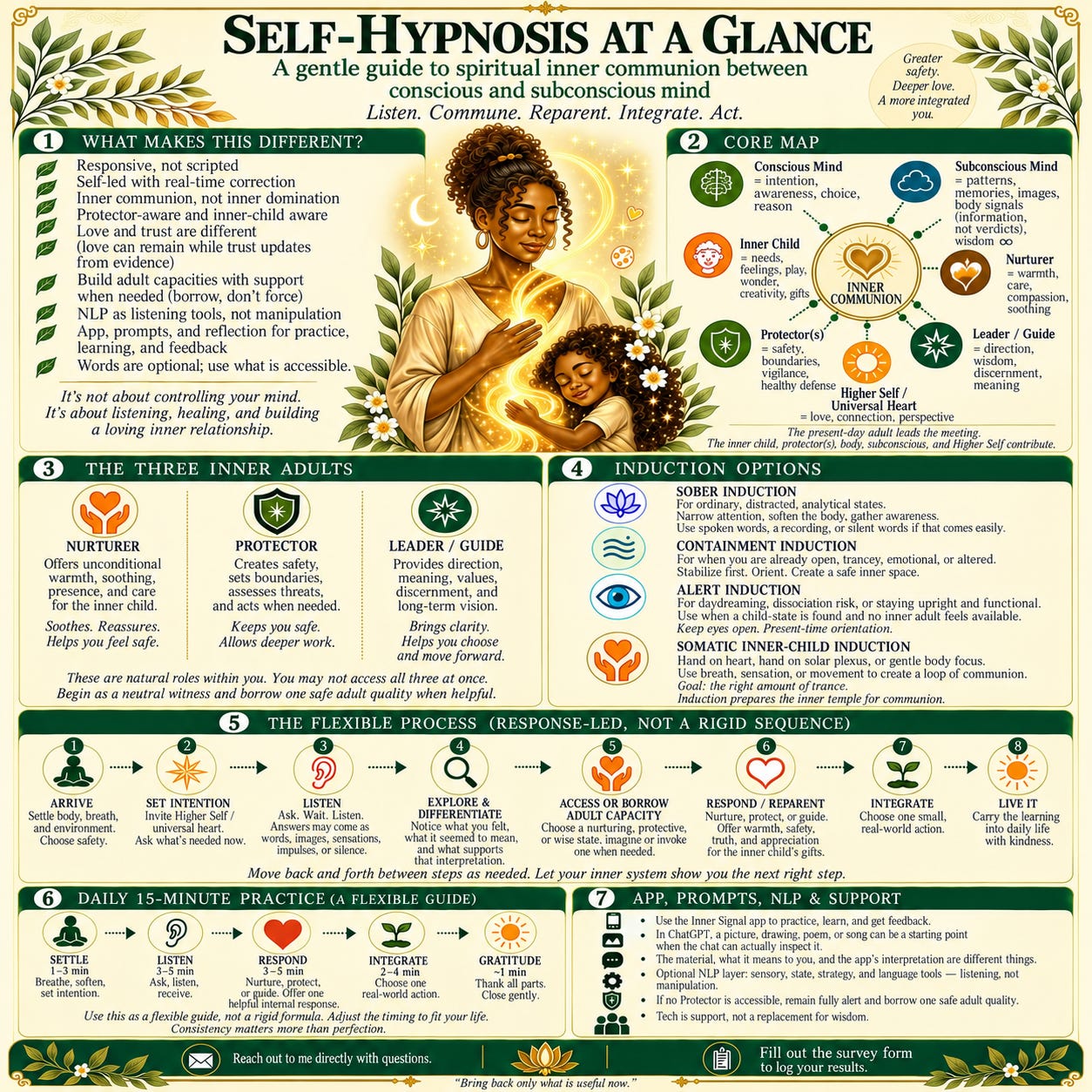
How to use this very large guide
Begin with Quick start, learn one induction and the complete return, then use Let the next response guide you for the part no recording can decide in advance. The daily and weekly sections help you make the practice your own. The appendices hold extra tools for questions, NLP language, anxiety, daydreaming, altered states, hostile-presence experiences, sleep, influence, and additional inductions. Sources are together in Appendix K.
The table of contents is hiding on the left
Substack kinda hides the table of contents until you move the mouse toward the left side of the page. On a guide this long, that little hidden menu is your friend.
Introduction
Hello Lovey Bunny!
You were born with a mind that can dream, protect, analyze, imitate, love, remember, hide, reveal, and heal. Nobody taught its different layers how to speak to each other.
Instead, most of us learned to push through, suppress emotion, perform confidence, obey or rebel against authority, and call that adulthood. Meanwhile, the deeper mind kept running its own programs: the child wanting safety, the guard expecting danger, the body remembering what the intellect had explained away, the intuition speaking before language, and the fantasy trying to become guidance.
A lot of hypnosis teaching treats the subconscious like a machine waiting for commands. That never did much for me. I get more from sitting down and listening until the scared kid, the guard, the body, the intuition, and the part trying to run Tuesday can all be heard without one of them seizing the microphone.
In this guide, self-hypnosis gathers attention until the conscious mind, subconscious, body, inner child, protectors, adult self, and Higher Self can participate in one honest inner meeting.
The method is simple: listen, warm, protect, clarify, reality-test, and act.
A dramatic trance is optional. The goal is a more trustworthy relationship with the whole mind, proven in ordinary life.
Communion is the closest word I have for that. The conscious mind stops shouting from the roof, and the subconscious no longer has to communicate only through symptoms, dreams, cravings, daydreams, and peculiar little body signals.
I treat the subconscious as a living ecology of parts, memories, impulses, images, protections, and wisdom. I bring in inner-child reparenting because a wounded young part won’t be repaired by a clever suggestion. I begin with Higher Self or the universal heart when the system needs coherence, and separate into parts only when that helps. I borrow from prompt engineering because the shape of a question changes the kind of answer we can hear. And I include influence literacy because hypnosis is hardly the only thing hypnotizing us.
Quick start: do this first
Gather attention, notice what is here, offer one fitting response, wait, then come all the way back. You can meet a difficulty or develop love, curiosity, play, or confidence. Nothing dramatic has to happen.
Before the first session, read the induction and full return below while awake. Set aside time somewhere physically secure. Choose one purpose and what you are leaving alone today. Then put the screen aside; the practice is something you learn to conduct, not a checklist to keep reading.
As you listen, a sensation, image, phrase, feeling, objection, or silence may become noticeable. Let the next invitation follow that response. Use warmth, a boundary, direction, or more time as needed. Finish with the complete return, then note what happened and any real-world action it calls for.
When you become panicky, disoriented, increasingly unreal, or less able to function, stop deepening and return to the room and appropriate support. A difficult feeling you freely choose to stay with while present is a different situation.
Do you usually think in words?
Before choosing a script, notice how words actually work in your mind. Do silent words or phrases arise often, occasionally, rarely, or hardly at all? They needn’t sound like an audible voice. Does this vary when you plan, remember, reflect, or feel upset? Can you deliberately form a silent sentence, even if words seldom arrive on their own?
That is different from feeling something before words come in a particular moment. Neither question requires deciding that feelings always come first. “Not sure” is a useful answer; this is a way to choose workable instructions, not a diagnosis.
Read “say,” “ask,” and “listen” in this guide as invitations, not a requirement for an inner narrator. Speak aloud, write, use a recording, or follow the invitation without rehearsing a sentence. The child and protector needn’t speak in sentences either. Don’t assume an image must appear instead. Try whatever is accessible, and change the route when it stops helping.
What I mean by hypnosis
APA Division 30 commonly defines hypnosis as focused attention, reduced peripheral awareness, and increased responsiveness to suggestion. That’s basically true, but there’s a lot more than meets the eye. In fact, hypnosis is such a broad and common type of altered state that it’s hard to confine it to one use. But I’m using hypnosis here as a therapy.
And hypnosis as a therapy is as old as time itself. While the modern technique of it was discovered by Franz Anton Mesmer in the 1770s, shamans have been using dancing, music, and drugs to induce hypnosis for therapeutic purposes forever. We enter into trance states every night which resemble hypnosis as we go to sleep and as we wake up as well. Those states can also be used for deep therapy.
Protecting Yourself from Hypnotists
Hypnotism can happen in a therapist’s office. It also happens through music, marketing, religious ritual, sexual chemistry, charismatic authority, social media, grief, fear, political messaging, belonging, fatigue, love, trauma, and beauty.
Influence doesn’t wait for the conscious mind to sign a form. Marketers and interface designers know this perfectly well. The FTC’s report on dark patterns describes designs that trick or manipulate consumers, while the OECD describes commercial patterns that steer, deceive, coerce, or manipulate people toward choices that may work against their interests.
Conscious agreement is one thing.
Unconscious receptivity is another.
Emotional compliance is another.
Legal and ethical consent is another.
A mind can be influenced without the adult self having clearly chosen the influence.
A line associated with the Silva Mind Control tradition says it plainly:
“If you don’t learn to control your mind, someone else will!”
Advertising, fear, craving, screens, tribe, resentment, authority, loneliness, and repetition are already training the mind. Self-hypnosis lets you practice from inside it: befriending the deeper layers, listening closely, and making adult choice more available.
The Most Extreme Example
I can tell you one shocking personal story that will make you never trust hypnotists again who maintain that you can’t be manipulated through hypnotism:
My friend P. has a friend named V. V. is a 33rd-degree Free Mason. V. has the ability to get anyone to strip naked and have sex with him within 3 seconds, even via phone call. How is this possible? The only way it could be possible, that I know of, is if people are already hypnotized by mass media/devices with a trigger word that is known by the elites.
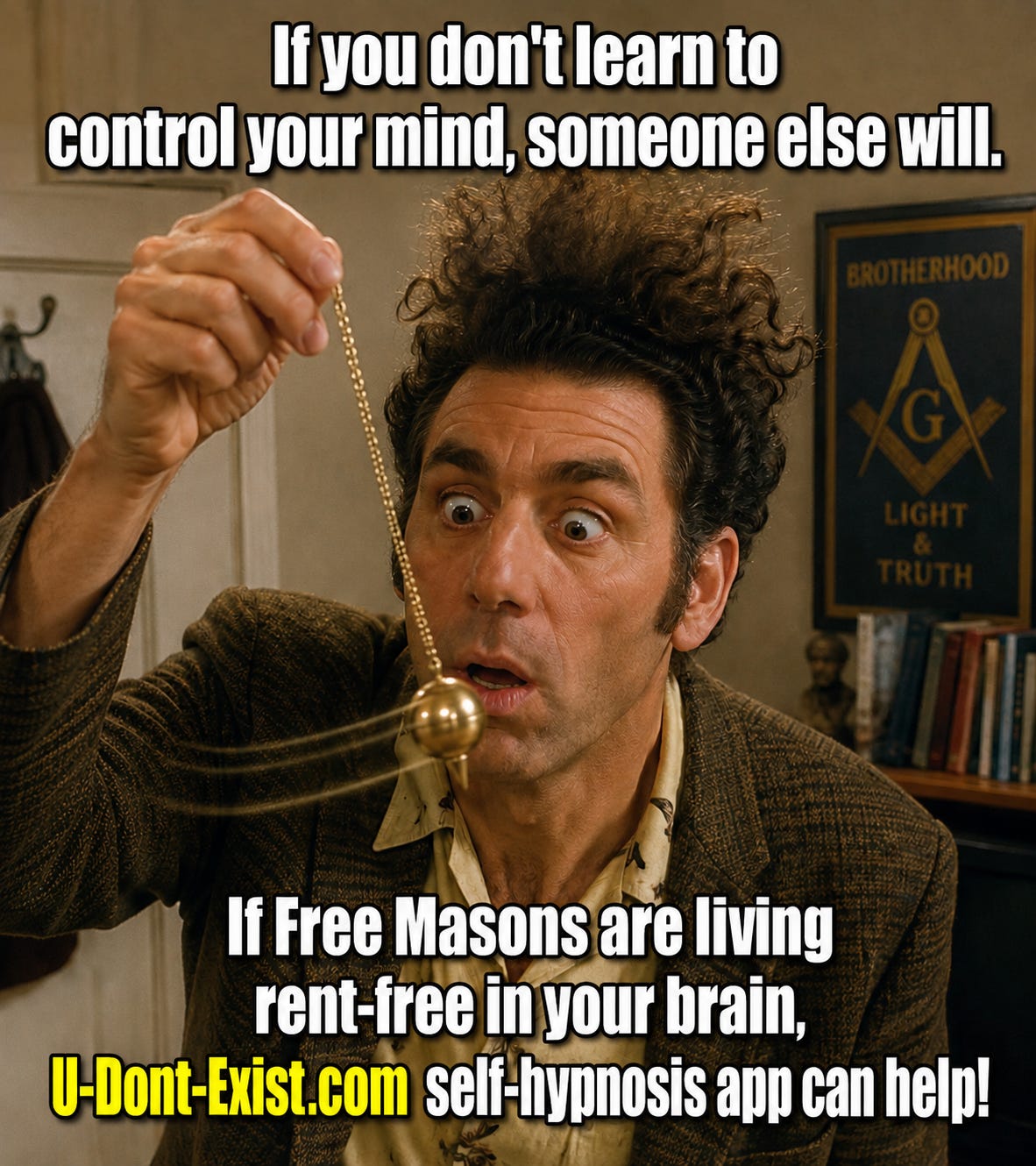
Do not let any strong state, charismatic person, sexual charge, spiritual claim, or authority figure replace the adult self. Legitimate influence can survive questions, sleep, boundaries, and time.
Affirmations Done Right
My dad always said: “Always, and in everything, expect the very best. But be prepared to take what you get. The best might come afterwards.” That’s a better affirmation than what most people think of as affirmation, because it’s not telling you something which you know to be false in the present. If you say “I am beautiful” but you know that’s not true, then you’re challenging your beliefs, and if you’re challenging your beliefs you should have some argument or reason why they are wrong, otherwise it’s bullying.
Another quote I use all the time from my dad… when someone asks me “How’s it going?” I say “Better & better!” This really confuses a lot of people. Some think it’s amazing that I’m always doing better. Some ask if I was sick or something. But it’s doing multiple jobs. On the one hand, it’s deflecting from the fake question because most people don’t actually want to hear how you are doing in detail anyway. On the other hand, more importantly, it’s reprogramming your mind to remove you from tunnel vision. You might be sad now, but if you say, “I am sad” then you’re subtly identifying with the sadness and it keeps you stuck. It’s best to say, “I’m feeling sad now, but I’m doing better and better, every day, in every way!” That’s more like a mission statement than a historical analysis. Although you can also re-evaluate your history as lessons to make that true.
Try it out right now and see how it feels!
Reversing Accidental Affirmations
Many times, we say things that we wish we hadn’t said, or our minds wander into places that we actually don’t want to live in. A very common example is masturbation, where people might fantasize about someone they don’t really want to be with in real life. While it might be optimal to just avoid doing that, if it does happen, it’s good to apply a trick my sister taught me, which she learned from Positive Magic. Right after the wrong thought, say, “I take it out of the law of cause and effect.” It’s not exactly magic, and it’s not like you can actually remove anything from laws of nature, but it does sort of do that because without the rupture in your thought stream, you can end up just going directly where it leads you. With the intentional correction, you don’t have to be unconsciously led astray but your random wrong thoughts.
The Buddha also taught that the important thing is always to come back to mindfulness regardless of what disturbs the mind. My sister doesn’t realize how close she is to Buddhism!
Hypnosis Evidence
Hypnosis has real evidence, although it doesn’t have magical evidence. A 2024 overview of 49 meta-analyses, covering 261 distinct primary studies, found the strongest support in pain, medical procedures, and work with children and adolescents. The quality still varied by outcome and study design.
Self-hypnosis has its own evidence. A systematic review of randomized controlled trials reported benefits in studies involving pain, childbirth, pediatric applications, stress, and anxiety. It appeared more useful when people learned it as a real self-directed skill and practiced it several times, rather than merely pressing play on an audio file.
That distinction matters here. I want you to learn an inner skill, not become a consumer of increasingly elaborate trance recordings.
Clinical caution still matters. Mayo Clinic warns that hypnosis used around stressful earlier-life events can trigger strong emotional reactions, and that other treatments may fit historical trauma work better.
Use self-hypnosis for regulation, dialogue, reparenting, clarity, habit change, present safety, emotional integration, and ordinary-life action.
Do not use it to force trauma memories, prove what happened, suppress medical symptoms, destabilize yourself, or replace appropriate clinical care.
Forget the left-brain/right-brain cartoon
“Syncing the hemispheres” can be a useful description of how the state feels, but I wouldn’t turn it into literal neuroscience. A large resting-state fMRI study of 1,011 people didn’t support the pop-science picture of whole people being globally “left-brained” or “right-brained,” even though particular functions and networks can be lateralized.
You’re inviting the verbal, analytical, imaginal, emotional, somatic, intuitive, relational, and spiritual modes to cooperate. Nobody needs to win a hemisphere election.
The loving mind stays warm while the analytical mind stays bright.
The intuitive mind offers signals without becoming dogma.
The rational mind tests signals without killing them.
The body gives yes, no, and not-yet.
The imagination opens the field.
The adult self chooses the next real action.
Peace and precision become compatible.
Love can drift into fantasy without analysis. Analysis can become sterile without love. Intuition can become delusion when nothing tests it; testing can become dead when nothing intuitive is allowed to speak. Let the modes correct each other.
A powerful state matters only if something survives it: kinder behavior, more humility, better judgment, real service, or a more workable ordinary life.
Why doing it myself worked better for me
Self-hypnosis became much more useful for me than working with a professional hypnotist. The session with the hypnotist did very little. Maybe part of that was state-dependent: I was sober and didn’t feel especially suggestible. The larger issue was trust and precision.
When I’m giving the suggestion, I can feel the exact moment a phrase is slightly wrong. I can stop, ask what the subconscious meant, and notice whether an image feels like guidance, fear, avoidance, wishful thinking, or something I don’t yet understand. I can catch the body’s no before the conscious mind writes a persuasive little essay called yes.
An outside hypnotist can’t easily conduct that rapid back-and-forth because they aren’t inside the mind receiving the suggestion. A skilled guide can still notice blind spots, help regulate the process, and hold a safer container. Self-hypnosis simply has one advantage nobody outside can duplicate: immediate dialogue with the system itself.
I found that especially amplified with loveyhuasca. My experiences included a much deeper understanding of my motivations, peaceful loving awareness operating alongside analytical clarity, the disappearance of unhelpful daydreaming, different priorities around relationships, stronger intuition, and repeated correction between intuition, subconscious response, and conscious analysis.
I also got stronger results when I practiced immediately after sky hypnosis:
Some benefits arrived the next morning or a few days later. After one loveyhuasca self-hypnosis session, I woke in what felt like an answer to prayer. I’d been dealing with a lot of lust energy and worrying it could pull me into a relationship that wasn’t right. I asked the subconscious to connect the heart chakra with the sacral chakra—to bring the love energy and sex energy into the same current. The next morning I woke in a kind of “perfected” love state. I didn’t feel that I needed to find a woman; the divine feminine felt somehow at zero distance from my heart. Ordinary interaction dissolved the state, but for a while it showed me a possibility my mind and heart may permit when the desire is sincere.
I’ve also had self-hypnosis seem to extend a short chrunga trip far beyond its normal duration. Subjectively, it felt as though the state might have continued indefinitely if ordinary life hadn’t required communication and interruption. I find that phenomenologically important. I’m not recommending that anyone prolong an altered state forever; integration is healthier than trying to live inside the extension.
Without drugs, self-hypnosis or meditation may also become much more effective inside a lucid dream. I explain that possibility in my lucid-dreaming guide.
A useful map of the mind
In this guide, subconscious means the deeper processes shaping perception, emotion, desire, avoidance, imagery, memory, bodily signals, habits, intuition, and automatic behavior. Sometimes it helps to address all of that as one mind; sometimes an ecology of parts gives more precision. Both are maps. Neither needs its own priesthood.
Parts give precision.
Higher Self gives coherence.
Communion is the movement between them.
When you need coherence, speak to the deeper mind as a whole:
“Wise subconscious, please help me understand.”
When you need precision, notice the different tendencies inside it: the child wanting love, the protector wanting safety, the critic wanting standards, the fantasy-maker wanting possibility, the body memory wanting recognition, the social self wanting belonging, the spiritual self wanting God or source or the benefit of all beings, and the wiser part wanting what is true.
Begin with unity when the system feels scattered:
“Higher Self, universal heart-mind, wise subconscious, please guide me.”
Differentiate only when the question needs it:
“Which part of me is afraid?”
“Which part is protecting?”
“Which part is avoiding?”
“Which part knows the next step?”
“Which part is too young to carry this?”
Then bring the parts back into one life:
“Let all of this belong to one life. Let the adult self lead with love.”
Sometimes start with the whole
Some people feel more fragmented when they begin by naming twelve parts and assigning everybody office space. Start with the sacred whole when that happens.
“I begin from the universal heart.
I begin from Higher Self.
I begin from the part of me that belongs to life before it belongs to any wound, role, family, group, identity, ideology, or story.
Please help me understand what is true, kind, timely, stabilizing, and useful.”
If Higher Self, the universal heart, or any sacred language feels unavailable or borrowed from somebody else, begin with plain witnessing instead. Notice the room, the body, and the younger state. The fact that something can notice is enough adult presence for the first step.
If you can already notice and distinguish what is happening inside, you don’t need to keep rehearsing the Witness. Work with the warmth, protection, or direction that is actually missing. Higher Self language can help you gather around a meaningful source of care; it doesn’t establish that a perfectly capable inner parent is already available. Those adult functions still grow through practice.
Differentiate only when something specific appears:
“Is this the inner child?”
“Is this a protector?”
“Is this the body?”
“Is this fear?”
“Is this intuition?”
“Is this social conditioning?”
“Is this divine guidance, or my interpretation of guidance?”Start from the heart. Differentiate only as needed. Return to the heart.
The inner child, the guards, and the three inner adults
The inner child won’t trust you because you said three kind sentences during one meditation. Trust grows when the present-day adult becomes reliable.
I organize that adult capacity into three functions: Nurturer, Protector, and Leader/Guru. They aren’t three literal beings. They’re three ways the present-day person reparents the inner child.
The child’s worth doesn’t depend on developing those capacities. Worth was never the missing skill. The child also brings play, tenderness, irreverence, creativity, and wonder. Those qualities belong inside the adult relationship, not just the wounds.
When the adult role is not available yet
Some people can summon one of those adult functions. Others go blank, hear only the inherited critic, or feel like a child pretending to be grown. Telling them to “be the adult” assumes the capacity they are trying to build.
For that starting point, I use a provisional, author-developed bridge I call borrowed adulthood. It combines familiar practices—witnessing, modeling, supported action, and gradual transfer of responsibility—without claiming that the complete sequence has been validated as one treatment.
Witness, when needed. Notice what is present without demanding warmth, wisdom, or certainty. If you already distinguish the internal positions, move to the adult function you need.
Borrow one function. Choose a safe adult, mentor, older sibling, future self, spiritual figure, value, or written plan. Borrow only the warmth, boundary, or direction needed now.
Become the adult apprentice. Choose the exact words or action yourself and carry at least one small part.
Hand it back. Name what the borrowed figure modeled and what five percent you can now do without them.
The borrowed figure stays beside your judgment rather than replacing it. The fuller sequence is in my Inner Child Self-Love Reparenting Guide.
You don’t need a history full of trustworthy people to borrow care. Use a remembered person when that helps, or an imagined adult whose intention is to take good care of you. Ask, “What would that person say or do with my actual history, limitations, and options?” Begin with the least cruel response you can believe if warmth is unavailable. Once you find one usable sentence or action, try it rather than repeating the exercise in different words.
Borrowing can also help the position trying to be the adult: how would a decent adult hear distrust without retaliating, defending their goodness, collapsing, or leaving? Borrow that one response. You may still feel young while doing it; adult identity can develop after the behavior.
Let the child speak without handing over the steering wheel
Letting a younger feeling-state speak doesn’t mean handing adult judgment to an outside caretaker or trying to become literally younger. Wonder, play, vivid sensation, vulnerability, honest need, or the wish to carry fewer decisions can all come forward while the internal adult remains present.
“A younger part of me may speak.
The adult in me remains here to listen, evaluate, protect, and stop.
No child-state, guide, recording, or outside person replaces adult judgment.”
That distinction lets you recover curiosity, spontaneity, play, sensory freshness, honest need, and quick emotional movement without pairing those gifts with obedience, helplessness, scolding, or weakened judgment.
Love doesn’t have to wait for trust
When love is available, the younger state doesn’t have to believe in it before you can offer it. Trust can question your promises, remember failures of protection, and take its time. Love can remain present while that happens.
“Okay. I believe that you don’t believe me. I still love you. You don’t have to love me back. Tell me what feels unsafe.”
That isn’t a way to end the complaint. Listen for what is true in it and answer seriously. Hearing anger without retaliation, admitting a real failure, and repairing after an internal attack are evidence alongside meals, boundaries, appointments, and kept promises. Non-retaliation expresses love; it shouldn’t replace love with a colder performance of good behavior.
Notice what each position teaches the others. A vow followed by blame when it is doubted teaches that love depends on receiving it correctly. The blaming voice and the voice making the vow may be different positions, the same position, or a blend. Don’t decide from the person’s chronological age.
When a younger version of you becomes the defendant, ask what they understood then, what options they could see and tolerate, and what happened because of the choice. Harm can require responsibility and repair. Punishment cannot retroactively create the capacity that was missing.
The two-hand practice
Place one hand at the center of the chest as a physical connection to love. Put the other at the solar plexus, just beneath the chest, where you can relate to the vulnerable child.
Send warmth from the heart toward the child. Notice whatever comes back—a sensation, image, feeling, resistance, or nothing—and answer with warmth again. Let it become a conversation rather than a performance.
Love above.
Child below.
Adult present.
The Nurturer
The Nurturer brings warmth without trying to rush the feeling away, and takes pleasure in the child’s company: “I’m glad you’re here.” The child needs to be enjoyed, not only comforted when hurt.
“It’s okay to feel this.”
“I’m here.”
“You don’t have to do anything right now.”
“You are not too much.”
“You can be small here.”
“You can be angry here.”
“You can be sad here.”
“I will stay.”
The Protector
The Protector turns warmth into something the child can believe.
“I will set the boundary.”
“I will leave the unsafe conversation.”
“I will stop texting the person who destabilizes us.”
“I will eat.”
“I will sleep.”
“I will keep a small promise.”
“I will not leave the child alone with adult consequences.”
This is where inner-child practice often turns decorative. The voice says loving things while the adult sends the destabilizing message, skips the meal, avoids the task, and breaks the promise. Trust begins when you handle the consequence.
If warmth is unavailable, a protective act can begin the relationship. Make it small enough to carry out and review what actually happened. A missed action might reflect fear, exhaustion, missing skills, a practical barrier, or a poor plan. Completion without immediate relief isn’t automatically failure, and a tick on a list doesn’t prove the action helped.
The Leader, Guide, or Guru
The Leader gives direction. You can call this function Leader, Guide, Guru, Wise One, Sage, Inner Teacher, Director, or Higher Adult. The label matters much less than the ability to orient the whole system toward a life.
Direction can ask for something difficult without turning life into perfect discipline and hidden needs. Sometimes the next adult move is asking for help, expressing a preference, or letting a safe person see an imperfection. Wanting closeness is legitimate; punishing someone for needing space is a different strategy. Find a way to meet the need without erasing either person.
“We are not only here to feel better.”
“We are here to become whole.”
“We are here to belong to life itself, not only to people who approve of us.”
“We are here to serve truth, beauty, love, God, source, nature, universe, dharma, Tao, and the benefit of all beings.”Begin with the adult function you can actually reach. Protection may come before warmth. Direction should help the child grow without erasing care, play, or support.
Working with protectors
Use this parts language when you actually recognize a protective pattern or find it useful to explore. A sensation, distraction, or objection doesn’t establish its cause. Notice it first; hunger may need food, skepticism may be reasonable, and a sentence may simply not fit.
People assume inner-child work begins with the child. Very often, you meet the guard at the door first.
You sit down to connect and get numbness, cynicism, anger, sudden hunger, a phone urge, a sexual urge, planning, sleepiness, dissociation, or the thought, “This is stupid.” I wouldn’t call those failures. They’re often the protector making an appearance in its usual charming way.
One important voice is the inherited parent: the internalized caregiver voice formed from how the child was treated. This is different from the inner adult—the Nurturer, Protector, and Leader/Guru you deliberately build. The inherited parent may sound like a critic or warden—don’t cry, don’t be needy, don’t embarrass us, don’t become too independent—and can make a new loving voice feel fake before you’ve even begun.
“I notice you.
You are trying to protect something.
I want to understand.
What are you afraid would happen if you stopped?”
Then wait. The answer may be: “You’ll lie to yourself again.” “This will become another performance.” “If you feel the pain, you’ll be destroyed.” “You’ll use spirituality to avoid reality.” “You’ll forgive too early.” “You’ll call fantasy guidance.” “You’ll abandon us as soon as the session ends.”
“That makes sense.
You do not have to move yet.
What would help you trust me 1% more?”
Usually the protector needs evidence more than another spiritual insight. Hold the boundary. Handle the task. Eat the meal. Don’t send the message. Keep the promise. Sleep. Contact the therapist. Acknowledge the debt. Write down the truth.
Protection that knows when to stop scanning
The Protector is more than an inner voice saying no. You can practice it as a bodily sequence:
Orient: look around and feel the support beneath you.
Assess: ask what is known, what is uncertain, and what needs checking.
Distinguish: separate present danger from uncertainty, old alarm, or imagined danger.
Set one proportionate boundary: move, stop, delay, ask, leave, or get support.
Verify enough safety: not perfect certainty, just enough reality-based evidence for the next step.
Stand down and rest: protection includes ending the scan when continued vigilance is no longer helping.
A mature Protector can say, “I don’t know.” It can ask another human, delay interpretation, or choose a no-trance practice. I’m aiming for discernment that acts when needed and then quits scanning the room after the danger has passed.
Inner child reparenting
I connect my reparenting therapy to self-hypnosis because I find they are a perfect match. The child may arrive as an age, image, posture, voice, memory, emotion, or plain vulnerability. Sometimes no child appears. Stay with a recognizable protector, or with the sensation, feeling, or preference that is actually present.
When the child does appear, resist the urge to begin a healing project immediately. Be with them first.
“Little one, I am here.
You do not have to explain everything.
You do not have to be healed today.
You do not have to become impressive.
I only want to know what would help you feel less alone.”
The need may be warmth, play, protection, grief, anger, food, rest, a boundary, a safer relationship, less fantasy, less overwork, or one adult promise kept today.
Don’t rush the repair
When a younger state, protector, feeling, or bodily signal needs care, move patiently:
Prepare: create enough time, privacy, support, and adult capacity.
Inspect: notice what is present before deciding what it means.
Ask permission: “May I come closer, or would you prefer warmth, space, words, silence, or no contact?”
Respond to one need: do the smallest useful thing rather than attempting a total repair.
Wait: let the response settle. Some changes need quiet, sleep, or ordinary time.
Reconnect: invite contact only where it is welcome. No part has to merge, disappear, forgive, or become cheerful.
Rest: stop before care becomes another performance.
Reassess: return later and ask what actually helped.
The goal isn’t “good as new,” as though history should disappear. Aim for good as you: more supported and connected while still recognizably yourself. If parts language makes you feel more divided, use signals, feelings, younger states, or another metaphor that helps.
Play and rest still need an adult present
Reparenting doesn’t have to become solemn. A younger state may respond to texture, drawing, movement, a plushie with a voice, or whatever feels interesting. Keep reality-testing intact. You’re recovering play, not becoming somebody’s child, pet, doll, or owned object.
Rest also doesn’t require helplessness. Reduce decisions for a defined period, put unfinished tasks somewhere visible, and let the internal adult keep watch. You remain able to move, stop, and return.
Non-dominant hand dialogue
When speech or visualization feels fake, write. Let the non-dominant hand speak for the child or protector, awkward handwriting and all. Answer with the dominant hand as the adult.
Non-dominant hand: “I don’t trust you.”
Dominant hand: “I hear that you don’t trust me. I still love you. Tell me where I’ve let you down. I won’t demand trust; I’ll listen and keep one small promise today.”
Non-dominant hand: “Which promise?”
Dominant hand: “I will eat, clean the desk, and not text the person who makes us feel unsafe.”
When “your voice” is everybody else’s voice
Sometimes the inner-child question lands nowhere because a private self had very little room to develop. In controlling families, rigid religions, enmeshed communities, or high-pressure achievement systems, performance can begin so early that a person doesn’t know what they feel, want, believe, or prefer until somebody else tells them first. Then “love yourself” produces a reasonable question: love whom? Reparenting and identity-building can proceed together. For some people the child-self is already easy to feel. For others, creating enough safety for preference, curiosity, and experimentation is part of how that self becomes easier to hear.
This may apply when:
You do not know what you want unless someone else says what they want first.
Your opinions shift dramatically depending on who is in the room.
You agree in the moment and later realize you did not agree.
You feel responsible for other people’s emotions to the point of self-erasure.
Self-love feels performative.
The question “What does my inner child feel?” produces guesses, not felt answers.
You can rebel, but you cannot yet choose.
A useful developmental explanation is that when childhood is organized around avoiding pain and preserving attachment, attention goes into reading danger, meeting expectations, and keeping the bond. That can leave less room for the ordinary experiments that answer, “What do I like? What do I want to try? Who am I when nobody is grading me?” This is a practical model, not a claim about one specific brain system.
Sometimes a temporary, intentional period of distance from the people or group supplying the answers helps quieter preferences surface. Use that distance only long enough to tell your own signal from the social echo; prolonged isolation would undermine the purpose.
The difference between a human doer and a human being helps here. When worth isn’t felt internally, it gets earned through beauty, performance, intellect, status, spirituality, or becoming indispensable to everybody else. Those can all be real gifts. They become belonging bargains when failure in the arena feels like losing yourself.
Useful questions:
“What do I like when no one is watching?”
“What do I believe before I check whether others approve?”
“What do I want that is neither rebellion nor compliance?”
“Where am I buying belonging with self-betrayal?”
“Which arena am I using to earn the right to belong?”
“What would I try if nobody needed to be impressed?”
“Which relationships let me remain myself?”
“What am I noticing in my body, and what meaning am I giving it?”
Give the inner child a small experiment with no résumé value: painting, dancing, gardening, a language, a sport, volunteering, music, or anything else you’re allowed to be bad at. The inherited parent may demand immediate talent. The adult can answer, “We’re finding out whether we enjoy this, not proving our worth.” Give it enough repetitions to get past the humiliation of being a beginner.
For a child, belonging can feel like survival, so families, religions, romances, political tribes, spiritual groups, institutions, and online communities can reach astonishingly far into identity. Adulting means noticing where you buy belonging with self-betrayal, choosing your own ground, and learning that you can disappoint someone without disappearing. The subconscious contains a crowd of borrowed voices, which is why this belongs in a self-hypnosis guide.
“Where do I become less true in order to remain included?”
“What would belonging look like if I did not have to disappear?”
“Is this guidance, or is this a belonging program?”
“Is this love, or is this fear of exclusion?”
“Is this conscience, or is this conditioning?”
“Is this devotion, or is this compliance?”
“Is this rebellion, or is this freedom?”
Then wait for the body. It isn’t infallible, but it deserves a seat at the hearing.
De-hypnosis: wake up inside the influence
Self-hypnosis also teaches influence literacy: noticing when somebody else is already shaping your attention. Screens, advertising, politics, religious fear, erotic imprinting, charismatic authority, belonging pressure, shame, urgency, and repetition all do it. Influence is everywhere—a lullaby, a prayer, a good teacher, a beautiful song, love. Ask what it does to your ability to see and choose.
Manipulation often arrives with urgency, specialness, fear of missing out, threatened exclusion, sexual charge, shame, confusion, rescue fantasy, destiny, obedience, secret knowledge, or far too much certainty arriving far too quickly. You may also feel that one honest question would break the spell.
Pause there. Don’t obey immediately, and don’t perform automatic rebellion either. Wake up inside the influence.
Hypnotic language turns manipulative when it smuggles in your consent, makes one choice seem inevitable, or hides a disputed claim inside the sentence.
“When you finally admit…”
“As you realize I’m right…”
“The only reason you resist is…”
“Part of you already knows…”
“Your higher self wants…”
“Everyone who is truly awake understands…”
“If you doubt this, that proves your ego is afraid.”
The grammar assumes the conclusion, turns resistance into proof, and makes obedience feel like awakening.
“What exactly is being claimed?”
“What choice is being framed as inevitable?”
“What is being presupposed?”
“Who benefits if I accept this frame?”
“What emotion is being amplified?”
“What information is missing?”
“Can I say no without being punished, shamed, mocked, abandoned, or spiritually downgraded?”
A useful guide leaves the adult self more present. Powerful states need stronger boundaries.
Soft language can still take away choice
Permissive words can still conceal coercion. I watch for the following:
Indirect suggestion can slip past the skeptical guard because the conscious mind may never receive one clean proposition to accept or reject. The intended direction can still be quite specific even when the wording feels open, vague, conversational, or merely suggestive.
Induction hidden inside explanation: attention is being narrowed while the speaker pretends only to inform. Even an “anti-hypnosis” lesson can use induction mechanics.
Every answer means compliance: “yes,” “no,” noticing, not noticing, resistance, and silence are all redefined as proof that the suggestion is working.
“Whether you notice it or not” binds: uncertainty is converted into invisible success that cannot be checked.
Identity and ownership language: safety or goodness becomes tied to obedience, a role, the guide’s approval, or belonging to someone else.
Unannounced fractionation: moving in and out of absorption without telling you that repeated re-entry is part of the method.
Hidden post-session cues: words, gestures, blinks, sounds, or repeated listening are meant to produce later behavior that was not plainly disclosed.
Amnesia or truth inflation: dreamlike material, missing memory, imagery, or body sensations are treated as proof of what happened.
An exit that does not exit: the recording ends while preserving a role, reduced judgment, impaired movement, blankness, or an indefinite altered state.
A real choice includes at least one branch that doesn’t continue the induction: make it lighter, change the method, remain fully alert, pause, or stop. No remains no. Silence and uncertainty don’t become consent because the narrator has a soothing voice.
Appendix C has the longer de-hypnosis checklist.
Induction: gathering attention without disappearing
An induction gathers scattered attention until quieter material becomes easier to hear. You don’t have to surrender, play asleep, or obey anyone. When you’re sober, distracted, analytical, or guarded, an actual induction may help. When meditation, loveyhuasca, lucid dreaming, grief, music, prayer, fatigue, or another intense opening has already made you trancey, begin with orientation and containment instead of adding depth.
Aim for the amount of trance that suits the practice: focused, warm, receptive, embodied, and still able to stop. Depth is optional.
What an induction is actually doing
Prepare the session, gather attention, deepen only when that helps, then let what you notice shape the words and the next response. Counting is one way in. Conversation, story, movement, repeated sound, and curiosity can also organize attention. Say so when you use them; elegance doesn’t excuse a covert induction.
For a simple, chosen target, you can test the suggestion before deepening. If the useful response is already happening, build from it. An induction helps you find a receptive way of listening; you don’t need to complete a ceremony before you’re allowed to respond.
Please don’t put six metaphors in one trance
Choose one purpose, one starting anchor or image, and a way back. Decide whether warmth, a firm boundary, direction, or neutral witnessing would help. Floating, stairs, gardens, inner rooms, colored light, and child dialogue do not all need to report for duty at once. Switch consciously when the metaphor stops helping.
Imagery is optional. A signal may arrive through sensation, rhythm, movement, words, spatial sense, simple knowing, or no response at all. Keep the language in the world you chose: let a count mark something meaningful there, and reverse the journey when you finish. Borrow qualities such as warmth or steadiness without replacing your identity.
Pick one central verb, one sensory quality, one short refrain, and one transition phrase, then read the script aloud; long elegant sentences become soup during an induction.
Before you begin
Read the induction and Come all the way back while fully awake. Choose the question or quality you want to explore, what you’re leaving alone today, and how much time you have. Love, play, confidence, creativity, and communion are worthwhile purposes; you don’t have to find a problem. Leave several minutes for returning and reflecting.
Choose a physically secure place without driving, water, machinery, or anyone needing your supervision. When intoxicated, acutely confused, or unable to keep yourself safe, deal with immediate support rather than exploratory hypnosis. The later Already open? practice is for orientation, not permission to intensify an unstable state.
Decide what kind of encouragement is welcome: spacious listening, warm company, or a firmer invitation to stay with a feeling. Preview eye closure, any repeated exit and re-entry, and the return. For a recording, read the script beforehand when possible. “Stop” ends the exercise; “less” reduces the demand; “quiet” stops the words. You can simply open your eyes and finish. No inner part has to approve your decision to stop.
When entry and return are unfamiliar, first rehearse them without a difficult subject. Once you know how to change direction, you don’t need to supervise every moment. Let a useful response become easier and less effortful. A no remains no; silence doesn’t authorize a narrator to add something you haven’t agreed to.
Let the next invitation grow from the response you got—not the response the script expected.Utilization means working with what actually happens: a thought, sound, movement, or objection may change where the practice goes. Notice what actually happens; no change doesn’t mean secret success. Keep safety and exit instructions plain. Appendix B teaches the richer language tools, and Let the next response guide you shows how to use them after the induction.
Sober induction: 3–5 minutes
Read this slowly into a recorder, speak it aloud, or learn its movement and use silent words if that comes easily. Choose one anchor—a sound, bodily contact, or your two-hand practice—and an opening phrase. Keep using the same anchor where the words refer to it. Pause between paragraphs; don’t read the delivery directions aloud.
Let your eyes settle somewhere in the room, somewhere they can rest for a little while, and notice the difference between looking for something and letting what is already there come into view.
There is a surface beneath you. Notice where you meet it … the contact, the pressure, whatever you can actually feel. And while you notice that, a sound may reach you, or a breath may draw your attention, without needing you to arrange either one.
You can give this a little time.
A thought about the day may still be here. A thought about whether you’re doing this properly may be here too. There is room to notice a thought and return to the anchor you chose, without finishing the thought first.
And as you return, you may find one detail that holds your interest … something about the sound, or the contact, or that particular way of listening … and let attention stay with it long enough to become curious.
Perhaps you can give yourself the time you would give someone you care about who has begun to speak and hasn’t yet found the words. You can remain nearby, listening, without finishing their sentence for them.
Let your chosen phrase come to mind now. Say it as an invitation, and notice how it is received.
As you continue, your eyes can close, soften, or stay open. Let that be a choice you make. Listening may deepen while a sound from the room remains available in the background.
Count slowly from five to one. Give each number its own moment.
Five. Notice your chosen anchor again.
Four. Let attention gather around what you find.
Three. Leave a little space after the words.
Two. Listen into that space, without preparing an answer.
One. Stay here for a moment.Bring your chosen concern lightly to mind, or remain with your wish for contact. Let it be present without rehearsing its whole story.
What am I noticing now?
Give the response time to take its own form. It might be a sensation, a few words, an image, a feeling, or an impulse to move. There may be nothing clear yet.
Leave room to notice, with words or without them.
Already open? Contain before you deepen
Use this when loveyhuasca, meditation, lucid dreaming, grief, music, prayer, erotic energy, exhaustion, or intense beauty has already opened the state. Stabilize before making it stronger.
“The state is already open.
I do not need to intensify it.
I need to aim it, stabilize it, and keep it kind.”Look around the room. Name where you are. Name the date, or at least the day. Feel your feet, hands, and spine. Press your thumbs gently but firmly against your index fingers. Focus on the physical friction of skin meeting skin.
“Only what can be integrated is welcome now.
Anything too much can wait.
The body may stay safe.
The adult self remains present.
The inner child does not have to carry this alone.”
Once you’re oriented, choose one intention:
“Please show me the next useful truth, symbol, feeling, question, or action — only in the amount I can live well with.”
Stay awake when your mind likes to escape
Sit upright. Open the eyes. Feel the feet. Let the breath be natural.
Say: “I am not going away. I am coming more fully here.”
Look at one object. Feel the spine.
“Is this daydream guidance, emotional digestion, or avoidance?”
“If it is guidance, show me the action inside it. If it is avoidance, bring me gently into the present and show me what I am avoiding.”
If stillness makes you sleepy, diffuse, or escape-prone, hypnosis can become more alert rather than more relaxed. Keep the eyes open and pair a small repeated hand movement with increasing clarity; stop the movement and notice what remains without trying to disappear inward.
“Eyes open.
Press thumb and forefinger together gently. Release.
Again — clearer, not sleepier.
One more time.
Now stop the deliberate movement.
Notice the first second after the rhythm ends.
Is there an echo in the fingers, the breath, the attention, or nowhere at all?
Stay upright and work from exactly that level of alertness.”
The two-hand induction
Place one hand on the heart. Place the other hand on the solar plexus.
Let the heart hand represent the Nurturer. Let the solar plexus hand represent the vulnerable child.
Breathe gently.
“Love above.
Child below.
Adult present.”“I send love to the child.
I receive the child’s signal.
I send love again.
I listen again.”
Sleep induction
Sleep induction has a different job. In inner work, the adult returns, writes, and acts. At bedtime, analysis can remain off duty. Revelation can wait; the task is rest.
For sleep hypnosis, see Nimja’s sleep playlist.
Optional fractionation: practice coming back
Fractionation means returning toward ordinary awareness and then deciding whether to enter absorption again. Used openly, it teaches that trance has a door in both directions. Name the technique before using it; every answer cannot secretly mean “deeper.”
“Open the eyes and return toward ordinary awareness.
Feel the room and decide whether to stop here.
If you choose to continue, close or soften the eyes and notice what changes as attention gathers again.
You may stop at either point.”
Deepening, if useful
“If it is useful, attention may become more gathered. If it is not useful, I remain exactly as awake as I need to be.”
Choose one simple scene: a room in the heart, a garden, a temple, a fire with the Protector nearby, a clear lake, or a chair where the adult waits. One scene is plenty.
“Who or what needs to speak first?”
Optional trance depth check
“As I wait, I give up the responsibility of making anything happen.
If it is useful, the wise subconscious may let one finger twitch, pulse, lift, warm, tingle, or become subtly noticeable when the inner meeting space is ready.
I will not force it. I will not fake it. I will simply wait with love and notice.”
A finger may move, a hand may warm, the breath may change, or nothing may happen. None proves truth; at most, something may be listening.
A shortcut back into hypnosis
Learn a useful induction and the full return below before developing a shortcut. My dad brought two fingers together in a mudra like the OK sign to help himself relax, including while driving. That’s his experience, not a recommendation to enter trance at the wheel. Keep alert calming and inward hypnosis on different cues.
Choose a distinctive word, phrase, or optional gesture. During a familiar, welcome hypnotic state, pair it with that receptive way of listening—not peak emotional intensity, a child-state, or a traumatic scene. Give it the meaning you choose:
When I’ve set aside time, settled somewhere appropriate, and deliberately use my cue to begin, I can return to this familiar way of listening. I can change direction or finish.
Return fully. On a later suitable occasion, deliberately begin practice and try the cue. Give it time; gradually shorten the longer induction when the shortcut helps, and use the familiar route when it doesn’t. No fixed repetition count, instant depth, or particular sensation is required.
Check usefulness and selectivity: does it help when chosen, remain absent when unchosen, and leave changing direction and returning workable? It mustn’t become obedience to a narrator, notification, or overheard word. Faster entry doesn’t determine what material you can handle.
Never train, test, or use hypnotic re-entry while driving or doing anything requiring active attention. Open eyes and conditional wording are not safeguards.
To retire the cue, stop rehearsing it, remove it from recordings or active app instructions, and return to the familiar induction. State your decision while awake; a cancellation sentence does not prove the association vanished instantly. Persistent unwanted responses or disorientation need qualified help. Any retained cue is for a future, separately chosen session; today’s altered state ends with the return.
Come all the way back
Reverse whatever you used to enter. If you floated, regain chosen weight. If you became small, return to ordinary scale. If you met a younger state or several parts, confirm present wholeness, body ownership, and adult judgment. If you traveled, come back by the same route. Keep only the qualities you deliberately chose.
“I bring back only what is useful now.
The rest can remain safely held until there is more capacity.
I return to the room, the body, the day, and one honest action.
All instructions to deepen or remain in this session are finished. I keep only the ordinary-life intention or future-practice cue I consciously chose; neither keeps today’s altered state running.
I am myself, in my body, with adult judgment fully available.”One — feel the body’s contact and chosen weight.
Two — let the breath return to its ordinary rhythm.
Three — hear the room and name where you are.
Four — move fingers, toes, shoulders, and eyes.
Five — eyes open, present, ordinary, clear. The session has ended.
Name the day or date. Look left, right, near, and far. Move before standing, and stand only when steady. Check that you are actually oriented and alert; repeating the count is not proof of a complete return. Note only what actually appeared, and any action it calls for. Then do something normal.
If a recording stops unexpectedly: say, “The recording stopped and the session is over.” Open your eyes, name the location and day, press your feet or hands into a surface, move, look around, and use the five-step count. Don’t wait for the missing narrator to release you.
Sleep is separate. A sleep recording may end in sleep or quiet rest. A waking recording shouldn’t end by preserving a role, reduced judgment, impaired movement, blankness, an undefined reset word, or an invitation to remain altered indefinitely.
The actual inner meeting
Sit rather than lie down when you tend to daydream, dissociate, or fall asleep. Let the spine rise without becoming military, soften the jaw, and keep some awareness of the room. Save lying down for sleep, deep rest, or dream incubation.
“I am not leaving life. I am listening more deeply to life.”
Begin by invoking the larger field:
“Higher Self, universal heart-mind, wise subconscious, body intelligence, inner child, inner adults, protective parts, and all that serves truth and love: please help me understand what I need to know, only in the form and timing that is useful, kind, stabilizing, and real.”
You’re asking the conscious mind to listen without forcing an answer.
Thoughts do not have to stop before deeper listening begins. Let thoughts, sensations, images, doubts, and emotions pass through awareness without fighting or following them; keep the intention lightly in the background and notice what becomes salient on its own.
“Please tell me what I need to know, or ask what you need to know. I will wait silently for five minutes.”
The response may be a phrase, sensation, memory, color, child, protector, pain, warmth, silence, task, gratitude, an urge to stop, or the realization that today’s practice is over.
Listen to all of it. Believe none of it automatically.
Let the next response guide you
The induction and inner meeting bring you to a place where you can listen. From here, learn to answer what happens instead of reciting a speech that has already decided what every part will say. Read these examples before practicing, then put the screen aside.
Notice one thing accurately. Offer a small, believable invitation, an act of care, or more time. Acknowledge only what actually happens, then wait. A sensation can lead to an image, a gesture, a feeling, or words; you don’t need to fill every category.
Finding your own words
Suppose you notice, “My chest tightened when I imagined asking for help.” Start with that, rather than deciding you’ve found an abandoned child or a protective mechanism.
And as I notice that tightening, I can give myself a little time before deciding what it means … and notice whether there’s something I’d like to say, change, or simply stay with.
Then listen. That is enough language for one invitation. A plain “What happens next?” may be better than an elegant sentence. When a feeling is developing, pause the words if that gives it room; keep using them when they help you understand.
You can be firmer when that is the help you chose: “Let the explanation wait a moment. What do I feel as I say that?” Directness can focus attention without deciding the answer. A difficult feeling needn’t become pleasant before you can stay with it. When you remain present, can change direction, and want to continue, sadness or tension alone doesn’t require an exit.
Keep apart what you noticed, what it seemed to mean, and what you think about that meaning now. These can overlap; you don’t need to prove which came first. When useful, ask: “What did I notice? What did it seem to mean? What supports or challenges that interpretation?”
“My stomach tightened” reports a sensation. “That person is evil” is a conclusion—even if it arrived as a wordless certainty. Ask what they actually did, what cues you noticed, and what else could explain the alarm. A sentence you find now can help examine the meaning without being a sentence you thought then. Nonverbal doesn’t mean deeper or truer; earlier doesn’t mean more reliable. Feelings deserve attention, and their meanings remain open to analysis.
Let the response change the invitation
“My shoulders tightened” and “that wording feels wrong” are different observations. Tightening alone doesn’t explain itself. Ask what happened and whether the invitation fits. An explicit no needs no further justification; change the words, the pace, or the approach. Don’t repeat an unwelcome suggestion more persuasively.
I notice the tightness. I can leave it as it is for a moment. Does this invitation fit, or would I prefer something different?
Sometimes the sentence was simply wrong. Sometimes an unfamiliar possibility brings a feeling worth meeting. You don’t have to decide which before making space to find out. Skepticism is not automatically a protector, and silence is not proof that a hidden process is working.
Look at the situation too
When another person is involved, notice what they actually do before making the whole problem an inner-child reaction. Can they hear disagreement, take responsibility, and make room for your experience? Keep the judgment specific and revisable; disagreement or a boundary alone doesn’t establish emotional immaturity. You don’t need repeated exposure to danger before protecting yourself.
Notice your side too. Guilt doesn’t prove wrongdoing or manipulation. Did you cause harm that needs repair, abandon your position to make their disappointment go away, or both? Choose a realistic purpose for the next interaction. Sometimes it is mutual understanding; sometimes it is conveying information, saying no, or ending the exchange. You don’t have to make someone understand before you can act.
Change the amount of contact
When you need less, widen attention to the room, the chair, a sound, or somewhere in the body that is easier to meet. Let that support become noticeable alongside the difficulty. Moving between difficult and more manageable experience is often called pendulation; approaching in smaller amounts is titration. Use the actual response to set the pace, rather than counting compulsory cycles.
I can let this much be here and notice the support beside it.
Return to the difficult material only when you choose. If you’re losing track of the present, becoming increasingly unreal, or unable to shift or stop, end inward exploration and use the full return. Persistent disorientation needs human help rather than a stronger induction.
An impulse to turn, reach, push away, or change posture can also be explored through a small, voluntary, physically comfortable movement—or imagined without moving. Notice what follows. You’re not obliged to enact an impulse, shake, or produce a release. Stop movement that causes pain or concerning symptoms.
Offer the care that is actually wanted
When a younger feeling appears, offer company without making it become literally younger or explain its history. When a protector is recognizable, listen to its concern without demanding that it step aside. No part is exiled from the meeting, and none has to disappear or trust you immediately.
I’m here. Would company help, or would you prefer some space?
“Don’t come closer” is information you can act on. Stay at the chosen distance and notice what receiving that response is like. The Nurturer can change the tone; the Protector can carry out a boundary; the Leader can point toward the life you want. They don’t each need a speech. When a capacity isn’t available, borrow that one function. Use the Witness only if you need it to begin; don’t restart a step you can already do.
You can also deliberately try support: a welcome hand placement, an imagined presence, words you’d like to hear, a different posture, or more distance. Introduce one change and discover its effect. A comforting-sounding resource earns its place by helping this person now.
Care can bring grief for what was missing. That needn’t mean the love failed. Stay with the response when you want to and can remain present; more tears don’t prove more healing. If this particular voice, closeness, touch, or image feels intrusive, change it before concluding that you can’t receive love.
A metaphor can develop before you decide what it means. “If this problem had its own image or story, what would appear—and what wants to happen next?” Try only the missing resource, boundary, distance, or action that seems useful. The result is symbolic information or a hypothesis, never proof of history.
Or spend the session developing love, play, courage, or curiosity. Let a pleasant experience have time to grow. Rehearse a chosen action and notice what it would take to carry it out. Hypnosis can invite something new as well as listen to what is already present.
Finish without forcing a revelation
When you’ve received enough, stop opening new questions. Ask what would help you leave this here for now. Thank the parts or capacities you worked with, in whatever words you can mean. A meal, a boundary, rest, a repaired relationship, or a promise kept may matter more than another insight. There needn’t be an action when none is called for.
Keep the analytical mind available throughout: you can question, disagree, and stop. Save extended factual checking and consequential commitments for after the return. An image can be meaningful without being a historical memory; a bodily shift or relief doesn’t make an interpretation true.
Use Come all the way back, even when you ended early. Afterwards, write a few lines: what was there before; what I tried; what happened; what remains uncertain. Include a phrase, bodily signal, child’s need, protector’s concern, boundary, repair, or what not to force only when it actually appeared. You don’t owe the notebook a complete cast of characters.
The 15-minute daily practice
Use the same practice rather than learning a second script: gather attention, listen, respond, wait, return. Fifteen minutes is a convenient appointment with yourself, not a therapeutic dose or a timetable your feelings must follow. Use a few minutes to enter, leave several minutes to return, and let the middle unfold at its own pace. Five minutes of silent listening is available when useful; you can interrupt it to change direction.
Another simple entry is to notice three things you see, three you hear, and three bodily sensations; then two of each, then one. Count from five to one and begin listening. Use the entry that suits you, rather than stacking inductions.
After familiar runs, shorten a recording to the cues you still need, then try practicing without playback. Keep recordings when you enjoy them; independence means being able to guide yourself, not having to refuse help. The optional re-entry cue can shorten an already familiar induction.
Afterward, ask what needed warmth, what needed protection, and what direction serves truth, love, and life. Was there something to explore, or capacity to build? What can you carry yourself now? When action is needed, make it concrete: “If [cue] happens, then I will [small action].” Check how you sleep, relate, and function later, not only how impressive the session felt.
The weekly deeper practice
Once or twice a week, give the same practice more time when that is useful. More time needn’t mean greater intensity. Start from Higher Self or neutral witnessing, follow what appears, borrow an adult function when needed, and ask whether anything important is being bypassed. Leave room for the full exit and any ordinary action needed afterward.
Do the ordinary action immediately when possible. That teaches the subconscious that the adult heard and acted, instead of staging another beautiful internal meeting and then leaving the dishes exactly where they were.
Capacity before content
Altered-state rule: do not ask for hidden truth while medically unsafe, panicking, sleep-deprived, nauseated, destabilized, manic, psychosis-like, or chemically overwhelmed. First stabilize. Truth that requires destabilization is not ready to be known directly. Ask for capacity, not content.
Sometimes it feels as though the subconscious knows something the conscious mind can’t yet tolerate. The subject may be sexuality, grief, trauma, family truth, betrayal, shame, vocation, relationship reality, illness fears, spiritual calling, addiction, identity, or moral conflict.
Interrogation is the dangerous response:
“Tell me now.”
“Reveal everything.”
“Stop hiding.”
“I demand the truth.”
That pressure can produce flooding, panic, false certainty, confabulation, dissociation, or a generally worse Tuesday. Flooding can make the adult capacities needed for pausing, comparing options, reality-testing, planning, and choosing much harder to reach. In that state, regulation and support come before deeper dialogue. Silence may be protection when the adult lacks enough regulation, support, humility, or practical capacity to receive the material.
Ask for the next tolerable piece:
“Do I need to know the content now, or do I need to build capacity first?”
“What would make the conscious mind 5% more able to receive this?”
“Can you show me the truth as a symbol, not a full revelation?”
“Can you give me the next protective action without revealing the whole story?”
“Who, if anyone, should help me hold this?”
A safer script:
“Wise subconscious, if there is something I cannot yet handle, please do not break it open violently. Help me become someone who can know it safely. Give me preparation before revelation. Give me grounding before memory. Give me support before intensity. Give me one next action.”
Hypnotic imagery can be meaningful without being literal. The mind symbolizes, compresses, distorts, dramatizes, and borrows from culture and fear. Around trauma and memory especially, treat an image as an image and involve outside support when needed.
Troubleshooting
Nothing happens
Start smaller:
“Show me one body sensation.”
“Show me one word.”
“Show me whether today is for listening or resting.”
It feels fake
First ask what feels fake: the wording, the image, the expectation, or the role you’re trying to perform. Not experiencing an inner voice or image isn’t, by itself, resistance or a missing adult capacity. Correct an explicitly unwanted invitation. If you recognize a protective part, you can talk to it:
“What are you protecting me from?”
“Are you afraid I will lie to myself again?”
“Are you afraid this is performance?”
The voice may be the inherited parent enforcing an old belonging rule. Don’t argue with it. Ask which rule it is enforcing and what ordinary evidence would make the new adult voice more believable.
The fake feeling can also mean that a needed adult capacity isn’t available yet. Stop demanding a convincing voice. If you can already observe what is happening, borrow the particular warmth, boundary, or direction you lack. A real or imagined caring figure can help. Try one believable sentence or action and see how it is received.
The subconscious will not answer
There may be no answer, or the question may not help. You can change it, rest, or finish. If a concern about trust is actually present, ask:
“What do you need to know before you trust me?”
The reply may be extremely un-mystical: “Will you set the boundary?” “Will you keep the promise?” “Will you stop abandoning us?” “Will you stop substituting insight for action?”
The inner child will not appear
If a guard is recognizable, speak to it; otherwise stay with the feeling or preference that is actually present.
“You do not have to let me in. Just tell me what would make the doorway safer.”
If no clear child-state appears, use the session to notice one preference, curiosity, or beginner experiment instead of forcing an image. Identity-building and reparenting can happen in the same practice.
You get anxious
Notice whether the anxiety is manageable and you want to stay with it, or whether you need less contact. When it is escalating or overwhelming, stop searching for content and help the body first.
Feet. Chair. Breath. Room.
“Little one, I am here.
Protector, thank you for warning me.
You do not have to scream for me to listen.
If there is real action needed, show me one step.
If there is no action needed, help the body stand down gently.”
Get professional help when anxiety includes chest pain, fainting, suicidal thoughts, psychosis-like or mania-like symptoms, severe dissociation, inability to sleep, or urges to harm yourself or someone else. Appendix D has the longer anxiety toolbox.
You dissociate or feel unreal
Open your eyes. Move. Touch something textured. Name five objects. End the deeper practice for the day.
You become grandiose
Return to food, sleep, chores, humility, and somebody who will disagree with you.
“If this insight is real, it will survive sleep, food, time, humility, and feedback.”
You become too analytical
When the practice turns into a technical performance, stop improving it. Put one hand on the heart and one on the solar plexus.
“I am not here to do this perfectly. I am here to be in relationship with what is deeper than my surface mind.”
“What would make this feel more like communion and less like performance?”
Silence may be the answer. Rest may be the answer. One honest action may be the answer. Take the answer that actually arrived.
You become too blissful or diffuse
Ask the bliss to become specific.
“What task, boundary, meal, rest, repair, or conversation does love require next?”
You want the hidden truth immediately
Don’t pry.
“Show me the capacity before the content.”
You keep daydreaming
Sit up and open your eyes.
“What real action is this fantasy replacing?”
You get stuck in spiritual bypass
“Where has divine love not yet descended into the wound?”
A genuine opening can show you a depth of love or freedom you hadn’t known was possible. Let that matter without demanding the child receive it on command. Prayer can also evoke abandonment or condemnation, or a teacher’s betrayal can damage something sacred. Ask what was lost and what needs questioning; more of the same practice isn’t automatically the answer.
Sometimes practical care helps while the available horizon of life still feels too small. Curiosity about deeper happiness is worth following without pretending to believe an explanation. Other people already have enough love and meaning for the life they want. Spirituality doesn’t need to become another assignment.
You get stuck in endless processing
A real wound and a checking loop can coexist. Ask whether this round helps you feel, understand, decide, or respond differently—or whether you’re checking the same question for reassurance. Grief and practice can revisit familiar ground; novelty isn’t required every time.
When it is a checking loop, let the thought remain without arguing with it or chasing it away, and return to a chosen activity or relationship. You don’t have to hold an inner meeting every time a thought appears or complete a ritual before you’re allowed to live.
“What direction would the Leader choose now?”
You keep using hypnosis but not changing life
“What would prove to the inner child that the adult is real?”
Then do the thing.
What not to do
Do not treat inner voices, images, autonomous movements, or body signals as commands or proof. Listen, then reality-test.
Do not chase grand downloads or turn demons, jinn, and “Unattached Burdens” into a hobby. Stabilize first, and seek help when reality-testing or function weakens.
Do not use self-hypnosis while driving, bathing, swimming, operating equipment, supervising children, or doing anything that requires active attention.
Do not force memory recovery, use trance to prove what happened, or suppress medical symptoms.
Do not override hunger, fatigue, pain, grief, anger, or fear before understanding the signal.
Do not prolong altered states indefinitely or treat intuition as fact without testing it.
Keep the inner roles in proportion: the child does not lead adult life; the Protector cannot exclude all love; the Nurturer cannot erase consequences; the Leader cannot bypass the child; analysis and tenderness both remain available.
Do not use NLP to override protectors, manufacture certainty, manipulate anyone, or perform healing when the body says no.
Doubt, distraction, resistance, silence, and “no” do not prove that an induction is working.
“The unconscious will keep me safe” does not replace clear limits, a safe setting, the ability to stop, and a tested exit.
Ordinary sensations do not prove hidden trauma, illness, toxicity, possession, attachment, transformation, or subconscious truth.
Imagined repair does not establish physical recovery, neurological repair, cellular change, or a cure.
Do not install hidden instructions, undisclosed third-party activation, compulsory behavior, identity switching, or amnesia. A consciously chosen reusable cue should have a clear purpose, remain reviewable, and be retired if it becomes unwanted; saying “cancel” does not guarantee instant erasure.
End every waking session with ordinary identity, movement, orientation, judgment, and a direct statement that the session has ended.
When this needs more support than a guide can provide
Use self-hypnosis as a relationship with yourself. When the situation needs actual care, the guide shouldn’t become a substitute for it.
Get urgent help now for immediate danger, severe confusion, inability to keep yourself safe, or concerning physical symptoms such as chest pain or fainting. New or worsening suicidal thoughts, severe insomnia, mania-like or psychosis-like symptoms, or dissociation that disrupts functioning need prompt professional assessment, not a four-to-twelve-week practice schedule.
For ordinary learning, start with shorter sessions, warmth, a manageable subject, and a full return. Over a week or two, track one target—anxiety, daydreaming, relationship repair, an avoided task, sleep, emotional regulation, or intuitive accuracy. Worsening function or growing certainty about unverifiable memories calls for reassessment, not more intensity.
Seek suitable ongoing help for recurring panic, compulsive behavior, substance-related destabilization, or major relationship instability.
Methods to explore with a trained person present
Use a trauma-informed clinician trained in the method, present with you, for deliberate trauma-focused regression, searching for unknown traumatic origins through an affect or somatic bridge, or work with substantial flashbacks or dissociative reactions. A bridge follows associations from a feeling or sensation; regression revisits recalled or imagined younger experience. Either can have different uses, including resourcing. Ask what is intended and how uncertainty and unexpected reactions will be handled. Hypnosis cannot prove a historical event, even with a clinician present.
Trauma history, tears, or wanted difficult feelings don’t automatically exclude self-practice. Choose the working range with attention to the actual response and available support. Some people need a narrow range; others much broader. Confidence alone doesn’t supply missing support.
Major trauma guidelines emphasize treatments such as trauma-focused CBT variants, CPT, PE, and EMDR depending on the person and guideline. Self-hypnosis and inner-child practice may support that process, but high-risk trauma work needs a larger container.
If the practice makes ordinary life more loving, honest, functional, relational, grounded, and precise, continue gently.
If it makes ordinary life less stable, stop deepening and return to sleep, food, grounding, boundaries, and outside support.
Closing
The subconscious isn’t the enemy. Neither are the body, the sharp analytical mind, or the protector that has been braced for years. Most of them have been trying to help without ever being properly introduced.
I’m less interested in how deeply you can get hypnotized than whether you become an adult you can trust.
Listen until the kid is willing to come closer. Keep enough small promises that the guards can occasionally sit down. Love yourself enough that thought stops bracing against tenderness, and think clearly enough that love doesn’t drift into fantasy. Then take the practice back into ordinary life, where the adult keeps the promise.
Try it in the Inner Signal app
Use the Inner Signal app to get voice hypnosis sessions, learn the method, develop your own language, reflect on what you report, and ask questions about a hypnotist’s approach. Self-hypnosis doesn’t require an app, and finding a practitioner is an option rather than a graduation requirement.
In the ChatGPT version, an uploaded picture or drawing, a poem, or a song can be the starting point rather than a prose explanation. Use material the current chat can actually inspect; it should say when it cannot open an image or hear audio. What the material contains, what it means to you, and the app’s interpretation are different things. You can correct the interpretation without having to justify your choice of expression.
Keep in mind that even with voice, an app has to ask what is happening. It cannot feel your body, share a practitioner’s embodied intuition, or know an unreported response. Its role is to help you learn and make better-informed choices, not pretend to be a skilled therapist.
Enter through this page rather than bookmarking the app itself, so you reach the current version.
Please fill out the survey with what you learned. It gives you a record for later analysis and helps other people learn how the guide is landing in real practice.
When the guide or app leaves a real question unanswered, you can contact me directly for a consultation.
Appendices
The main path is enough for daily practice. Everything below is optional: extra precision, extra safety, and specialized scripts for particular situations.
Appendix A: How to ask the subconscious a useful question
The subconscious isn’t an AI model, but prompt engineering offers one useful lesson: the shape of a question changes what kind of answer can appear. A prompt should make you more present, honest, loving, and able to hear the next signal—never more controlling.
I use seven elements when I want a prompt to be precise:
Role: who or what you are addressing.
Context: what situation you are bringing.
Intention: what kind of change is desired.
Constraint: safety, truth, kindness, no forcing, no false certainty, and capacity before content.
Output: image, phrase, body signal, memory, next action, question, symbol, silence, or rest.
Evaluation: true, kind, timely, stabilizing, specific, testable.
Iteration: revise after life gives feedback.
Always include a safe fallback so the analytical mind doesn’t treat silence as failure and manufacture an answer.
“And if the system needs more time to process this, or if silence is the safest answer today, let my body settle into deeper comfortable rest instead. A peaceful silence is a fully successful answer.”
Sometimes nothing answers because nothing is happening. Sometimes the answer is not yet, rest first, build capacity, or do the ordinary thing you already know to do.
Core prompts
For clarity:
“Wise subconscious, please show me what is true, kind, and timely. If the full truth of this situation is too intense for my body to integrate today, pass it to my conscious mind only as a gentle symbol, a body signal, or a single next step. Show me my capacity to hold peace before you show me the content of the wound.”
For resistance:
“What are you protecting me from, and what would help you trust me 1% more?”
For the inner child:
“Little one, what do you need me to understand, and what can I do today so you are not alone with it?”
For the Protector:
“What real-world action would make this system safer?”
For the Leader/Guru:
“What direction serves truth, love, life, and the benefit of all beings?”
For intuition:
“Let intuition offer a signal, let analysis examine its meaning, let the body give feedback, and let reality test the interpretation.”
For separating intuition from conditioning:
“Wise subconscious, please help me look at this impulse clearly. If part of this signal belongs to family programming, religious fear, marketing, erotic imprinting, political tribe, trauma response, or a childhood bargain for belonging, let that part become visible as conditioning. Let it soften or step back only as much as is safe. Leave behind whatever belongs to true guidance, the universal heart, and a better ordinary life. Let my body feel the difference.”
For daydreaming:
“If this daydream is useful, reveal the guidance inside it. If it is avoidance, bring me gently into the present and help me deal with what I need to deal with.”
For anxiety:
“What is anxiety trying to protect, and what would help it trust the adult self?”
For hidden truth:
“If the full truth would overwhelm me, please do not reveal it all. Show me the capacity before the content.”
For integration:
“What ordinary-life action would prove that I heard correctly?”
The prompt defines the search. NLP language affects how gently the question enters. Used together, they can create a safer field for an answer without pretending the answer is automatically true.
Appendix B: NLP without turning yourself into a sales seminar
You can practice the core method without learning one term of Neuro-Linguistic Programming. Read this appendix when you want more precision about imagery, bodily states, rehearsal, and sentence design. NLP is useful when it helps the system listen; it becomes a bag of tricks when technique replaces love, truth, contact, or consent.
The four NLP layers
Sensory NLP changes the form of an inner experience: image, sound, distance, size, brightness, volume, posture, pressure.
State NLP makes useful states easier to access: warmth, adult presence, courage, steadiness, love, clarity.
Strategy NLP rehearses a better response: when this cue appears, the adult does this.
Language NLP shapes the sentence: pace what is already true, open awareness, presume only safe capacity, link cause and effect carefully, embed invitations, and use de-hypnotic questions when language becomes vague, absolute, manipulative, or grandiose.
The Milton Model, minus the covert sales seminar
The Milton Model concerns the architecture of the sentence. Commands such as “Relax now,” “Stop being anxious,” or “Trust me” often make a part brace.
Part of the point of indirect language is to get past that reflexive skeptical argument without having to overpower it. The destination can still be deliberate even when the route is subtle.
Begin with what is already true, lower the pressure, presume only a small safe capacity, and invite one movement:
“As the body notices the bed beneath it, it may become a little easier to stop holding the whole day alone.”
Pace reality. Open awareness. Validate function. Presuppose capacity. Bridge gently. Invite one small movement. Test with the body.
Pattern 1: Pacing and leading — truth before suggestion
Pacing and leading means stating what is already true before inviting anything new.
“Anxiety is here. The body is activated. A protector is trying to help. And one breath at a time, the adult can start to listen.”
The simplest form is a Truth + Invite loop:
“It is completely true that [current sensation or emotion] is here. It makes sense that my system is reacting by [current protective behavior or thought]. And right alongside that truth, my adult self is here, breathing in this room, ready to listen to whatever comes up next.”
Pattern 2: Awareness verbs
Awareness verbs point attention without yelling at it: notice, realize, recognize, sense, feel, wonder, imagine, picture, listen, allow, discover, remember, consider.
“Notice whether the answer comes as an image, a word, a pressure, a warmth, a silence, or a next action.”
Pattern 3: Presuppositions
A presupposition hides an assumption inside a sentence. Use that power only to presume choice, timing, capacity, safety, love, and adult leadership. Don’t smuggle in obedience.
“Before any part has to change, it can first become more understood.”
Pattern 4: Gentle cause-effect bridges
Words such as as, while, because, when, after, before, and which means connect one event to another. Use them carefully. A gentle voice doesn’t make a false causal claim true.
Too strong: “Because I breathe, the trauma leaves.”
Better: “As I breathe, the adult self may become present enough to hear one small piece of what the wound needs.”
Pattern 5: Embedded invitations
An embedded invitation places a small direction inside a larger sentence. It should invite a modest inner movement, not hide a demand.
“And somewhere inside this breath, I can let the adult self listen.”
“As I sit here, I may allow one small truth to become clear.”
“The child does not have to trust me all at once; it can simply notice I am still here.”
Use one when it helps. Ten embedded invitations in a row feel like somebody took a weekend certification.
Pattern 6: Ethical double binds
A manipulative double bind traps every answer inside the speaker’s agenda. An ethical one offers two genuinely safe routes.
“Would this part prefer warmth first, or space first?”
Pattern 7: Conversational postulates
These are questions whose ordinary conversational form also acts as an invitation.
“Can the system show me the next step without showing me the whole wound?”
Pattern 8: Tag questions
Tag questions—isn’t it, can’t it, doesn’t it—can soften a sentence. They become oily very quickly, don’t they? Use them lightly.
“The body already knows something about resting, doesn’t it?”
Pattern 9: Nominalizations
Nominalizations turn processes into nouns: healing, safety, trust, integration, communion, clarity, rest. Their vagueness can sometimes help because the subconscious supplies its own concrete meaning.
“A little more safety can arrive in whatever way the body understands.”
Pattern 10: Meta Model questions — the de-hypnosis tool
The Milton Model opens possibility. The Meta Model asks exactly what somebody means. Ethical practice needs both.
“How specifically?”
“According to whom?”
“Compared to what?”
“Always?”
“Never?”
“What exactly would happen?”
“How do I know?”
“What evidence would change my mind?”Use Milton Model to soften into the body. Use Meta Model to return to truth.
Sensory, state, and strategy tools
Submodalities — editing the form, not denying the truth
Fear, craving, fantasy, belief, and memory may have sensory qualities: near or far, bright or dim, loud or quiet, moving or still, heavy or light, inside or outside the body. Work with qualities you actually notice. If none are apparent, skip this tool rather than inventing an image or voice.
Ask how the experience is represented. What changes when the image moves two feet back, the voice gets quieter, or the edge becomes less sharp?
“I am not deleting the signal. I am adjusting the volume so I can listen without being overwhelmed.”
Before moving one imaginary pixel, ask the guard whether that change is acceptable.
“Would it be okay if we moved this image back just a little, or lowered the volume slightly, purely so my adult self can stay present enough to hear what you need to tell me?”
Anchoring — giving the body a doorway back
An anchor is a cue connected to a state: a hand on the heart, two fingers touching, a breath, a word, a posture, scent, or song. Find a real state you want easier access to, feel it, and pair the cue while it is clearly present with the phrase, “This is available.” For hypnotic re-entry, choose a usable receptive state rather than peak emotional intensity; follow “A shortcut back into hypnosis” in the main induction section. Keep alert calming and the synchronicity wake-up cue separate.
Using synchronicity as your own wake-up bell
People notice a synchronicity and immediately ask what it means. Sometimes that opens insight; sometimes it starts compulsive pattern-hunting. I prefer using the moment of noticing as a wake-up bell. The coincidence doesn’t have to contain a message. It has already captured attention, which is enough.
The cue I give myself is:
“Whenever I notice something that feels like a synchronicity, I wake up inside the state I am in. I feel my body and the room. I remember that the coincidence is not proof of an interpretation. I let attention widen beyond the story my current mood is telling. I ask what is fact, what is interpretation, what needs warmth, what needs protection, and what needs action. I return to the highest perspective I can access without leaving the body, the facts, or ordinary human reality.”
I make room for whatever is genuinely available: objectivity, clarity, ease, peace, freedom, joy, and gratitude. I do not have to manufacture any of them.
Synchronicity noticed → pause → orient → widen → reality-test → listen → choose one loving action.
The cue interrupts identification without erasing the state’s message. A negative state may still contain an inner-child need, a Protector warning, grief, a bodily problem, or a real demand for action.
Installing the synchronicity cue
Imagine noticing an ordinary, harmless synchronicity.
Feel the moment when attention says, “Whoa.”
Use that opening to feel the feet, body, breath, and room.
Repeat: “The noticing is my wake-up bell, not proof of a message.”
Ask the Nurturer, Protector, and Leader what each sees.
Rehearse returning to a grounded, wider perspective.
End with one small action and the complete waking exit.
The cue remains self-authored, visible, reversible, and limited to orientation. It can’t authorize a decision, prove an intuition, suppress a warning, or let another person control the response.
Psychologically, this resembles an implementation intention: an advance “if X, then Y” plan that links a recognizable cue with a chosen response. Gollwitzer’s foundational paper supports the general mechanism. This particular use of synchronicity hasn’t been studied directly.
The same mechanism creates the risk: rehearsing synchronicity as a cue may make you scan for it. Pattern perception can drift toward false-positive meaning, especially during absorption or destabilization. Research links stronger apophenic pattern detection with false-positive judgments and psychosis-spectrum traits, although ordinary pattern noticing is not itself pathological. See Blain and colleagues and Grant and colleagues.
Deactivate the cue if it increases compulsive scanning, sleeplessness, anxiety, certainty that random events are personally directed messages, or difficulty distinguishing observation from interpretation.
To retire it, stop rehearsing it and say while fully awake: “Synchronicity is no longer a cue. I release this association and return coincidence to ordinary uncertainty.” Remove it from the written cue list and stop rehearsing it. The statement expresses your decision; it does not prove the association has vanished immediately.
Reframing — changing the meaning without lying
Dishonest reframing declares that the problem was secretly good all along. I prefer questions that widen meaning without lying:
“What else might be true?”
“What is this part trying to do for me?”
“What would the Nurturer, the Protector, and the Leader each say about this?”
Perceptual positions — self, other, witness, universal heart
First: what do I feel from inside myself?
Second: if I sit inside the other person, what might they be feeling or protecting?
Third: if I watched this from across the room, what would I notice?
Fourth: from the universal heart, what serves truth, love, boundaries, and the good of everyone involved?
Don’t use perceptual positions to excuse harm. Use them to escape the prison of one angle.
Future pacing — let the future test the insight
Don’t end with “I understand.” Ask where life will test the understanding, picture the actual cue, and rehearse the smallest better response.
“If [cue], then I [small action].”
The Swish, softened
Classic NLP uses the Swish to replace an old self-image with a new one. Done mechanically, it can feel like an inner eviction. Here, the old pattern stays visible, the new possibility stands beside it, and I notice the body’s response while comparing what each future would actually require.
Parts integration, without pretending the conflict is solved
“What does one side want?”
“What does the other side fear?”
“What need sits under both?”
“What third option honors both without letting either run the whole life?”
What I will not use NLP for
To talk myself out of a real signal.
To override fear before asking what the fear protects.
To recover memories.
To manipulate anyone else.
To convince myself an intuition is true.
To erase pain, hunger, grief, anger, or a medical symptom.
While panicking, destabilized, manic, psychosis-like, chemically overwhelmed, or too dissociated to reality-test.
To make another person’s no feel like resistance.
To make someone feel spiritually inferior for disagreeing.
To hide a command inside soft language.
To create urgency where time is needed.
To bypass consent by calling something “subconscious agreement.”
To use trance, fatigue, attraction, shame, grief, or altered states to get compliance.
Running the whole NLP sequence
Induce or contain. Gather attention, or stabilize first if you are already wide open.
Ask permission. Is it useful to work with this image, feeling, or pattern today?
Represent the pattern. How does this show up — image, voice, sensation, posture, distance, size, color, movement?
Ask what it protects. What is this trying to do for me?
Adjust the form, gently. Move it back, lower the volume, add space, change posture, slow the scene.
Bring in the three adults. Nurturer warms, Protector makes it safe, Leader points a direction.
Anchor the useful state. Heart, fingers, breath, posture.
Future pace. If the old cue shows up, what is the smallest new action?
Check the fit and the evidence. What changes in the body? Is the response kind and doable? What supports the interpretation beyond how it feels?
Exit and act. Come back to the room. Do one ordinary thing.
Appendix C: The extended de-hypnosis checklist
Use this checklist when a person, advertisement, ideology, spiritual teaching, romantic pull, or inner voice is pressing too hard.
“I notice influence is happening.
I do not need to obey it or attack it.
I can slow down.
I can ask what is being presupposed.
I can ask who benefits.
I can notice what my body is signaling without assuming what it proves.
I can ask what love, truth, humility, and ordinary life would require.If this is true, it will survive questions.
If this is love, it will survive boundaries.
If this is guidance, it will survive sleep.
If this is for me, it will not require me to abandon my adult self.”
Before acting, ask:
Is there urgency?
Is there secrecy?
Is there shame?
Is there a threat of exclusion?
Is there a promise of specialness?
Is there sexual charge?
Is there spiritual superiority?
Is there a demand for money, sex, loyalty, silence, or obedience?
Is there a narrowing of choices?
Is questioning treated as betrayal?
Is resistance pathologized?
Is ordinary life being downgraded?
Is the child part being seduced, scared, or rescued?
Is the adult self still allowed to say no?
Several yes answers mean slow down. Don’t deepen trance or make an irreversible decision. Return to the room, body, food, sleep, time, and counsel.
A good guide increases your adult self. A bad guide replaces it. A good guide can tolerate your no. A bad guide calls your no resistance, ego, fear, low vibration, trauma, sin, or proof that you need more of their guidance.
Hypnosis-specific audit
Before accepting a recording or live suggestion, ask:
Was I plainly told that induction mechanics are being used?
Can at least one answer lead to pause, modification, full alertness, or stopping?
Does the speaker treat not noticing as secret proof that the process worked?
Are roles, ownership, obedience, age, identity, or belonging being used to lower adult judgment?
Are fractionation, cues, later behavior, or memory effects disclosed before they are used?
Are ordinary body sensations being turned into evidence for a hidden claim?
Does the exit restore ordinary identity, movement, orientation, and critical judgment—and plainly say that the session has ended?
When an answer is unclear, stay fully alert. Ask for the exact script, change the method, or leave.
Appendix D: Anxiety — body first
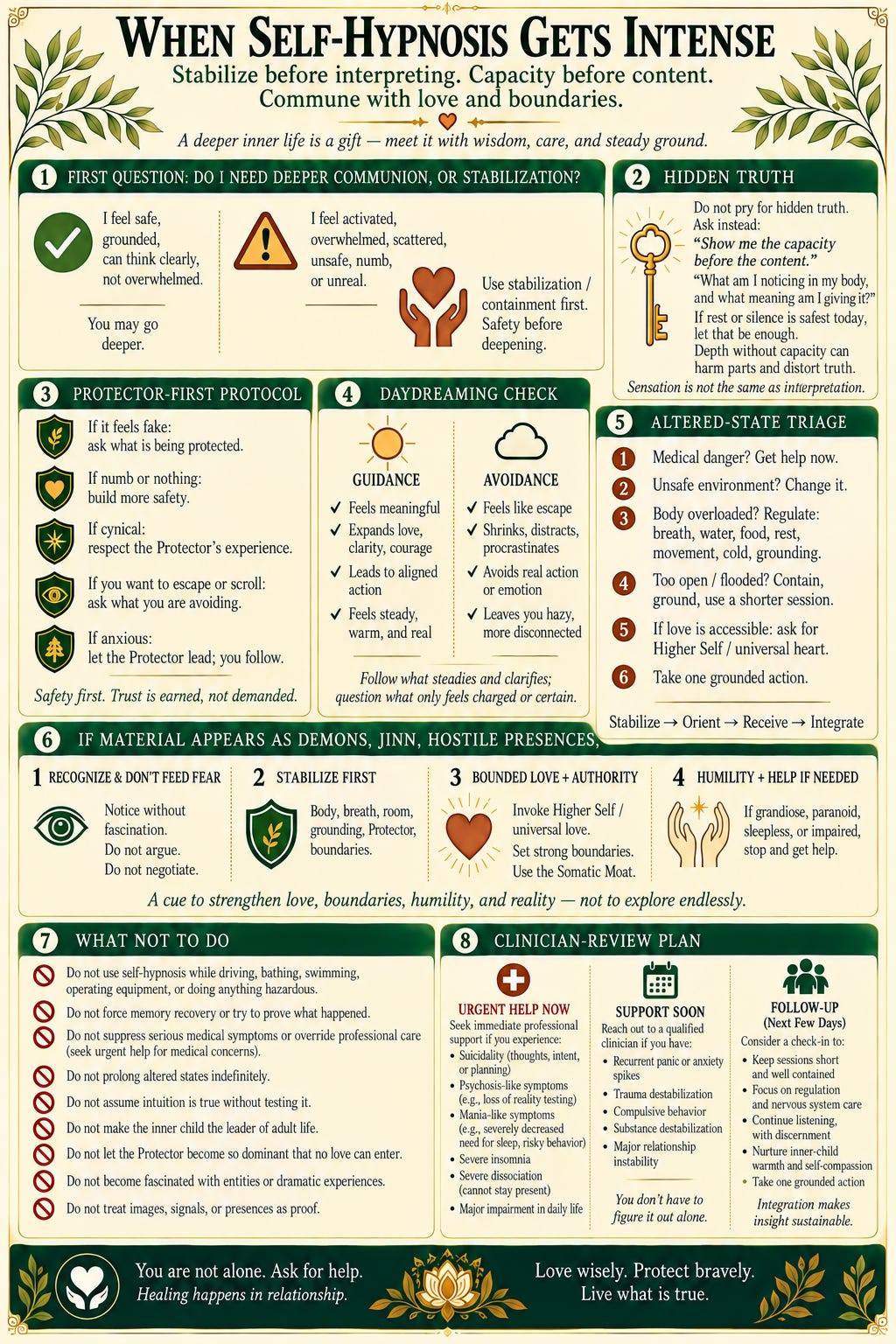
Anxiety is often a Protector trying to prevent danger, shame, abandonment, failure, exposure, illness, rejection, loss of control, or a feeling it believes would be unbearable. Don’t begin by cross-examining it. Help the body first.
Body first. Inner child second. Inquiry third. Action fourth.
Inner child love
Start with the hand-on-heart, hand-on-solar-plexus practice.
“Little one, you are not alone. You do not have to solve this. I am here now. The adult is listening.”
Don’t recite the words like an incantation you’re hoping the subconscious will grade. Say them the way you’d speak to a frightened child you actually love.
Reduced breathing / Buteyko-style breathing
Use this gently. Buteyko-style reduced breathing can help some people who overbreathe or panic, but don’t force breath holds. Air hunger can briefly increase anxiety before it settles, so go slowly.
Breathe through the nose. Let the inhale be small. Let the exhale be quiet. Pause only if comfortable. Let the breath become less dramatic. Stop if dizzy, strained, panicky, or medically concerned.
EFT tapping
EFT can be a simple bodily ritual: name the fear, tap gently, and stay in contact with what you feel. The evidence is still developing. A 2025 systematic review found seven randomized controlled trials involving EFT for anxiety disorders; EFT beat no intervention in several of them, although the evidence should still be treated cautiously beside first-line therapies.
“Even though this anxiety is here, I am willing to be kind to the part of me that is afraid.”
Somatic Experiencing
More info, and a free intro session on my Somatic Guide.
With SE, we track gently. Don’t turn the exercise into trauma excavation.
“Where is the activation?”
“Where is the neutral place?”
“Can attention move slowly between them?”
Gendlin Focusing
“What is the felt sense of this whole anxiety?”
Don’t answer from the head immediately. Give the body time to form one vague sense of the whole situation, then ask:
“What would this felt sense like me to know?”
Try a word or phrase and check how well it fits the felt sense. Then examine what it suggests about the situation; feeling right doesn’t settle that. Words and bodily attention can help correct each other.
Body supports
Sometimes the mind is too activated to meditate usefully. Then help through the body: foot, scalp, temple, neck, or shoulder massage; warmth; pressure; a weighted blanket; darkness; familiar calming music; or a massage gun used carefully. Avoid the front of the neck, injuries, numb areas, bruises, inflamed tissue, recent surgery sites, varicose veins, and anything that produces pain, dizziness, tingling, or a symptom that feels wrong.
Other people settle with warmth, darkness, music, massage, weighted blankets, breathwork, familiar objects, or personal relaxation technology. Use the support that actually helps rather than assembling a tiny wellness trade show around the anxiety.
Personal relaxation-tech note: On my ZHoly3O page, I discuss ozonated charcoal “holy water” as one relaxation support, and I also mention Blushield. These remain optional supports. They don’t prove that any inner signal is true. Stabilize the body, listen gently, reality-test, and return to one grounded action.
Anxiety script
First, body.
Feet, chair, breath, room.Little one, I am here.
Protector, thank you for warning me.
You do not have to scream for me to listen.If there is real action needed, show me one step.
If there is no action needed, help the body stand down gently.I will not abandon the signal.
I will not worship the signal.
I will listen, test, and act.
Appendix E: Is the daydream helping or replacing your life?
Daydreaming can be intuition, simulation, grief digestion, creative rehearsal, symbolic teaching, or the subconscious showing a possible future, fear, or desire. It can also become avoidance, fantasy addiction, dissociation, romantic obsession, or an escape hatch from adult life.
Does the daydream return me to life with more clarity, love, and action? Or does it pull me away from life into repetition, craving, and avoidance?
When it seems useful, ask:
“What is the guidance inside this?”
When it seems to be pulling you away, change the body before debating the story. Sit upright. Open the eyes a little. Feel the feet.
“Subconscious, thank you for showing me images. If this daydream is useful, please reveal the guidance inside it. If it is avoidance, please bring me gently into the present and help me deal with what I need to deal with in a gentle but structured way.”
Then get embarrassingly practical:
“What real-life action is this daydream replacing?”
The answer may be: send the message, stop sending the message, clean the room, eat, sleep, grieve, create, apologize, leave, tell the truth, make the plan, ask for help, return to the task, or stop chasing unavailable love.
Appendix F: Self-trust, outside guidance, and oracle-like states
The synchronicity cue above turns noticing into orientation and reality-testing rather than an oracle.
Suggestibility varies wildly. Some people open more with an external hypnotist, some with themselves, some only in particular states, and some barely respond to commands while responding deeply to imagery, music, metaphor, or spiritual feeling. A professional can bring pacing, containment, and another set of eyes. Self-hypnosis gives you instant follow-up, real-time correction, and a private line to your own protectors.
Self-hypnosis may be best for daily intimacy with the subconscious.
Skilled outside support may be best for trauma complexity, blind spots, dissociation, destabilization, and relational wounds that need another nervous system.
Finding a hypnotist who can work with you
Ask what they are trained to treat, how they use hypnosis, and how they respond when a suggestion doesn’t fit. For trauma work, ask about actual trauma and dissociation training, not only a hypnosis certificate. Credentials matter without guaranteeing competent care.
Describe what has helped, what hasn’t, your preferred directness, acceptable touch and imagery, and how you’ll stop. Ask about unexpected reactions, uncertain memories, and the full return. Firm encouragement can fit; refusal still ends it.
Evaluate what actually happened, not the method’s name. Was its purpose explained? Did you agree? How did the practitioner respond to you? Discomfort alone doesn’t settle the question; treating every objection as proof you need more of the same deserves scrutiny. Ask the app or another informed person for explanation, without expecting a practitioner to be certified from a brief account. Self-hypnosis, combined work, or another practitioner remain your choices.
When the subconscious speaks like an oracle
The subconscious can notice things the conscious mind misses: anticipations, pattern reads, and sometimes something uncanny. Respect the signal without turning a vivid image or directive into an order.
When the message has large or irreversible consequences, slow the action to the scale of those consequences, ask the adult questions, and bring the message to a council.
The council — internal first, then outward
The first council is internal: child and adult, conscious and subconscious, intuition and analysis. Reach outside when the message is bigger than those parts can hold alone. The larger and less reversible the move, the more seriously you seek other minds.
Ask people who love you, like-minded people, or somebody who has walked the path. Going alone can be legitimate, but I’d make it the last step after counsel was genuinely sought.
The opposite danger is giving away your power. “Seek counsel” can quietly become “find an authority and obey.” Another person deserves neither automatic trust nor automatic dismissal.
Peer support can lend a different kind of help. In Hearthwork, equal time, warmth, confidentiality, and respect for “no” let each person lend Nurturer and Protector without taking over the other’s Guide. Then you switch roles. A carefully timed question can help your own direction become audible; the peer doesn’t decide what the experience means.
Forgiveness without bypass
Forgiveness can’t be forced. It grows from understanding, and pushing it too early creates bypass. Staying angry forever can also let the injury keep governing the present. All of these can remain true together: the harm happened, the boundary still matters, the person remains accountable, and forgiveness may come later when your relationship to the event changes on its own.
The understanding that helps me is seeing how conditioning, history, pain, and capacity shaped the harmful move. Given the total person they had become by that moment, the harmful move was the only one their accumulated nature had available. The harm remains real, and so do accountability, consequences, and the work of making a different response possible now. Understanding someone’s limitations should make expectations more realistic, not make the limitations less consequential.
“You do not have to forgive before you are ready. I will not use spirituality to silence your pain. I will also not build our whole life around this wound forever.”
Questions for forgiveness without erasing anything:
“What happened?”
“What was the impact?”
“What boundaries are still needed?”
“What shaped this person into someone capable of that harm?”
“What belongs to them?”
“What belongs to me?”
“What does accountability require?”
“What would release look like without denial?”
For self-forgiveness, name what you did without taking responsibility for what wasn’t yours. Let remorse register the harm or violation of your values without making the person who acted a permanent criminal. Then move through responsibility, remorse, rectify, release: name the action and impact; allow the remorse; repair or prevent repetition where possible; and stop holding yourself hostage after responsibility has been faced.
Appendix G: Altered states
This guide doesn’t tell anyone to use substances. It does acknowledge that many people first encounter self-hypnosis, inner-child contact, or Higher Self dialogue while altered.
Do not use altered states to force revelation. Use them to deepen listening, strengthen love, and improve ordinary life.
A past opening can be a resource without becoming a state you must reproduce. Having experienced love once, being able to access it only in a particular state, and contacting it reliably in daily life are different things. Let the experience widen what seems possible while you build usable access. If the child cannot receive it, meet the difficulty rather than escalating the intensity.
During or after an altered state, these prompts are usually more useful than demanding a revelation:
“Help me stay grounded.”
“Help me receive only what I can integrate.”
“Help me remember love.”
“Help me return when it is time.”
“Help me translate this into one ordinary-life change.”
Don’t use self-hypnosis to prolong an altered state indefinitely, recover memories, intensify fear, bypass sleep, override medical needs, or make yourself less able to communicate.
If the state makes you less loving, less grounded, less honest, less able to sleep, less able to communicate, or less able to meet ordinary responsibilities, stop deepening and start integrating.
Stabilize before you interpret
Self-hypnosis can become very powerful during loveyhuasca, meditation, lucid dreaming, grief, sexual energy, prayer, sleep loss, or other plant-medicine-adjacent states. Sometimes the mind opens faster than the adult self can organize what is arriving.
Intensity then gets mistaken for meaning. Sometimes the inner child is finally speaking. Sometimes a Protector is showing fear, or shame, grief, anger, longing, and other buried material are asking for care. But an intense state can also be bodily overload, environmental chaos, sleep deprivation, or plain confusion. A frightening image isn’t automatically truth, a bad feeling isn’t automatically a lesson, and a “download” doesn’t deserve belief merely because it came with excellent lighting.
Before trying to interpret the state, ask a simpler question:
“What kind of problem is happening?”
Trip-Sitting: Medical Triage, Shadow Work, Therapy (v 5.3, updated July 19, 2026)

Quick Triage Web-App Version HERE
Appendix H: Demons, jinn, hostile presences, and “Unattached Burdens”
I’m speaking from experience in this appendix.
During self-hypnosis, meditation, lucid dreaming, loveyhuasca, grief, prayer, plant-medicine-adjacent practice, or other altered states, people sometimes meet something that doesn’t feel like an ordinary emotion or younger part. It may appear as a demon, jinn, parasitic energy, dark intelligence, or terrifying archetype—a voice or image that feels intrusive, hateful, seductive, mocking, or simply alien.
I don’t need this guide to settle the metaphysics. Perhaps these are literal beings. Perhaps they are symbolic mind-forms, trauma in a frightening costume, dissociated energy, or ancestral and relational burdens. The practical question is:
“What response makes me safer, clearer, more loving, more grounded, and less hooked?”
Start with the room, the body, and basic safety
When a demonic, jinn-like, hostile, or intrusive presence appears, don’t reward it with instant metaphysical certainty. Run the triage first: medical danger, environment, body, overload, and how open the mind has become. Open the eyes, feel the feet, name the room, lower stimulation, leave hostile company, and stop adding prompts. Don’t deepen, hunt for hidden truth, or debate ontology while destabilized.
“Only what can be integrated is welcome now. Anything too much can wait. The adult self remains present. The body may return to safety.”
Danger to self or others, psychosis-like fear, inability to sleep, extreme paranoia, chest pain, seizures, serious overheating, overdose concern, or loss of basic functioning means the self-hypnosis session is over. Get real-world help.
A response check, not a verdict about what it is
Once you’re stable enough to stay present, notice what helps without turning the response into a metaphysical test. Put a hand on the heart if that feels welcome, take a comfortable breath, and keep the room available.
I don’t have to decide what this is right now. I can notice whether warmth or distance helps, and keep my boundary either way. Nothing here requires my obedience.
If vulnerability appears—a knot in the throat, sadness, fear, or a sense of trying to protect something—you can bring in the Nurturer. If the experience remains hostile or becomes more frightening, stop engaging with it and return to the body and room.
Neither response establishes its origin. A protective part needn’t reveal its fear quickly; a comforting response doesn’t prove an interpretation either. The useful question is whether this way of responding helps you become clearer, steadier, and less hooked. Love and boundaries don’t require a verdict first.
Do not fight from fear
The first impulse may be to fight, banish, hate, prove power, argue, panic, or identify completely with the threatened self. Some traditions use prayers, mantras, protections, banishing rituals, or exorcism forms, and some people find them useful. But fighting from fear can fasten attention more tightly to the thing you want gone.
Fear gives it center stage. Hatred gives it a hook. Pride gives it an opponent. Panic gives it the nervous system.
“I do not need to hate this. I do not need to merge with this. I do not need to obey this. I do not need to defeat this from fear. I return to loving awareness.”
A bodily boundary: compassion present, door closed
When the presence feels hostile, cold, alien, parasitic, or boundary-violating, don’t offer soft sentimental love as though inviting it in for tea. Use love with a boundary.
Sit upright. Press your feet into the floor. Let the spine rise. Gently draw the shoulder blades back so the chest is open but not exposed. Feel the skin boundary of the torso. Feel that this body has a perimeter.
“I recognize that suffering may be here, and I wish all suffering to return to the space where it belongs. But the boundary of this skin belongs to my adult life. You do not have permission to enter this house.”
“Compassion is present. The door is closed.”
If it might be psychosis or destabilization
A symbolic hostile-presence experience that settles with grounding and love is very different from a state that becomes persistent, paranoid, sleepless, dangerous, or impossible to reality-test.
If somebody believes they’re under attack for days, can’t sleep or function, hears commands, feels compelled to hurt themselves or anyone else, becomes manic, can’t communicate normally, or can’t distinguish symbolic experience from ordinary reality, stop treating the problem as hypnosis material. Get help.
If the practice makes you more loving, grounded, relational, honest, and functional, continue gently. If it makes you more paranoid, sleepless, grandiose, isolated, frightened, or unreal, stop deepening and get support.
The cosmic-download humility test
Hostile presences, shadow forces, grandiose parts, and altered-state imagery don’t always attack through fear. Sometimes they seduce through importance: a cosmic secret, a special mission, a vast download, a feeling of being uniquely chosen, or a revelation that makes washing dishes seem beneath your new rank.
“Thank you for the imagery. I do not require a grand performance. If this information cannot become a simple, honest act of care tomorrow morning — washing the dishes, cleaning my room, keeping a promise, apologizing, resting, eating, or helping someone I love — it is not useful to my path.”
Guidance worth keeping should make ordinary life more beautiful, honest, relational, humble, reliable, and useful to other people.
Don’t become an entity hobbyist
Demons, jinn, hostile presences, and “Unattached Burdens” all lead to the same practical training: can love remain present without surrendering the boundary, and can the mind become harder to hook? I’m not trying to turn anyone into an entity hobbyist.
Appendix I: Sleep hypnosis
For sleep hypnosis, use Nimja’s sleep playlist.
Appendix J: A practical induction library
Preview the sequence, choose one purpose, and decide whether you want to begin. Each family can be light, eyes-open, or replaced by no-trance contact. Notice the actual response—including no change—and let it determine the next move. Move, imagine, change the sensory channel, remain still, or stop. Use the complete waking return after every induction.
If vivid images don’t come, translate the metaphor into words, rhythm, spatial sense, touch, movement, or simple knowing. The mind doesn’t owe anybody a movie.
1. Stretch and release
Feel the support beneath you and the position of one hand or foot. Press gently, stretch slightly, and release—or imagine it. Notice ease, tension, warmth, breath, or no change. Repeat with no more than three areas, letting “release” guide the sequence. Which area or inner voice wants attention? What support is needed? Restore ordinary movement and return.
2. Supported floating
Notice where your weight is carried. Let support carry 1% more effort, as if floating without losing contact, or keep ordinary weight and pressure. Notice the response. You may deliberately alternate attention toward ordinary awareness on the inhale and support on the exhale; name this fractionation beforehand. What becomes easier to hear? Keep the support, regain chosen weight and firm contact, then return.
3. Rhythmic breath or pulse
Accompany a natural rhythm: breath, a comfortable hum, a finger tap, outside sound, or silent counting. No rhythm is also an option. Repeat “here, and here again,” noticing where attention lands between repetitions. Stop the deliberate rhythm and notice the first quiet beat, without trying to become blank. Is a word, feeling, need, or action clearer? Let ordinary rhythm resume and return.
4. Unwinding object
Notice a concern with several strands. Imagine yarn unwinding, bubbles settling, or knots placed visibly beside you. Leave the object unchanged or label it in words when that fits better. Count only strands you actually set down; nothing is erased. Which needs warmth, protection, or action? Keep one useful strand, give the others a visible holding place, and return.
5. Sensory journey
Hear the actual room and feel the body before imagining a step toward a chosen destination. Use footsteps, textures, or landmarks to gather attention. Change scenery or skip directly to dialogue when useful. Notice a detail without assigning hidden meaning; the mystery is how the scene develops, not what will be done to you. Who or what needs to speak? Return by the same route and close the imagined space.
6. Gradual wave
Start with a small neutral area and what is already there. Imagine warmth, steadiness, or attention spreading to the next comfortable area, or keep it localized. Pause at each step and notice what changes without claiming medical repair. Does the body want contact, space, words, or ordinary care? Let the image recede, feel the whole body and real contact points, and return.
7. Care workshop
Prepare time, a place, tools, and boundaries for patient care. Let a signal, feeling, or younger state approach only as closely as welcome; choose language that doesn’t make you feel fragmented. Ask before responding, wait, reconnect only where welcome, rest, and reassess. An available inner adult or one borrowed function can help; you choose words, pace, and action. Aim for “good as you,” not erased history. Close the workspace, affirm wholeness and adult presence, and return.
8. Resource embodiment
Choose qualities you understand: warmth, boundary, steadiness, curiosity, or dignity. Imagine posture, voice, or attention with 1% more access to one quality. Observe rather than embody it when preferred. Notice a movement, word, image, or no response. Repeat to strengthen access, not replace identity. How would that quality meet today’s situation? Keep the quality and one useful action, release the role, affirm “I am myself,” and return.
9. No-trance inner contact
Observable pacing: Keep the eyes open, name the room and day, feel the feet, and read or write in ordinary awareness.
Invitation: Ask one clear question and wait without narrowing attention further.
Genuine choice: Answer, write “unsure,” rest, change the question, seek another person’s view, or stop.
Autonomous signal: Record a word, sensation, impulse, objection, or silence without interpreting it as proof.
Deepener: None. Full alertness is not an inferior version of the practice.
Handoff: Let the internal adult respond in writing or through one practical choice.
Integration and exit: Reality-test the signal and do one small action. Because no altered state was cultivated, simply close the exercise and continue the day.
Appendix K: Sources and further reading
The personal accounts and the way I arrange this practice are mine. The revised teaching brings them together with body-oriented and hypnotic approaches described below. That combination is an adaptation, not a treatment validated as a whole. These notes are for readers who want to follow an idea further; you don’t need them open while practicing.
Learning, entering, and returning
Maggie Phillips and Claire Frederick, Healing the Divided Self (1995), especially pp.24–27, 45–50, and 83–90, discusses interactive hypnosis, sensory learning, self-hypnosis, and a definite return. It is a professional clinical book, not a self-help manual; its case procedures and historical claims shouldn’t be imported wholesale into solo practice. Adam Eason and Benjamin Parris’s ISH article on self-hypnosis discusses self-directed learning and its relationship to another hypnotist and recordings.
Indirect language and re-entry cues
Phillips and Frederick, pp.53–57 and 96–100, explain pacing, utilization, metaphor, and associational cues. Nimja’s hypnotic-language tutorial and trigger tutorial describe language and cueing techniques. They are technique sources, not evidence that every NLP claim is established or every example suits trauma work. The original wording and deliberately chosen re-entry sequence here are adaptations; Nimja did not write or endorse this guide.
Body awareness and changing the amount of contact
Peter Levine, In an Unspoken Voice (2010), chapters 5 and 7; Levine and Maggie Phillips, Freedom from Pain (2012), chapters 3–4; and Levine, Healing Trauma, chapter 4, inform bodily tracking, resources, titration, pendulation, and attention across sensation, imagery, behavior, emotion, and meaning. The invitation to try a movement or image is not a claim that a particular physiological repair has occurred.
Inner-child care and adult capacities
The companion Inner Child Self-Love Reparenting Guide gives the fuller treatment of borrowed adulthood, love without compulsory trust, practical and relational repair, spiritual struggle, differentiation, and mutual peer support. The corresponding practices here follow that account while retaining the self-hypnosis entry, responsive language, and complete return.
Healing the Divided Self, pp.148–153 and 171–174, discusses renurturing, somatic work, and developing nurturing capacities. Levine and Maggie Kline’s Trauma Through a Child’s Eyes, especially chapters 4–5 and 10, discusses attunement and individual responses in actual children and caregiving. Applying those ideas to an adult’s younger feeling-states is an adaptation. My three-adult arrangement and borrowed-adulthood sequence are not presented as those authors’ tested protocol.
Inner speech and putting experience into words
Nedergaard and Lupyan’s Not Everybody Has an Inner Voice (2024) studied people reporting different amounts of inner speech, not self-hypnosis adaptations. The questions in Quick start are a practical self-check, not a validated screening instrument or a test of hypnotic ability.
Memory, support, and choosing a practitioner
Levine’s Trauma and Memory (2015), chapter 7, is useful on the difference between compelling experience and historical verification. The VA’s hypnosis overview includes cautions about strong reactions and false memories. ASCH’s explanation of certification distinguishes professional preparation from a guarantee of someone’s competence. The existing links in the evidence and specialist sections point to their particular claims rather than validating every use of hypnosis.