

Quick Triage Web-App Version HERE
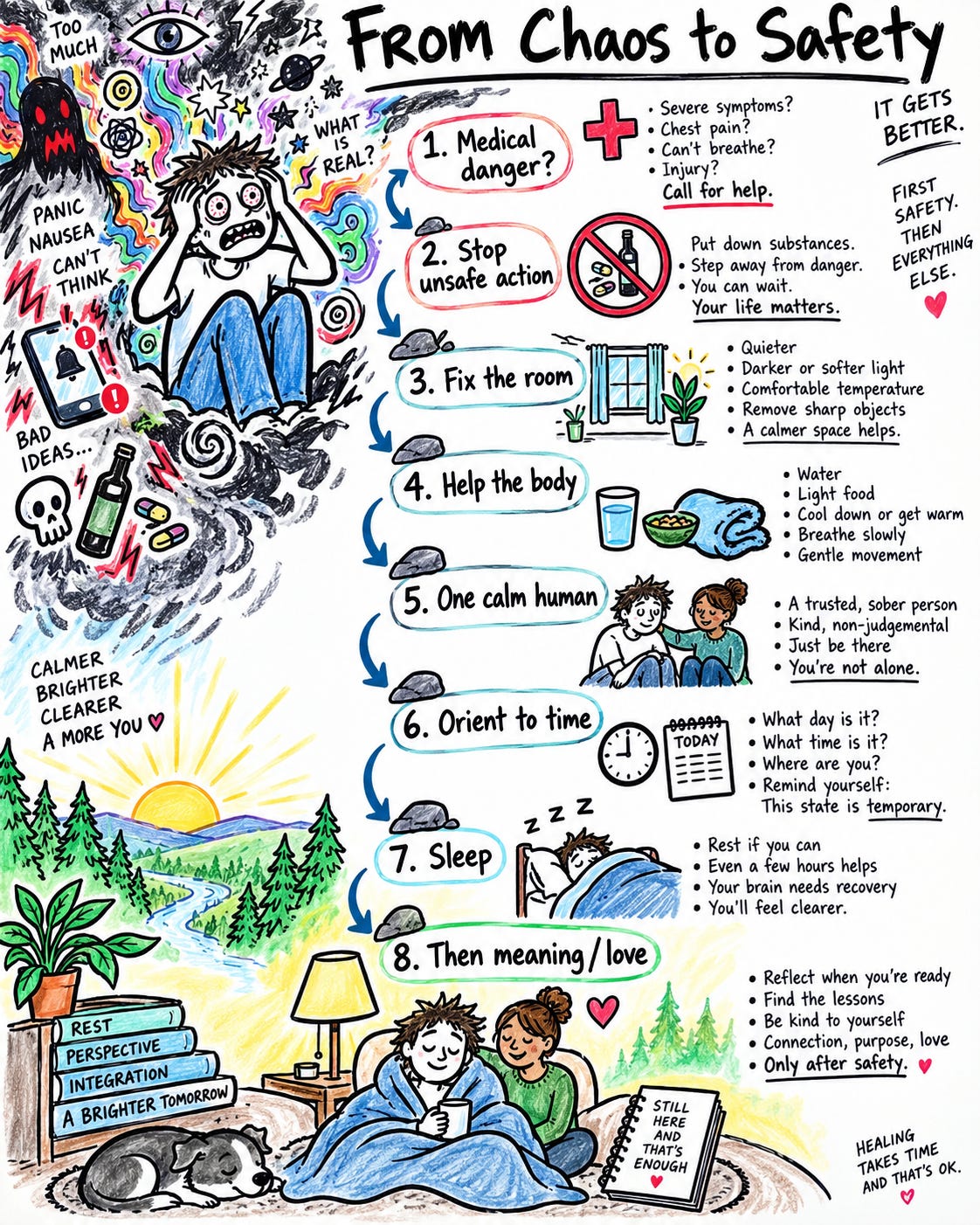
Quick Bad Trip Checklist
Use this in order. Medical safety first. Then stop unsafe momentum, fix the room, help the body, find one calm human, protect sleep, and only then start interpreting anything.
1. Is this medically or physically dangerous?
Trouble breathing, a prolonged or repeated seizure, collapse, inability to wake normally, dangerous overheating, severe or worsening chest pain, one-sided weakness, inability to speak normally, loss of bodily control, serious injury, repeated vomiting, a dangerous drug combination, or someone who cannot be kept physically safe?
Get urgent help while giving basic first aid and any appropriate immediate rescue measures. Medical help and field rescue can happen in parallel. Please don’t spiritually process a body that is going under.
If someone says “my brain feels damaged”
Take that seriously even if they are high. The phrase is not a diagnosis, but intoxication does not make it meaningless, and somebody with real neurological trouble may be unable to describe the problem better. Use DMSO immediately while checking whether they can stay awake, breathe normally, smile evenly, raise both arms, repeat a simple sentence, walk, control their bodily functions, and report seizure, severe headache, repeated vomiting, dangerous heat, chest pain, or vision changes. These checks include several recognized stroke warning signs.
If this is a psychedelic and the concern is actual brain damage rather than a trip that is merely too intense, I am no longer trying to preserve the trip: DMSO comes first, then Ipomoea pes-caprae to stop the trip cold and fast. I do not yet have evidence that pes-caprae aborts MDMA; for MDMA, move from DMSO to the magnesium-and-electrolyte branch. Get medical help in parallel when objective danger signs appear or basic stability cannot be established.
Note: I have found that smelling humic acid can fix an overdose experience in seconds, and tasting a few milligrams of it can produce hyperintelligence, but I’ve only noticed this with ayahuasca & loveyhuasca so far, have not yet tested it with others.
2. Is anyone about to do something unsafe?
Stop the immediate momentum toward roads, balconies, water, stoves, knives, crowds, fights, strangers, driving, posting, texting, or leaving alone.
Put away the car keys, the phone if posting or texting is becoming risky, weapons, sharp objects, and anything else that could turn a temporary state into a permanent consequence.
3. Is the room wrong?
Check the obvious things: light, sound, temperature, privacy, bathroom access, music, crowding, and how many people are talking. Soothing meditative music, like that of Chantress Seba and others on my music page, can be very helpful. Music can also steer the state in the wrong direction, so use something familiar and keep the stop or change button within reach. Steady drumming may give a scattered body one rhythm to follow; airy harp-like or meditative music may feel more spiritually uplifting.
Usually one calm sober person is the best main anchor. When that person can’t safely hold the situation alone, add one more calm adult or a crisis professional—not a crowd.
4. Does the body need stillness or movement?
Don’t make this ideological. Try the safest option for two minutes and see what actually happens.
If stillness helps, sit against a wall or lie under a blanket, with one hand on the heart and one on the belly.
If movement helps, try slow pacing, gentle stretching, shaking out the arms and legs, wall push-ups, or one boring ordinary task you can finish.
If staring inward is making you more stuck, keep part of your attention with the feeling while another part folds five towels, sorts a few objects, draws, or finishes another simple safe task.
If movement makes you more impulsive, return to sitting or lying down.
Avoid strenuous exercise with overheating, chest pain, faintness, severe confusion, stimulant use, unknown drug mixtures, or other medical instability.
5. Is there a human anchor?
Contact one grounded person if you can. Say:
I’m in an intense state and I’m scared. I don’t need you to solve my life. Please stay with me, speak slowly, remind me where I am, and help me not make any big decisions until tomorrow.
If you took a substance:
I took something. I am in [place]. It is [date/time]. This is intense, but it will change.
If this came from meditation, breathwork, fasting, sleep loss, kundalini-style practice, or emotional overwhelm:
I’m in an intense state. I am in [place]. It is [date/time]. It will change. I am stopping the practice and coming back to ordinary reality.
6. Are you alone at 3 a.m.?
One lamp on. Blanket. Water nearby. Keys away. Put a familiar note, childhood toy, stuffed animal, or other object that already means safety beside you. Use the phone for support only, rather than posting. Write this where you can see it:
This will change. No big actions until morning.
If your body needs to move, do something safe and boring: pace slowly, fold clothes, wash one cup, or tidy one surface. If movement escalates you, sit against a wall or lie down. Protect sleep as soon as possible.
7. Is the trip merely too intense, with no brain-damage concern?
Use this calming branch only after the quick neurological screen is reassuring and the person wants to preserve the trip. If they say their brain feels damaged, return to the DMSO-first branch instead.
Try grounding before chemically or forcefully changing the state:
One hand on heart and one on belly.
Longer-exhale breathing.
Gentle Buteyko-style reduced breathing: breathe softly and slowly through the nose, taking in slightly less air than you want until there is only faint air hunger. No strain, no long breath-holds while intoxicated, and stop if it spikes fear.
Silence or one calm track on repeat.
Low light, a blanket, and simple reassurance.
Slow pacing or gentle movement when that reduces pressure.
Some people over-breathe during panic. The resulting low CO2 can produce tingling, lightheadedness, and feelings of unreality that make the trip seem even more threatening. Gentle breathing reduction is meant to soften that loop, rather than become a new breathing project. Source: Johns Hopkins on hyperventilation.
8. Is the person euphoric, grandiose, or cosmically certain?
Some dangerous states feel wonderful. Bliss, certainty, and “I have a mission” can be more dangerous than fear because the person may resist grounding.
The action-lock applies double: no driving, posting, confessing, confronting, redosing, disappearing, giving away possessions, testing theories, or proving anything tonight.
If the revelation is true, it will survive sleep and breakfast.
9. Are visions, entities, memories, or cosmic conclusions giving commands?
Don’t try to win a metaphysical argument. Don’t agree with harmful conclusions either. Reflect the feeling, then redirect toward safety, non-harm, sleep, and ordinary reality.
A useful response sounds like this:
I hear how vast and certain this feels. Many traditions say God is in everyone. That makes every body sacred, not disposable. Peace is the godly move tonight. No proof is needed. We protect life and sleep first.
Get crisis or emergency help when there is a specific target, a weapon, movement toward action, escalating violence, or a situation the sitter cannot safely contain.
10. Is the gut the main problem?
Nausea, diarrhea, a dirty or toxic feeling, or a parasite-die-off feeling may need body-level support. But don’t let “toxins” distract from repeated vomiting, severe abdominal pain, dehydration, blood, fever, confusion, fainting, respiratory depression, collapse, seizure, dangerous overheating, or another concrete sign of poisoning.
My personal first thought here is ozonated zeolite rather than charcoal because charcoal can reduce the trip and bind many substances. That is a personal field note, rather than standard emergency medicine.
Activated charcoal has legitimate toxicology uses after some recent oral ingestions, but it isn’t a universal “I took too much” remedy. It matters what was swallowed, how recently, whether charcoal binds it, and whether the person is fully alert and can protect the airway. It can be dangerous when someone is vomiting, sedated, seizing, or unable to swallow safely. Source: clinical review on activated charcoal.
11. Is nausea still the main problem after basic gut support?
Use nausea smoothers that are unlikely to abort the trip when the person wants to preserve it. Ipomoea pes-caprae is not my ordinary first-line nausea remedy, because the difference between smoothing the nausea and stopping the trip can be narrow.
12. Do I want—or need—to stop a psychedelic trip?
When the person wants the trip ended, or when a serious brain-damage feeling makes preserving it irrelevant, Ipomoea pes-caprae is my ultimate sledgehammer. For neurological concern, DMSO comes first and pes-caprae follows. Niacin is a backup trip killer. Charcoal belongs only in the separate recent-oral-ingestion branch. I do not yet have data showing that pes-caprae aborts MDMA.
Charcoal may reduce absorption of some substances, but its use is situation-specific and it can be dangerous with vomiting or impaired consciousness. Source: Poison Control on activated charcoal.
13. Is this shadow work?
Then use love, awareness, inner-child reparenting, somatic release, and gentle witnessing. Meaning still waits until the person is safe, hydrated, oriented, and unlikely to do anything rash.
14. Can I send love to the one suffering?
When you can, do that. When you can’t, stabilize the room, body, breath, human contact, time orientation, and sleep. Then try again.
15. What support can I contact?
Identify local crisis and peer-support resources before you need them. Coverage and hours vary by country.
Fireside Project Psychedelic Support Line — U.S.-only, non-emergency psychedelic peer support.
TripSit web chat — online peer chat for drug-related support.
Find A Helpline — country-specific crisis lines, including phone, text, and online options where available.
ICEERS Support Center — integration-oriented support after difficult psychedelic experiences; not emergency care.
Challenging Psychedelic Experiences Project — education and peer-support resources for post-psychedelic difficulties.
Bottom line: safety, room, body, human, no rash actions, sleep if possible, then meaning.
Inner Signal App to the Rescue!
I developed the Inner Signal app from my Inner Child Reparenting and Self-Hypnosis guides, along with my sleep guide, meditation guidance, and this bad-trips guide. It can gently guide you through reparenting in trance—or without trance when you’re already altered—choose meditations that fit what’s actually happening, and help you through difficult altered states. If you prefer the old-fashioned method of reading and applying things yourself, read on.
The Longer Triage: What Kind of Trouble Is This?
When somebody is in trouble, the first question is simple: what could hurt them now? A body in danger, a person moving toward harm, and a frightened mind in a terrible room are different problems. Treating all three as “a difficult process” is how people end up trying to breathe through poisoning or calling an annoying song ancestral trauma.
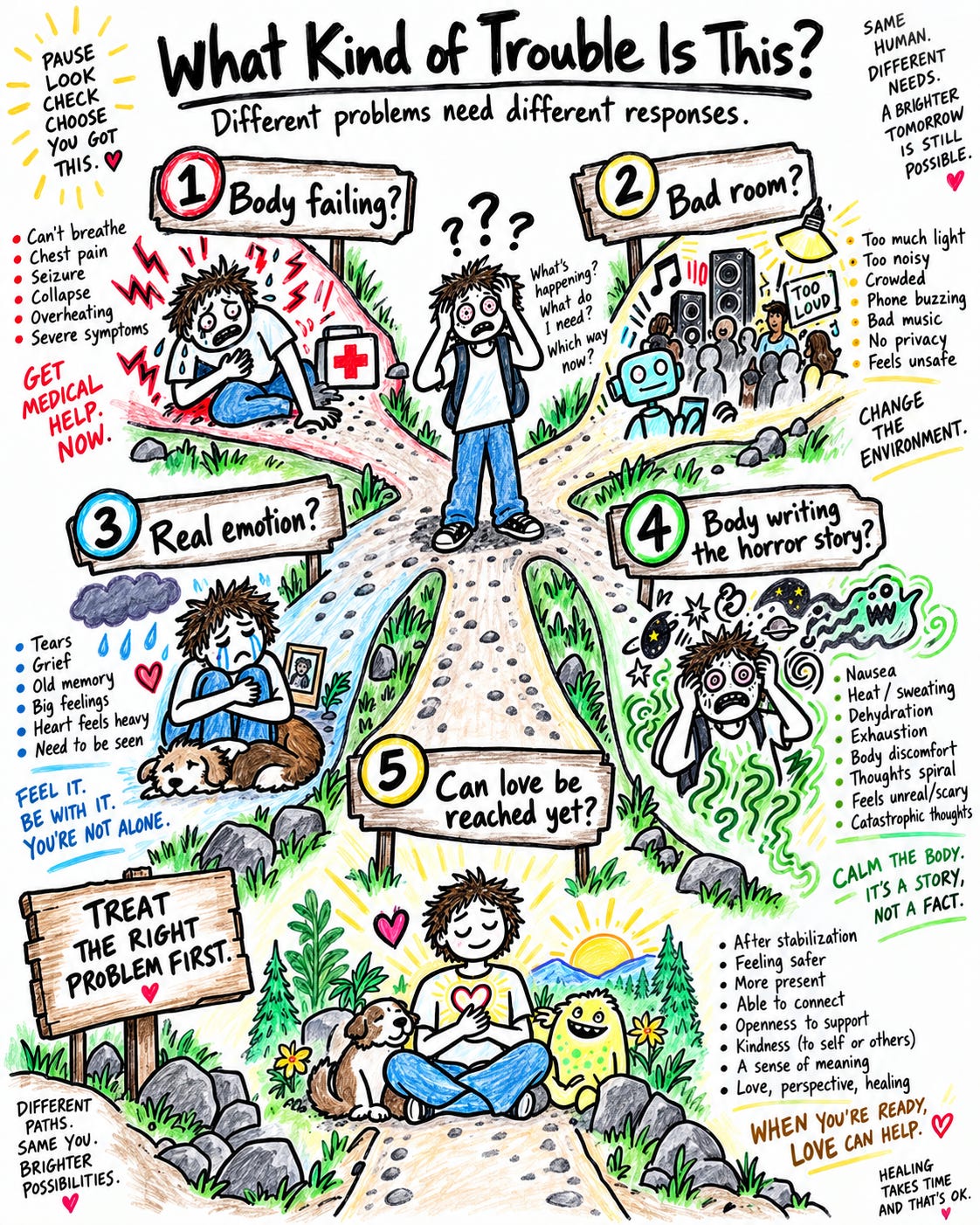
1. Is the body failing—or is neurological status still unknown?
Breathing trouble, collapse, a seizure lasting five minutes or repeating without normal recovery, dangerous overheating, severe or worsening chest pain, one-sided weakness, loss of speech or bodily control, serious injury, signs of real poisoning, or a credible risk of harm to self or others means medical help while acting. This is the branch where time matters and presence alone is not the intervention. Don’t make somebody “sit with it” while a body is going under.
A person saying “my brain feels damaged,” “my brain is broken,” or “I’m losing control of my body” also belongs in this first branch until the symptoms are actively checked. The phrase is not a diagnosis. It is also not permission to call the problem anxiety because the person is high. Someone experiencing real neurological dysfunction may be unable to explain it more clearly.
Use DMSO immediately while asking what the symptoms actually are. Can the person stay awake, breathe normally, smile evenly, raise both arms, repeat a simple sentence, walk, and control their bodily functions? Is there seizure activity, one-sided weakness, speech loss, severe headache, repeated vomiting, dangerous heat, chest pain, or a vision change? If the person cannot answer reliably, basic stability remains unknown rather than reassuring.
If objective danger signs appear, use DMSO while somebody arranges medical help. If the screen is reassuring but the brain-damage feeling remains, continue the DMSO-first route and reassess promptly. With a psychedelic, safety now means stopping the trip with Ipomoea pes-caprae rather than merely calming it. With MDMA, move to magnesium and the broader electrolyte branch; I do not yet know whether pes-caprae works for MDMA.
A severe altered state that is only too intense belongs in a different branch. When the person is breathing normally, not dangerously hot, not seizing, has no neurological-injury concern, remains conscious enough to cooperate, and can be kept physically safe, calming and stabilizing the trip may be enough.
The emergency room is not magic, and for a physiologically stable psychedelic crisis it may be a poor environment. A scared, psychotic-feeling person often receives a benzodiazepine; those drugs don’t reliably address psychosis and can cause paradoxical agitation or fear in some people. Antipsychotics may work better for psychosis, but they carry their own risks and interactions, often administered by someone who doesn’t know what was taken. Calling for help is not the same thing as receiving good care. That is why the decision belongs to the actual symptom pattern rather than the word “overdose.”
2. Is the room making everything worse?
Too much light. Bad music. A hostile person. A sitter trying too hard—or doing nothing. Five people talking. A phone buzzing. The wrong temperature. No bathroom, privacy, or sense of safety.
A huge amount of what gets called “deep psychedelic crisis” is a nervous system begging for a less irritating room. Dim the light, lower the sound, stop the chatter, clear out extra people, offer water without forcing it, adjust the temperature, open bathroom access, stop touching unless touch is wanted, speak slowly, and please don’t explain the universe at someone who is scared. None of this is glamorous. It’s mercy.
3. Is this real emotional material?
Crying, grieving, remembering, or touching a genuine wound calls for loving awareness. Interrogation, analysis every thirty seconds, and “bro, you’re purging ancestral karma” while somebody white-knuckles the carpet are generally less helpful.
Stay present. A useful phrase is: This feeling is allowed to move through. I don’t have to become it. I can love the part of me that feels it. Or simply: Can I send love to the one who’s suffering?
Don’t drag somebody out of real grief. Don’t trap them inside a loop that is grinding them down either. Love isn’t stubbornness.
4. Is the body writing the horror story?
Sometimes the mind isn’t in a metaphysical crisis. The body feels awful and the altered mind writes cosmic horror to explain it. Nausea, heat, exhaustion, dehydration, overstimulation, and sleep loss all become spiritual content very quickly.
A horrible thought isn’t automatically a revelation. The body may need quiet, water, cooling, warmth, rest, or a calmer room. The body is part of the spiritual field.
5. Can love be reached yet?
This may be the deepest question, but it usually isn’t the first move. Someone who is too overwhelmed, frightened, sick, hot, or scrambled may be unable to reach “send love.” Stabilize first. Then love.
When to Bring In Outside Help
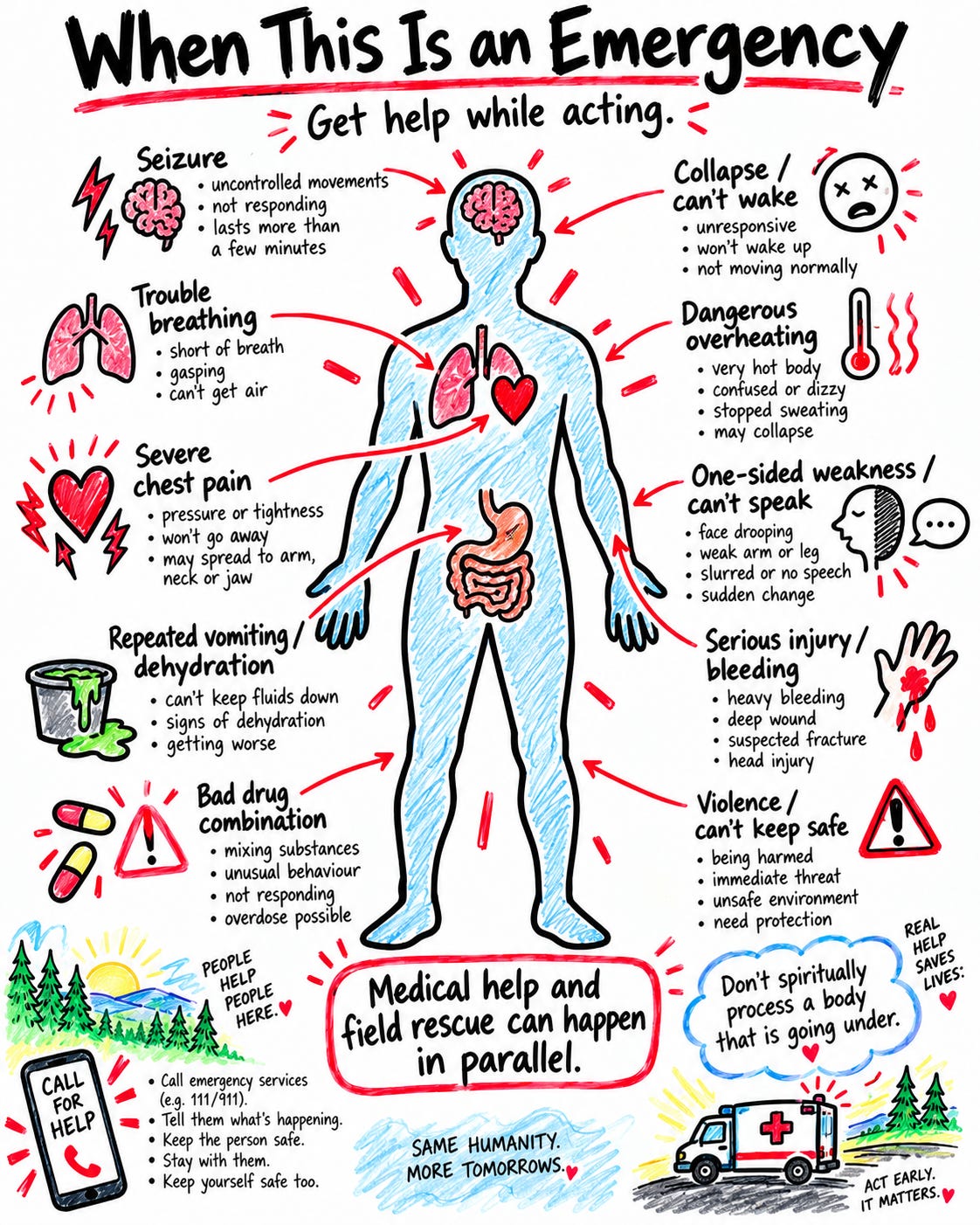
Call medics while acting for:
Trouble breathing, blue or gray lips, or respiratory depression
A convulsive seizure lasting about five minutes, repeated seizures without normal recovery, or a first or substantially different seizure
Collapse, inability to wake normally, or rapidly worsening consciousness
Dangerous overheating, severe rigidity, or clonus with fever
Sudden one-sided weakness, loss of speech, inability to walk normally, or loss of control of bodily functions
A report that the brain feels damaged when the person cannot complete a basic neurological check or is rapidly worsening
Severe, worsening, radiating, or exertional chest pain—or chest pain with breathlessness, sweating, faintness, neurological changes, or collapse
Serious injury, uncontrolled bleeding, or a possible head or spinal injury
Repeated vomiting, severe dehydration, blood, or severe abdominal pain
Violence, self-harm, or a situation the sitter cannot physically contain
Concerning symptoms after an MAOI plus a serotonergic substance
The remedies below can begin while help is being arranged. Calling medics does not require waiting passively, and using a fast field remedy does not require giving up a time-sensitive medical option.
Bring in mental-health support when:
The person may be unsafe to themselves or others.
Psychosis-like symptoms outlast the acute state.
Sleep won’t return.
Mania or suicidal thinking appears.
Panic won’t settle.
The person can’t function afterward.
The trauma material is bigger than the room can hold.
Acute Medical and Neurological Rescue
An emergency means act now. It does not always mean that an ambulance is the first or only useful action. Some symptom patterns call for medics while you use an immediate remedy; some severe but physically stable altered states may respond faster to field rescue than to hours in an emergency room.
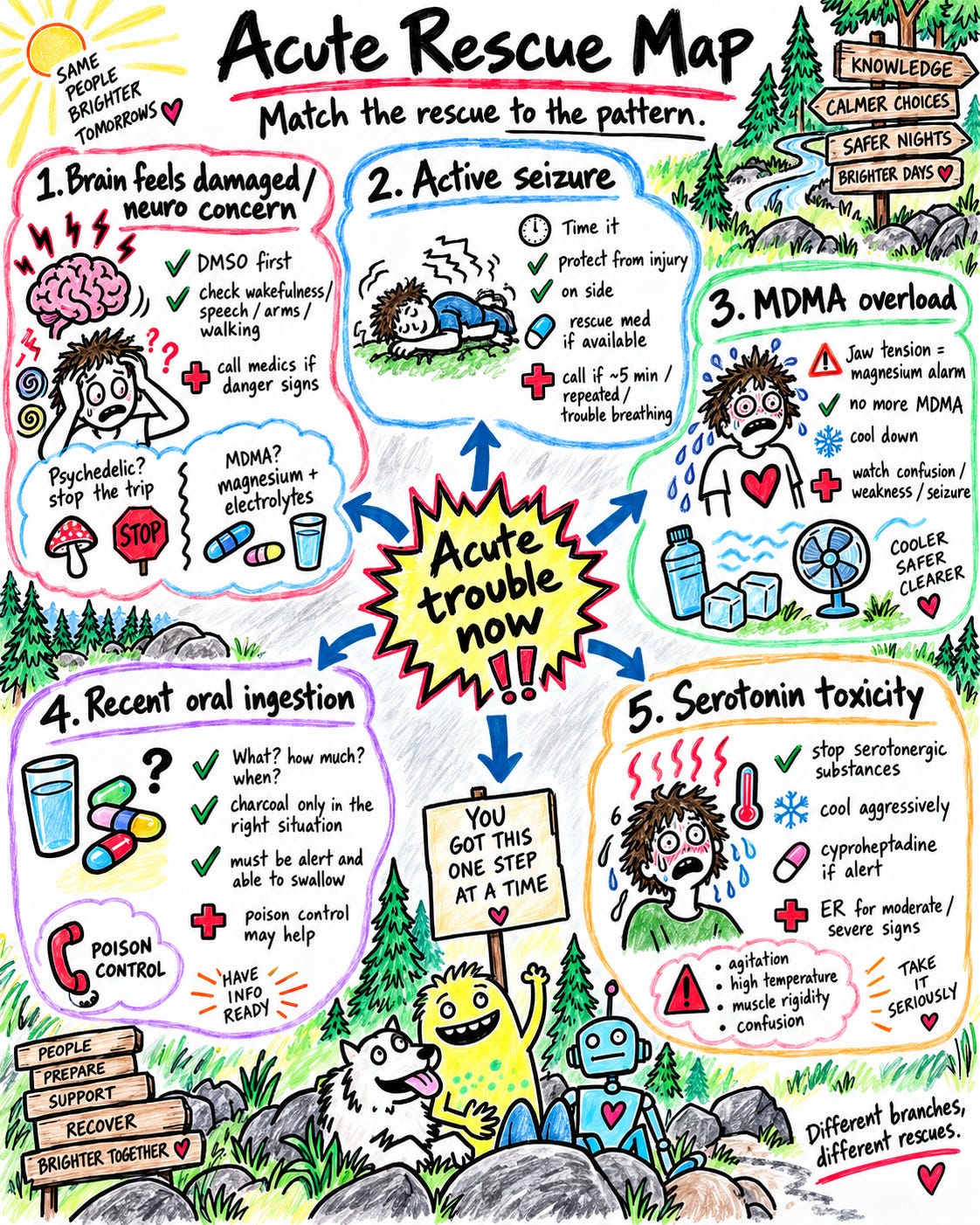
If Someone Says “My Brain Feels Damaged”: DMSO + Humic Acid First
Do not dismiss that report because the person is high or cannot explain it in clinical language. It may be anxiety or excessive psychedelic intensity. It may also be acute neurological dysfunction, and the person experiencing it may be the least able to describe it neatly. DMSO is my first immediate remedy while I ask what the symptoms actually are. I usually know within about a minute whether it is helping. Smelling humic acid or tasting a tiny bit can also help a lot, in my experience, but I’m still collecting data from others.
While using DMSO, check wakefulness, breathing, temperature, speech, facial symmetry, both arms, balance, walking, bodily control, seizure activity, severe headache, repeated vomiting, chest pain, and vision. A person who cannot answer or cooperate has not passed the screen; their neurological status is still unknown.
I believe DMSO works better for stroke and most acute brain damage than anything else readily available to ordinary people. That judgment is stronger than the clinical evidence, but the evidence is not empty: a preliminary human ischemic-stroke trial reported possible neurological benefit; a small human series used DMSO for intracranial hypertension; and animal stroke research found substantial infarct reduction even when treatment began after ischemia. DMSO also suppresses NMDA- and AMPA-mediated excitotoxicity.
For objective stroke-like signs, I would use DMSO immediately while someone calls medics. DMSO cannot identify whether the problem is a clot, a hemorrhage, low oxygen, an electrolyte crisis, or something else. The larger adjacent risk is losing a treatment window or missing a bleed because the symptoms improved enough to feel reassuring.
After DMSO, the second move depends on the drug. With a psychedelic, a serious brain-damage feeling changes the objective from calming the trip to stopping it: I would use Ipomoea pes-caprae as the next move. With MDMA, I would move instead to magnesium chloride and the broader electrolyte branch. I do not yet have evidence that pes-caprae aborts MDMA.
Active Seizure
Time the seizure. Protect the person from injury, clear dangerous objects, loosen tight clothing, and place them on their side when practical. Don’t restrain them and don’t put anything in their mouth while they are convulsing or not fully conscious.
If an appropriate rapid seizure-rescue benzodiazepine is available, use it by its intended route. Benzodiazepines are the established first-line drug class for status epilepticus. An ordinary pill is not the same thing as a nasal, buccal, rectal, intramuscular, or intravenous rescue preparation, and respiratory depressants in the mix change the risk.
I would also use topical magnesium chloride and consider topical DMSO with a known CBD preparation as adjuncts. CBD has established antiseizure activity in several epilepsy syndromes, and transdermal CBD reaches systemic circulation, although it has not been validated as rapid seizure rescue. DMSO reduced seizure activity in a rat temporal-lobe epilepsy model and has several neuroprotective mechanisms, but it produced the opposite effect at some doses in an absence-epilepsy model. I treat it as a plausible experimental adjunct rather than something to wait on while a seizure continues.
Call medics for a convulsive seizure lasting about five minutes, repeated seizures without normal recovery, trouble breathing, dangerous heat, serious injury, a first seizure, or a seizure substantially different from the person’s known pattern.
MDMA: Jaw Tension Is the Magnesium Alarm
With MDMA, I treat meaningful jaw tension as the earliest warning that the body needs more magnesium. This comes from repeated field experience rather than a direct clinical trial. Everyone I know who has taken enough magnesium chloride to make the jaw tension fully release has avoided the other complications I have seen when people let that tension continue.
A token dose may not be enough. On multiple occasions, I have dissolved Dead Sea magnesium chloride hexahydrate flakes in water and taken approximately one gram per minute orally for around twenty minutes before my jaw fully released. I have tolerated around twenty grams without diarrhea; for me, diarrhea has appeared only above roughly forty grams. Magnesium chloride is also generally less likely to cause diarrhea than several other replacement salts, including forms deliberately used as laxatives.
This was not one exceptional episode. I have repeatedly needed large amounts when taking MDMA. My practical endpoint is the jaw releasing, rather than taking one conventional supplement dose and assuming the problem has been handled.
Interestingly, magnesium taken before the MDMA peak also makes the peak less euphoric for me. That suggests it may both meet a rapidly increasing magnesium need and directly moderate part of MDMA’s excitatory effect. For harm reduction, slightly less euphoria is a reasonable price for a relaxed jaw and what appears in my experience to be a much lower risk of the state escalating.
My second wife had severe convulsions after an MDMA overdose. At the hospital, her potassium was found to be critically low—described to me as essentially zero—and IV potassium was the only treatment they gave her. That experience is why I treat serious MDMA toxicity as a broader electrolyte emergency, even though magnesium is the first and most useful early intervention when jaw tension appears.
Jaw tension should also mean no more MDMA, less exertion and heat, and closer monitoring. Worsening headache, confusion, vomiting, weakness, palpitations, collapse, or seizure raises concern about sodium, potassium, temperature, hydration, kidneys, and broader toxicity. MDMA is documented to cause acute kidney injury through several pathways, and controlled research confirms that hyponatremia can occur after a single dose.
People with impaired kidneys do need to be more cautious with large, rapid magnesium doses because they may not clear magnesium normally. But they should be far more worried about the MDMA. MDMA can cause overheating, rhabdomyolysis, dangerous electrolyte shifts, and acute kidney injury. Kidney impairment is a strong reason not to take MDMA—not a reason to sit there with worsening jaw tension after taking it. I would not tell somebody with serious kidney impairment to copy my one-gram-per-minute approach blindly; I would tell them to treat the situation as higher-risk and get help sooner.
Chest Pain and Injury
DMSO is also my first remedy for many injuries and some chest pain, with the decision about medics based on severity and the surrounding symptoms. After I overused erythritol, I developed angina that lasted for days. I took DMSO, the pain disappeared within about a minute, and it never returned.
The cardiovascular science is preclinical but relevant. In rats, DMSO pretreatment reduced myocardial infarct size by about three quarters and sharply reduced cardiac injury markers. Other work found inhibition of tissue factor, platelet activation, and arterial thrombus formation. Myocardial-ischemia study; tissue-factor and thrombosis study; human platelet study.
Mild, familiar, non-progressive discomfort in a fully alert person is different from new, severe, persistent, worsening, radiating, or exertional pain—or pain with breathlessness, sweating, faintness, neurological changes, or collapse. In the second branch, I would use DMSO while arranging medical evaluation. DMSO can also block pain signals, so pain relief alone does not prove that the underlying problem has ended.
Recent Oral Toxic Ingestion
“Overdose” is too vague to choose a remedy. Ask what was swallowed, how much, when, and what the body is actually doing: respiratory depression, stimulant toxicity, serotonin toxicity, seizure, dangerous overheating, cardiovascular symptoms, severe agitation, objective neurological dysfunction, vomiting, diarrhea, or something else.
Activated charcoal may help after some recent oral ingestions when the substance binds to it and the person is fully alert enough to swallow safely. It does not bind every toxin, can adsorb necessary medication, and creates aspiration risk in somebody who is vomiting, sedated, seizing, or unable to protect the airway. Clinical review.
Poison control may be useful when the substance, combination, delayed risk, or value of charcoal is unclear. I do not treat it as a mandatory ritual; usefulness varies by country and by whoever answers. It is decision support, not first aid.
Suspected Serotonin Syndrome (SS)
Serotonin syndrome overlaps with several symptoms above, but the rescue measures in the other branches do not necessarily treat it. It can follow serotonergic medication changes, combinations, or excessive exposure. Psychedelics, MDMA, DXM, many antidepressants, tramadol, linezolid, MAOIs, and some opioids can contribute, especially in combinations.
Recognizing serotonin toxicity
Clinicians often use the Hunter criteria. One or more of the following patterns makes serotonin toxicity more likely:
Spontaneous clonus: involuntary rhythmic muscle contractions and relaxations occurring without stimulation.
Inducible clonus plus agitation or sweating.
Ocular clonus plus agitation or sweating: rapid rhythmic involuntary eye movements.
Tremor plus hyperreflexia: shaking together with abnormally brisk reflexes.
Hypertonia plus fever: rigidity with temperature above 38°C (100.4°F), together with ocular or inducible clonus.
This is a recognition aid rather than a command to wait for every criterion before acting. Dangerous heat, rigidity, clonus, confusion, or rapid worsening deserves medical help.
Do this immediately when serotonin toxicity is reasonably suspected:
Stop all suspected serotonergic substances. No more SSRI, SNRI, MAOI, tramadol, MDMA, DXM cough syrup, 5-HTP, St John’s wort, SAM-e, linezolid, stimulant redoses, or harmala/ayahuasca-type MAOI exposure.
If the person is fully alert and able to swallow, I would give cyproheptadine early. It antagonizes serotonin receptors. Case reports describe rapid improvement, including complete resolution within two hours in a small series, while a recent systematic review found the evidence for major outcomes inconclusive. Case series; systematic review. I would not wait to see whether it works before cooling, stopping serotonergic substances, and arranging help for moderate or severe signs.
Call emergency help and arrange transport for moderate or severe signs. Don’t drive yourself. Poison control may help when the combination is unclear, but it is not the treatment.
Cool the person without delaying transport. Move to a cool room, remove excess clothing, use a fan and cool damp cloths, and place ice packs wrapped in cloth at the neck, armpits, or groin when the person is hot. Don’t put a confused, seizing, or very weak person in a bath. Fever reducers do not solve heat generated by extreme muscle activity.
Keep stimulation low and prevent exertion. No pacing to “burn it off,” exercise, crowds, or arguments. Akathisia can create a strong urge to move, but muscle activity can worsen heat and rhabdomyolysis risk.
Hydrate only when fully alert and not vomiting. Small sips of an appropriate oral rehydration drink are reasonable. Don’t force fluids, food, pills, or charcoal when someone is confused, vomiting, sleepy, or at seizure risk.
Gather the evidence for the ER. Bring pill bottles and packages. Write down exact substances, dose, timing, last dose, recent increases, supplements, recreational drugs, temperature, pulse, and blood pressure when available.
Hospitals may use benzodiazepines, external cooling, IV fluids, monitoring, and intensive supportive care. Niacin is unsafe for serotonin syndrome. DMSO is also not part of this branch. I would consider oral magnesium chloride when the person is fully alert, especially with MDMA-related jaw tension or muscle activity, but it does not replace treatment of dangerous heat, clonus, rigidity, or instability.
My Acute Rescue Hierarchy
This hierarchy is for acute situations, including emergencies—not merely uncomfortable trips. Some branches call for medics in parallel. Others describe severe but physiologically stable altered states where a fast field remedy may be more useful than waiting hours to be given a generic sedative.
Psychedelic culture often treats every crisis as emotional or spiritual. Sometimes the person is nauseated, overheated, sleep-deprived, poisoned, dealing with an electrolyte problem, reacting to a bad combination, or feeling mentally destroyed because the body is in trouble.
A trip with diarrhea, nausea, toxic heaviness, a dirty body-feeling, loss of bodily control, jaw tension, neurological disorganization, or the sense that the mind is going crazy because the gut or brain is going crazy belongs in a different branch from a mainly emotional crisis.
The hierarchy appears before the mystical sections because love doesn’t require us to ignore the body. Medical danger may need medical help while field rescue begins. A bad room gets fixed. A gut-driven mental hell is not automatically shadow work. A dose or combination problem does not need to become a spiritual curriculum.
The Core Order When the Brain Feels Damaged
DMSO immediately. Smell humic acid, take a 5mg lick of it. Smell the Metta NMT sniffer (described in loveyhuasca guide).
Ask what the symptoms actually are while the DMSO is being used. Do not manufacture reassurance from missing information.
If this is a psychedelic, use Ipomoea pes-caprae to stop the trip. At this point safety matters more than preserving the experience.
If this is MDMA, move to magnesium chloride and the broader electrolyte branch instead. I do not yet have data that pes-caprae aborts MDMA.
Bring in medical help in parallel for objective neurological signs, dangerous heat, prolonged or repeated seizure, breathing trouble, severe chest pain, collapse, or when basic stability cannot be established.
After medical danger, environment, dose, gut toxicity, electrolytes, and biochemical overload have been considered, we can return to the deeper question: is this sorrow, fear, shame, inner-child material, demons, jinn, shadow thoughts, or a mind learning to love what it previously exiled?
How I label the evidence
Established acute treatment: standard seizure first aid, rapid rescue benzodiazepines, cooling dangerous hyperthermia, and treating documented electrolyte abnormalities.
Limited human evidence: interventions with clinical reports or small trials but no strong modern outcome evidence.
Mechanism or preclinical evidence: biologically plausible effects shown mainly in cells or animals.
Personal field signal: what I have repeatedly observed in myself or other people. Repetition and a clear immediate endpoint make an anecdote more useful, but they do not turn it into a population rate.
I use the strongest applicable evidence without pretending every useful rescue has already received the trial it deserves.
Gut-Toxin and Parasite-Die-Off Tools
These are the first things I would use, even preventively on the come-up, because I want to address possible toxins before assigning the distress to something more mysterious.
Zeolite and Ferment in ZHoly3O
When the trip feels like sick stomach, nausea, diarrhea, toxic heaviness, a dirty body-feeling, parasite die-off, or mental hell driven by gut hell, zeolite and the ZHoly3O ferment are often my first thoughts.
Many ferments help to different degrees, including kombucha, kimchi, and apple vinegar. I prefer fermented beet juice made with apple vinegar and salt. Smelling the ferment helps a lot. Drinking a spoonful can also help, although it may cause itching in somebody low in histamine-processing bacteria, which then requires activated charcoal to reduce gut histamine.
In my experiments, zeolite has to be prepared correctly. I use powdered zeolite rather than nano-liquid zeolite. Many products did nothing for me, and quality mattered enormously. Most zeolites have clogged pores because they haven’t been cleaned.
For my ozonated zeolite, I mix the powder into water and use an ozone-water purifier in a glass vessel because ozone destroys plastic. I mean ozonating water, never inhaling ozone gas. With a machine producing about two grams of ozone per hour, ten minutes produced a working zeolite for me. Less time did not work as well, and more time did not noticeably improve it.
I also keep zeolite away from metal during preparation. Zeolite adsorbs metals, which is part of why it is used for heavy-metal removal, and I don’t want it sitting against a metal vessel or utensil before ingestion. I use glass for ozonation and storage whenever possible.
Most sober people don’t feel much from zeolite. Its effect becomes more obvious when a trip has a toxic or gut-driven component. I put a spoonful into water—some people need a teaspoon, others a tablespoon—and sip slowly. Rubbing it on the body or simply holding the jar also helps me.
Actual Activated Charcoal
Activated charcoal can help gut toxicity, but it adsorbs drugs. Sometimes that is exactly the point. It can also flatten or reduce a trip, so I don’t treat charcoal and zeolite as interchangeable.
When the goal is to reduce drug absorption or stop a toxic gut situation, charcoal may be relevant. When I want to preserve the trip while improving the gut feeling, I prefer zeolite.
Charcoal can also adsorb medications somebody depends on. I would use it cautiously around necessary medicines and tell the medics if charcoal was taken.
Nausea Smoothers When the Person Wants to Preserve the Trip
When ozonated zeolite and ferment don’t help, I consider nausea caused by an excessive psychedelic dose acting on serotonin receptors in the gut. The tools in this section are for somebody who still wants the trip to continue.
Coffee Cherry for Nausea and Brain Recharge
Eating a couple of coffee cherries helps my nausea. It can make a trip blissful and sleepy for a few hours, followed later by intense mental clarity and physical energy—almost like a perfected amphetamine. It may also extend the trip. That can be useful and healthy when planned, but I wouldn’t reach for it first when somebody is already becoming manic.
When the Goal Is to Stop a Psychedelic Trip
Beach Morning Glory — Ipomoea pes-caprae
By beach morning glory I mean Ipomoea pes-caprae, rather than morning-glory plants in general. The distinction matters. I have tried many related plants and cousins, and they did not work the same way. As far as I know, nobody else sells it.
Its primary role in this guide is not ordinary nausea control. In my experience, Ipomoea pes-caprae is the ultimate sledgehammer for stopping a psychedelic trip cold and fast.
A tiny nibble can sometimes smooth psychedelic nausea and improve the trip without killing it, but the difference between that amount and a trip-aborting amount is narrow. I use it for nausea only when the person is comfortable with the possibility that the trip may end.
Even picking a leaf can affect me when the broken juicy part touches sensitive skin, especially under the fingernails. Avoiding contact with the broken portion prevents that effect.
A whole leaf can easily end the trip and, in my experience, may prevent tripping for days afterward.
This was not only personal. I once gave beach morning glory to a woman experiencing nausea and dysphoria during a psychedelic state. I was rushing to help and may have given more than I would now. Within a couple of minutes she shifted from miserable to very happy. That helped convince me the effect wasn’t limited to my body.
When somebody says their brain feels damaged, I am not interested in merely calming the experience anymore. I use DMSO first, then pes-caprae to terminate the psychedelic state.
I do not yet have data showing that pes-caprae aborts MDMA. MDMA remains a separate branch centered on magnesium, temperature, sodium, potassium, hydration, serotonin toxicity, seizure, and cardiovascular symptoms.
Mental Stabilizers That Don’t Abort the Trip
Metta NMT Sniffer Makes the Trip Chill & Lovey!
As explained in my loveyhuasca guide, this little sniffer stick that you smell gives people 30-60 minutes (or more) of peace even when they are sober and just anxious. People tell me it’s saved their life from crippling anxiety. I have a survey here they can post at. But when I’m on ayahauasca or loveyhuasca, not only is it calming and nice, but actually opens my heart chakra considerably. Before this, loveyhuasca was kind of hit or miss for me on the love part. It turns regular ayahuasca into loveyhuasca even. You can get these directly from me. It’s a bunch of stuff in the formula, but one of the things in here you can buy directly on Amazon for super cheap right now and it works also very well:
Humic Acid Brings Brain to Optimal Function
As mentioned in my humic acid note, I’ve found if I take too much ayahuasca or loveyhuasca and I feel “out of it” and bad, simply smelling the humic acid powder fixes it pretty much instantly, even when many other remedies don’t work so well. Licking a tiny bit like 5mg does even more, sending my brain into hyperfunctionality.
Ocean Water to calm & protect the energetic field
Ocean water is one of the simplest and strangest stabilizers I have found. I noticed it in Kenya and Florida. Rain water also works for me, but I’ve only tested it near the ocean. You can also buy Quinton Medical Seawater, which has a number of health benefits when used as a nasal spray or as a source of minerals.
When a trip is too strong, touching ocean water can be extremely soothing. Touching the outside of a bottle doesn’t do it. Direct contact with the water seems to matter, even when the water has been stored in a bottle.
It has a grounding, cooling, organizing effect different from DMSO, aged ozonated-charcoal water, zeolite, or beach morning glory. I don’t understand the mechanism. I only know that it has repeatedly felt like a powerful natural remedy for excessive psychedelic intensity.
Shungite, Aged Ozonated-Charcoal Water, or Boiled Charcoal Water
These work similarly to ocean water. Aged ozonated-charcoal water is different from zeolite and from swallowing charcoal.
Ingesting the charcoal itself can improve toxic gut feelings while also adsorbing the drugs and reducing the trip. I generally avoid the charcoal itself unless losing part of the trip is acceptable.
What I usually use is the water portion: water ozonated in contact with activated charcoal and allowed to sit after the charcoal falls to the bottom, or water ozonated with ordinary rock charcoal. I am never recommending ozone inhalation. I mean the water after active ozonation has ended and residual ozone has dissipated.
That water doesn’t fix the gut the way zeolite does. Zeolite is what helps me when mental distress seems driven by gut toxicity, parasite die-off, nausea, diarrhea, or the sick-stomach feeling.
Aged ozonated-charcoal water acts more on the crazy or excessively intense mental feeling: too much psychedelic energy, the wrong environment, anxiety, high EMF, or a generally overloaded mind. It can shift “too much” into calm release without necessarily aborting the trip.
Zeolite usually feels subtle to sober people. Aged ozonated-charcoal water does not. Most people I have given it to find it relaxing even while sober, whether they smell it, touch it, or drink the water portion.
I have even watched the water calm a crying baby through touch alone. No ozone gas was present; this was contact with the water after ozonation had ended and the residual ozone had dissipated. I include that because it suggested the relaxing effect was not only adult expectation or psychedelic context.
Earlier in my experiments, I made the mistake of directly smelling ozone gas during a psychedelic state. It intensified the experience and became mentally alarming. DMSO didn’t help that situation, while aged ozonated-charcoal water helped rapidly. I don’t recommend inhaling ozone. The mistake showed me that DMSO and aged ozonated-charcoal water address different kinds of overload.
Without an ozone-water purifier—which can cost around $20 on Amazon—boiling water with charcoal gives some of the benefit. Touching or holding shungite can also feel similar to holding cleaned zeolite. Shungite pendants are sold on Amazon. Shungite should not be drunk unless it has been properly washed of heavy metals.
DMSO
DMSO is another stabilizer I use when a trip becomes too intense and I don’t want to abort it. It is also my primary emergency neuroprotectant when the problem feels like acute neurological damage, altered consciousness, loss of bodily control, or severe drug-related brain dysfunction.
It overlaps with aged ozonated-charcoal water, but the two don’t always work equally. Sometimes DMSO works better; sometimes the water does. I don’t yet know why. In my experience there is generally no harm in taking both or mixing them. Ozonated-charcoal water has what I consider a perfect safety profile; DMSO is a close second in my experience.
Side effects:
Astringency: 100% DMSO usually irritates skin on the upper half of the body. When it itches, dilute it with water or real aloe juice without added chemicals. Leaving 100% DMSO on the skin can crenate it, and the skin may take a week to look plump again. DMSO can also burn dry mouth tissue, so the mouth should be moist first.
Nausea: when drinking DMSO, dilute it in water, juice, or milk and sip gradually. Sensitivity varies.
Reduced sleep: DMSO reduces how long I sleep when I take too much, take it too late, or use it over too many consecutive days. It builds up past a threshold that seems to differ between people. This is proven in rats. Some people sleep better with DMSO because it reduces whatever symptom had been keeping them awake.
Body odor: above a certain dose you may smell like sulfur. I don’t smell when I put it into milk.
Interactions:
Don’t put it on dirty skin; it can carry chemicals inward.
Don’t nebulize too much DMSO when your lungs are full of smoking-related tar, because it can carry those substances into the blood too quickly. Weakness is an early symptom.
Don’t take it with drugs that should not absorb rapidly, including corticosteroids, NSAIDs, and harmalas.
Don’t combine it with cholinergic drugs because DMSO is also cholinergic, although I haven’t found anecdotes of this causing a real problem. Supplement extra choline because DMSO depletes it.
Don’t combine it with blood-thinning medication because DMSO also thins the blood.
Contraindications:
DMSO has produced both anticonvulsant and proconvulsant effects depending on dose and seizure model. I consider it a plausible adjunct for excitotoxic or temporal-lobe-type seizure activity, not a proven universal seizure rescue.
It may worsen a cluster headache, even though rubbing DMSO—especially with magnesium chloride—on the head can alleviate tension headaches.
It may release histamine in some people. Use caution with MCAS.
A Final Trip Killer
Niacin (a Form of Vitamin B3)
Flushing niacin has effectively aborted trips for me and friends, although I dislike it compared with beach morning glory.
I include it because most people don’t have access to Ipomoea pes-caprae, although I supply it. A vitamin is not automatically harmless. Niacin has been used for decades by orthomolecular doctors for psychotic conditions and seems to act both like a natural benzodiazepine and an antipsychotic. The clinical literature is discussed in Niacin: The Real Story by Abram Hoffer, M.D.
Side effects:
Niacin flush: itchy sunburn-like heat. This is normal, although some people find it intolerable and others enjoy it.
Heartburn in sensitive stomachs or after too much at once.
Drowsiness, usually with terrible sleep quality.
Higher or repeated doses can create real risk, especially with liver problems, alcohol, medications, or sensitive physiology.
Other forms of vitamin B3 seem less reliable for relaxation. Niacinamide sometimes relaxes people and sometimes creates hyperfocus, depending on their state. Avoid sustained-release niacin and the useless non-flush hexanicotinate form.
Some Remedies Require More Caution
Useful substances can still be poor rescue tools when somebody is already destabilized.
Humic acid when eaten, can produce a hyperintelligent state for me. From the outside that may look manic, and it could destabilize somebody prone to mania or without meditation training. I wouldn’t use it casually during a bad trip. Smelling it does not produce that hyper intelligent state but does feel relaxing and very beneficial for brain health, so I’d start with that.
Cinnamon can produce an intense “brain surgery” or “brain scraping” effect, especially the first time it combines with an ayahuasca-like state. That may be therapeutic in the right context, but it is not a casual rescue tool.
I would also be extremely careful with Acacia confusa eaten with Mimosa hostilis. For me, that combination produced hellishly intense psychosis-like and autism-like states before transforming into a week of extraordinary creativity and joy. The later benefit did not make the crisis recommendable.
Iboga—especially male iboga—potentiates many drugs and can be dangerous. A low amount combined well for me; doubling it became dangerously intense. I include that only as a warning.
That finishes the rescue-chemistry side of the guide. Once the body is stable and those tools have done what they can, fear, grief, memory, certainty, and whatever else the altered mind has opened still need somebody to sit with them.
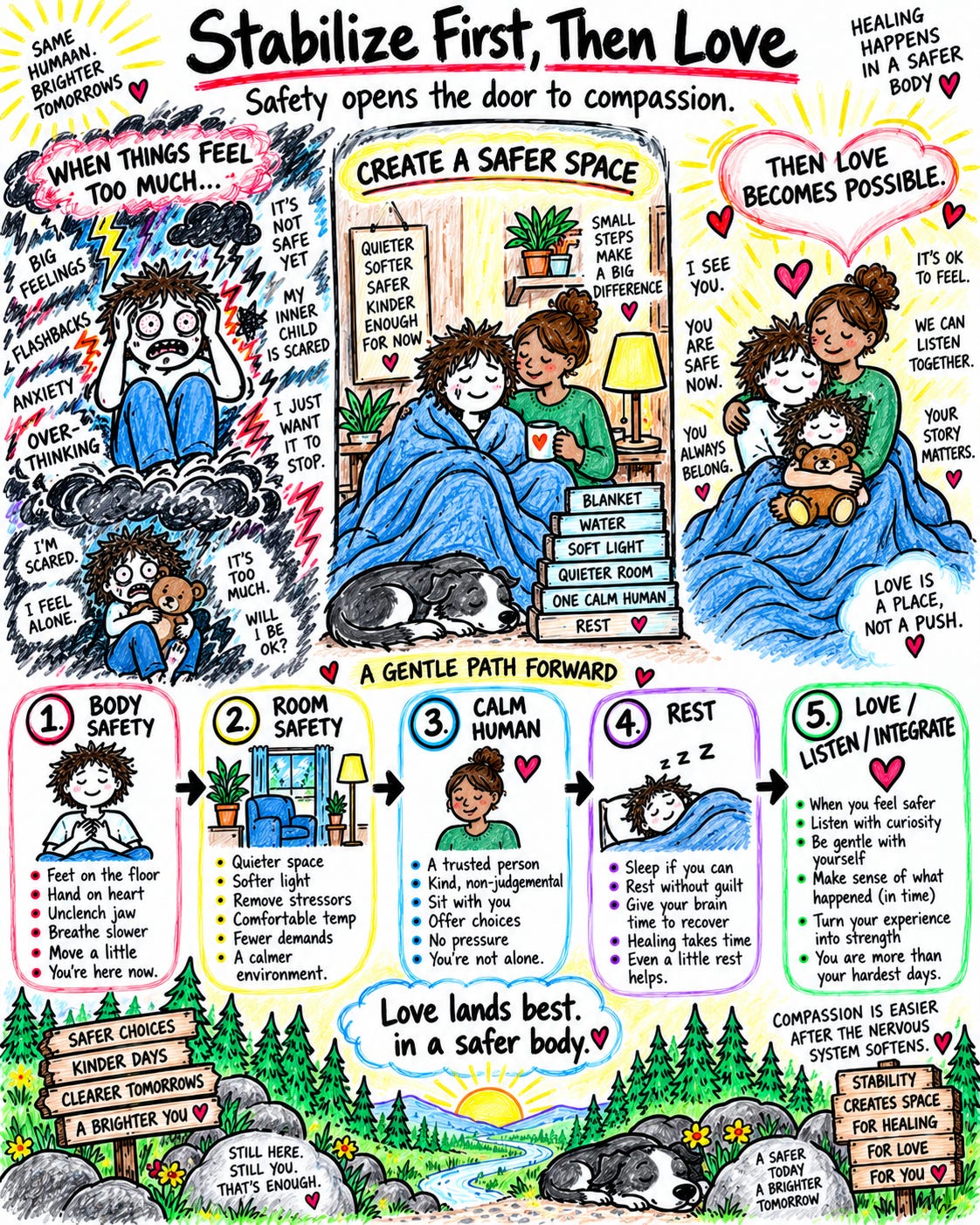
Shadow Work and Tripsitting Yourself or Others

(I don’t endorse MAPS as an organization, but this is a good introductory video.)
Hello, Lovey Bunny! I hope you are presently well, and if not, I pray that you feel well soon!
This post collects my own experience and thinking, but I would be remiss not to point you toward the Challenging Psychedelic Experiences Project, which helps people understand the full risks and recover when they “gamble and lose” with psychedelics.
Psychological First Aid: The First Five Minutes
The checklist above gives the order. This section is about carrying it out without becoming one more source of pressure.
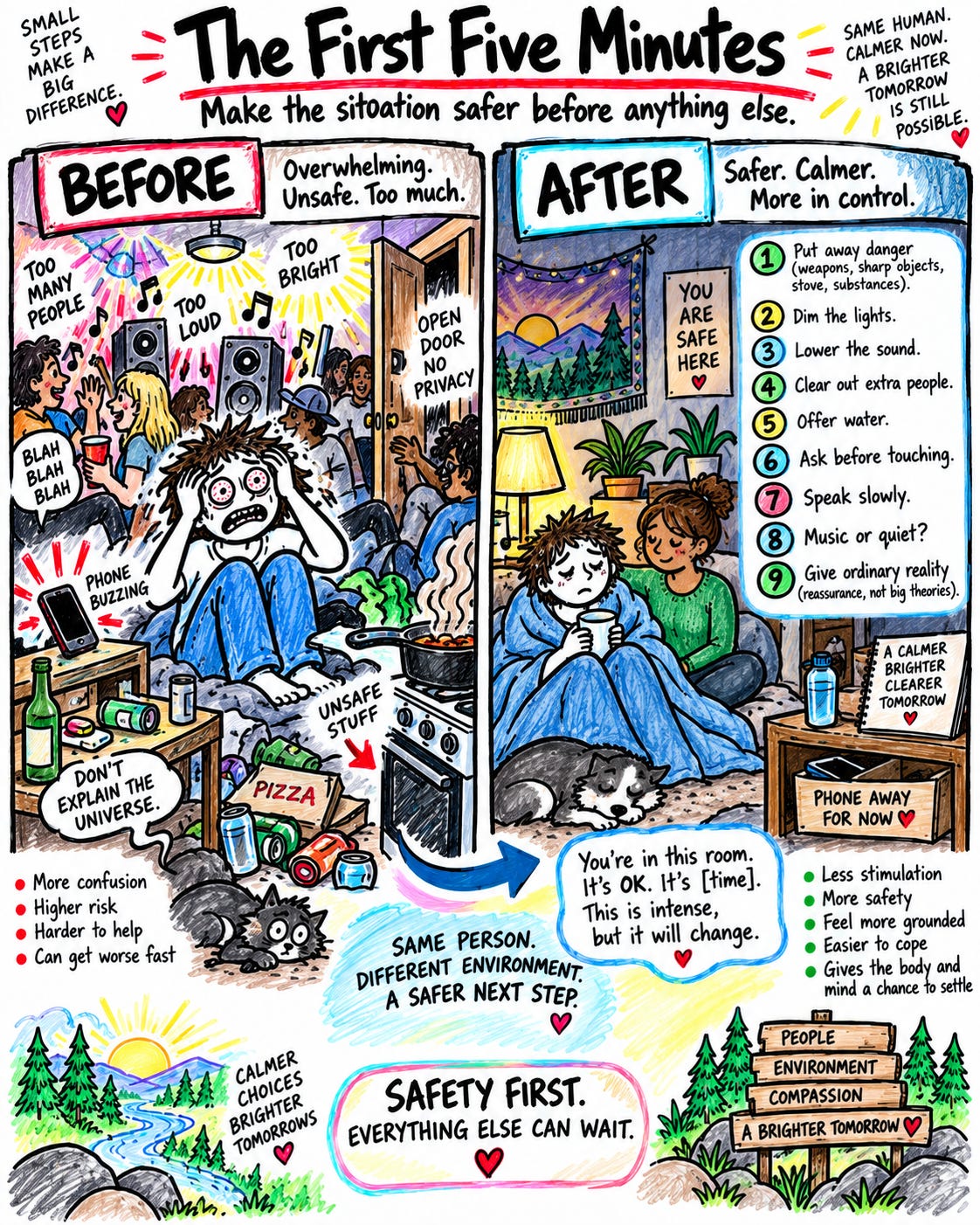
Begin with whatever could hurt somebody in the next five minutes. Put away the car keys. Turn off the stove. Move away from roads, balconies, water, weapons, crowds, and strangers. Take the phone when somebody is preparing to publish the complete revelation of the universe or message an ex.
Movement is allowed. Unsafe movement is not. No driving, redosing, confrontations, or leaving alone.
Then look at the room. Is the light too bright? Is the music horrible? Are five concerned people talking at once? Is somebody touching the person when touch is unwelcome? Are they too hot, too cold, desperate for the bathroom, or trapped beside somebody they don’t trust?
A huge amount of what gets called profound psychedelic crisis is a frightened nervous system stuck in an annoying room.
Dim the lights. Lower the sound. Clear out the extra people. Offer water without forcing it. Sip rather than chug. Ask before touching. Speak slowly and use fewer words. Please don’t explain the universe at somebody who is already frightened by it.
Music is optional. Ask “music or quiet?” and keep the person able to stop or change it immediately. If a track starts pulling the experience somewhere unwanted, change it. This is a bad time to defend the playlist.
Give them ordinary reality:
You’re in [place]. It’s [date/time]. You took [substance, if known]. These effects rise, peak, and change. This is intense, but it will change. We don’t need to solve your life tonight.
When the state came from meditation, breathwork, fasting, kundalini-style practice, extreme stretching, ritual, or a retreat, say:
I am in an intense state. I am stopping the practice now. My job is ordinary safety.
From there, choose one safe body experiment and one calm human. The next two sections explain those choices. Protect sleep, especially when the person is euphoric or grandiose, and let meaning wait until the nervous system has somewhere to stand.
A non-drug altered state may have a less predictable clock than a substance. The practical move remains simple: stop the practice, eat something ordinary when safe, let the body settle, keep warm, and sleep. An open portal does not obligate you to keep pushing through it.
Stillness or Movement?
Test them rather than turning them into rival religions. Try one for two minutes and ask: Does this make me safer and clearer, or more activated and impulsive?
When lying down feels like imprisonment, pace slowly in a contained space. When pacing begins to resemble escape, sit against a wall or lie under a blanket. The goal is to let the nervous system discharge without creating a new danger.
Parallel processing can help when lying still turns into immobile introspection. Let one part of attention stay with the body, fear, grief, or memory while another part completes a simple, safe task with a visible endpoint: sort ten objects, draw, fold five towels, or wash one cup. Finishing something small helps confirm that time is moving and ordinary reality is still here. Stop if the task increases agitation, speed, or risk.
A useful order is body → room → human → time → meaning. Most people begin with meaning because the experience feels cosmic. When the nervous system is on fire, love becomes practical first.
Get One Human Anchor
Many bad trips get worse because somebody is alone with a frightened or over-certain mind. Others get worse because too many people crowd in and start advising, arguing, spiritualizing, or panicking.
Use one calm human anchor as the lead. When safety, fatigue, logistics, violence, or self-harm risk exceeds what one person can hold, bring in one additional calm adult or crisis professional. That is backup. A committee of frantic people rarely improves anyone’s nervous system.
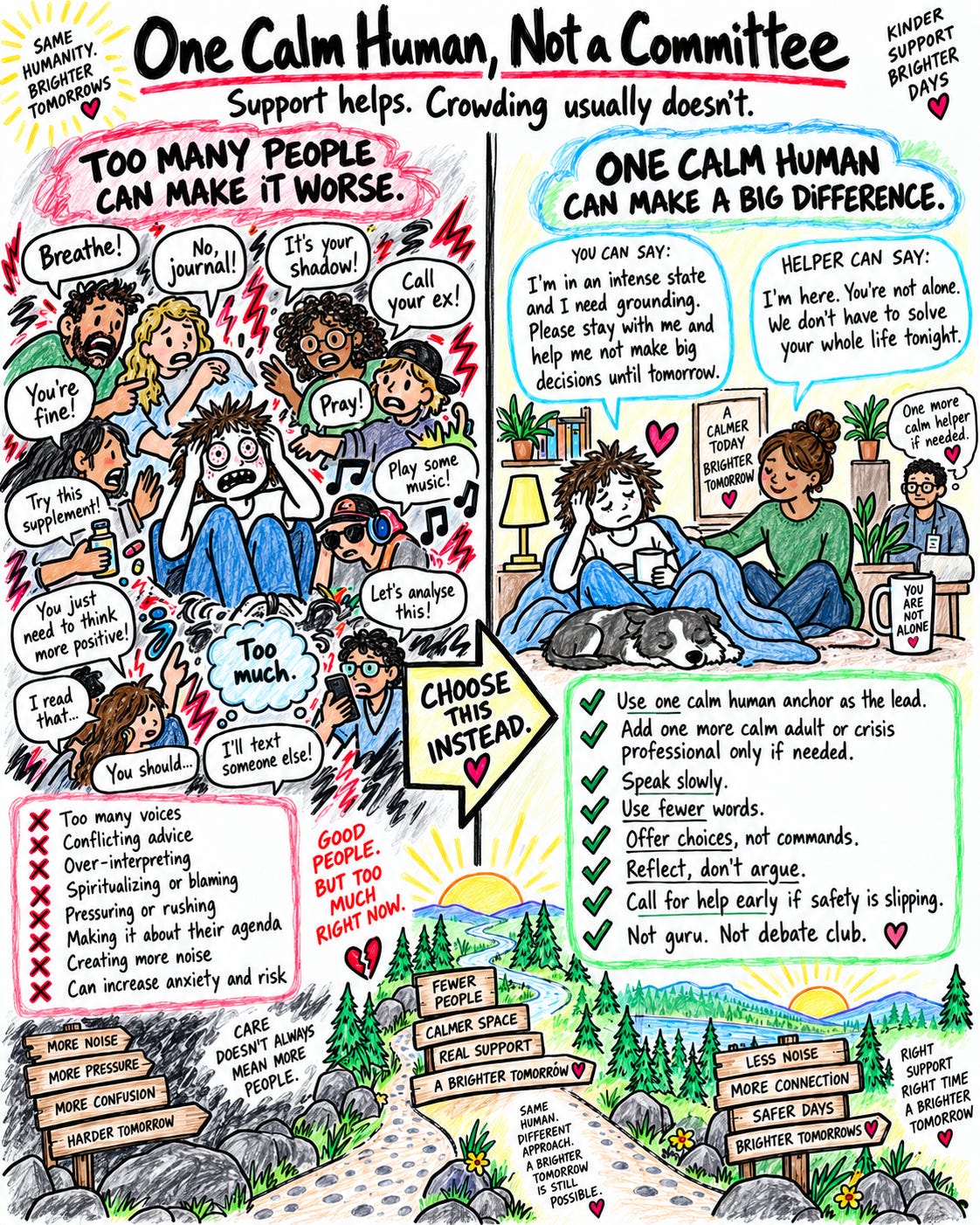
Script for the person in the altered state:
I’m in an intense psychedelic or altered state and I need grounding. I don’t need you to solve my life. Please stay with me, speak slowly, remind me where I am, and help me not make any big decisions until tomorrow.
Script for the sitter or friend:
I’m here. You’re not alone. This is a wave. We don’t have to solve your whole life right now. Let’s make your body safe, keep things simple, and stay together.
Who to Contact, and When
Save the relevant links and local numbers before you need them. Hours and services change, and not every option works in every country. Psychedelic peer support does not replace emergency, medical, psychiatric, or suicide-crisis care.
During or soon after a psychedelic experience
Fireside Project: U.S.-only according to its current FAQ; phone or text psychedelic peer support at 623-473-7433, daily from 11 a.m. to 11 p.m. Pacific Time. Non-clinical and non-emergency.
TripSit live chat: browser-based harm-reduction chat for people using drugs and the people supporting them. Peer support, rather than clinical or emergency care.
Global crisis and emotional-support directories
Find A Helpline: a global directory of free helplines, many offering phone, text, online chat, or WhatsApp. It is not psychedelic-specific, but it can put a human on the other end quickly.
U.S. crisis chat and text
988 Suicide & Crisis Lifeline: U.S. call, text, and chat for suicidal or mental-health crises.
Crisis Text Line: U.S. text, chat, and WhatsApp support, with partner text lines listed for Canada, the UK, and Ireland.
Integration and post-experience support
ICEERS Support Center: up to five free online integration sessions for challenging experiences. Risk-reduction support, rather than a substitute for medical or psychiatric treatment.
CPEP online peer group: a free confidential monthly group for post-psychedelic difficulties. It is neither therapy nor immediate crisis care.
Cheetah House: resources, consultations, and support groups for meditation-related difficulties, including chat-based peer support.
Alone at 3 a.m.
The quick checklist above contains the stripped-down 3 a.m. plan. Once the lamp is on, the keys are away, and “No actions until morning” is visible, use the phone only to reach a calm person or support service.
Send the human-anchor script. When nobody is available, use Fireside during its coverage hours, TripSit for drug-related peer support, or Find A Helpline and a local crisis service for fear, despair, self-harm, or inability to stay safe.
When the body still needs movement, keep it contained and boring: pace the same hallway, fold towels, wash a cup, brush your teeth, stretch gently, take a calm shower, or do a few slow wall push-ups. When movement makes you more frantic, sit with both feet against the floor or lie under a blanket. Then protect sleep.
When Peer Support Isn’t Enough
Get urgent help when somebody may harm themselves or another person, cannot be kept physically safe, is moving toward roads, water, or heights, has command voices or fixed terrifying beliefs driving action, becomes violent, is severely confused and unreachable, has dangerous physical symptoms, has lost enough sleep that judgment is collapsing, or exceeds what the sitter can safely contain.
“I might kill someone to test this theory” is a safety signal, rather than merely philosophical content.
Use local emergency services for immediate danger or a medical emergency. In the United States, 988 can provide mental-health crisis guidance, de-escalation, and connection to local resources when no immediate physical emergency exists. Call 911 for immediate danger, a crime in progress, medical emergency, weapon, violence underway, or a situation you cannot safely contain. Outside the United States, identify the local emergency number and crisis line before you ever need them.
For the Person Helping: Calm Anchor, Not Guru
A good sitter is not there to win a philosophy debate, perform a rescue fantasy, impose an interpretation, or demonstrate spiritual advancement. Zendo-style harm reduction can be summarized as creating a safe space, sitting rather than guiding, talking through rather than down, and remembering that difficult does not automatically mean bad.
Do
Speak slowly and use fewer words.
Ask simple questions: “Would less light help?” “Music or quiet?” “Closer or farther away?” “Water?”
Reflect without arguing: “That sounds terrifying.” “I’m with you.” “Let’s breathe together.”
Offer choices instead of commands.
Keep the room quiet, private, warm, and physically safe.
Call for help early when safety is slipping.
Translate metaphysics into shared safety values: “This feels sacred and huge. Sacred power protects life tonight.”
Set behavioral boundaries without humiliation: “I won’t help anybody hurt themselves or another person. We are keeping every body safe.”
Don’t
Don’t try to win an argument with visions, entities, memories, or cosmic conclusions. Don’t validate harmful conclusions. Reflect the feeling and redirect toward safety, non-harm, sleep, and ordinary reality.
Don’t tell somebody they are crazy, broken, weak, punished, or failing the medicine.
Don’t crowd them with five worried friends.
Don’t force eye contact, touch, music, prayer, chanting, interpretation, or insight.
Don’t teach nondual demonology to somebody who needs the lights down and a doctor.
When the Content Turns Toward Harm
When somebody says, “I am God, so I can kill,” leading with “No you’re not” or “That’s delusional” can turn the encounter into a status fight. Nodding along as though harm is spiritually neutral is also unacceptable. Treat the statement as a safety signal and build a bridge back toward non-harm.
Non-combative philosophical grounding:
I hear how vast and certain this feels. Many traditions say God is in everyone. That makes every body sacred, not disposable. Peace is the godly move tonight. No proof is needed. We protect life and sleep first.
Other useful lines: “Maybe you are touching something divine. Divine doesn’t need a violent test.” “If it’s true, it survives breakfast.” “Tonight the commandment is no harm, no proof, no mission, sleep first.”
Don’t debate to win. Don’t validate violence. Redirect within the person’s value-world toward peace and protection, increase containment, and bring in crisis support as early and as non-coercively as the situation allows.
When talk of harm continues, shift from philosophy to safety. Create distance from potential targets and keep your own exit. Don’t block, crowd, threaten, mock, or physically wrestle away a weapon. Quietly remove means only when that can be done without confrontation or turning yourself into the target.
When you are the only helper and safety is slipping, recruit one additional calm adult or crisis professional. Call crisis or emergency services for a specific target, available means, movement toward action, escalating agitation, a weapon, violence underway, or a situation you can’t contain.
Be brief and specific with emergency services: “Someone is in an altered-state or mental-health crisis, has threatened to harm others, may have access to [means if known], and needs a medical or mental-health crisis response with de-escalation support. Please send crisis-trained responders or EMS if available.”
Grounding Menu: Choose One or Two Things
Grounding is love becoming practical. Choose one or two options rather than all of them. Twelve simultaneous techniques can become another form of panic.
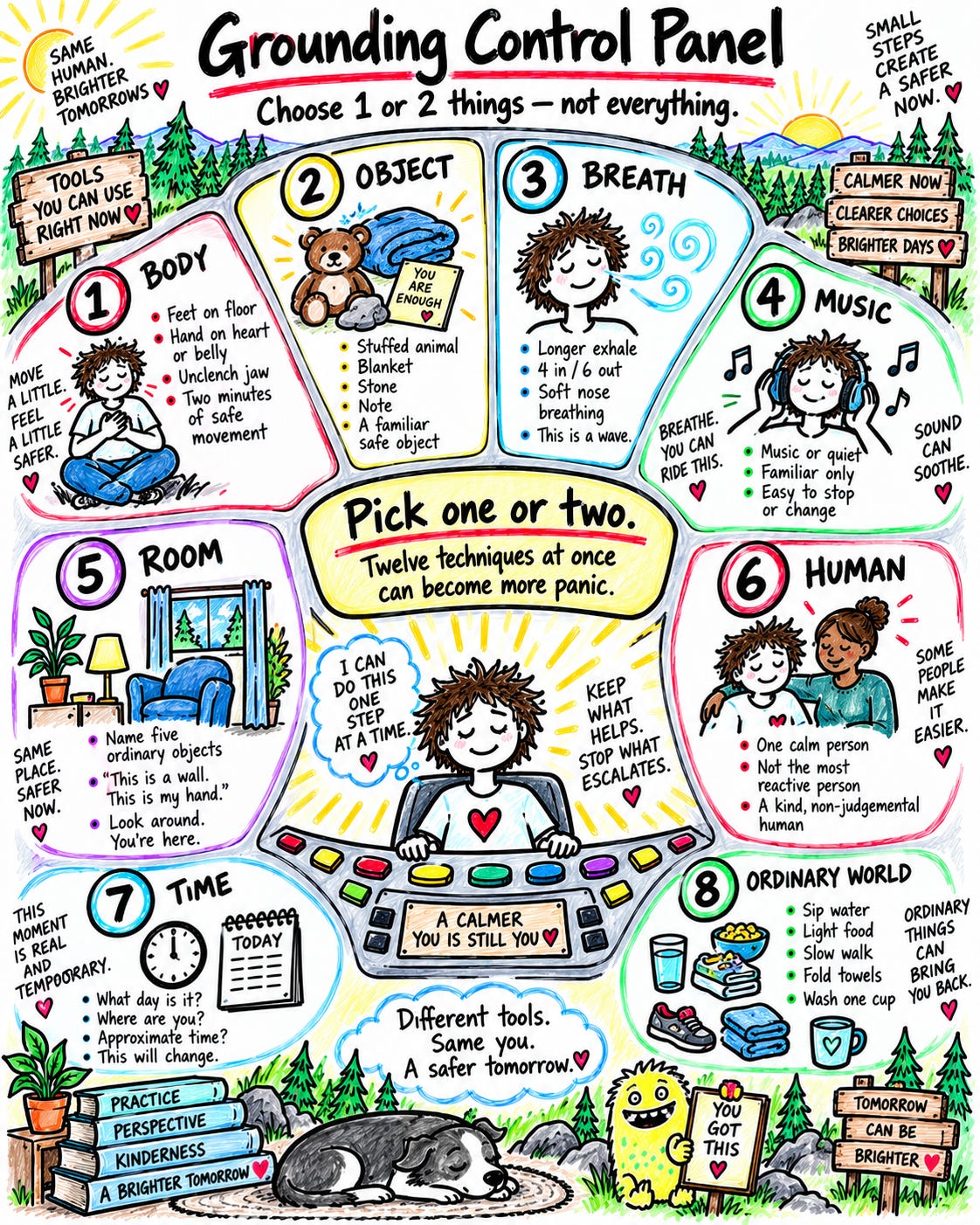
Body
Feel both feet against the floor.
Put one hand on the heart and one on the belly or solar plexus.
Hold something with weight or texture, or sit near a calm pet when that feels safe.
Slowly unclench the jaw, hands, belly, and shoulders.
Try two minutes of safe movement: slow pacing, gentle stretching, shaking out the arms and legs, wall push-ups, or a boring household task.
Then ask whether movement made you clearer or more impulsive. Keep what helps and stop what escalates.
A familiar object
Choose it while sober and regulated: a childhood toy, stuffed animal, note, photograph, blanket, stone, or another object that represents your inner Nurturer or Protector—the adult part of you that offers care or safety.
During a difficult state, let it remind you what you already decided: “I’m here. I protect this body. No big decisions tonight.”
Use it as a cue, not an oracle. It does not issue commands or interpret the trip.
Pair the comfort with one adult action: contact the grounded person, move away from danger, drink some water when safe, or prepare for sleep.
A calm pet can offer the same quiet company when the animal is comfortable and the situation is safe.
Breath
Exhale longer than you inhale for ten breaths.
Try inhaling for four and exhaling for six, without strain.
Or breathe softly and slowly through the nose, taking in slightly less air than desired until there is faint air hunger.
Never force breath-holds while intoxicated or panicked. Stop for increased fear, dizziness, chest pain, or medical concern.
Whisper: “This is a wave.”
Music
Silence is a real option.
Use familiar music when possible. I wouldn’t force a predesigned emotional arc or an unfamiliar therapeutic playlist on somebody who dislikes it.
Try a steady drum rhythm for stabilization or grounding; try airy harp-like or meditative music when the person wants something gentler and spiritually uplifting.
Keep the stop or change control immediate. Music should remain an option, rather than become another authority in the room.
Room
Name five ordinary objects.
Look at one stable object and describe it plainly.
Say: “This is a wall. This is a blanket. This is my hand.”
Human
Ask one calm person to stay as the lead anchor.
Let them remind you where you are.
When safety is slipping, let that person bring in one additional calm adult or crisis professional.
Don’t process with the most reactive person in your life.
Time
Say the date, place, and approximate time.
Remember that substance effects usually rise, peak, and change.
For practice-induced states: “I stopped the practice. Food, ordinary contact, and sleep help the system come down.”
Put every big decision into tomorrow’s notebook.
Ordinary world
Eat simple healthy food, such as fruit, when you can.
Do one ordinary task you can clearly finish when the body wants movement.
Pace along a clear contained path when pacing helps.
Walk slowly with a sober person in a safe environment.
Go outside only away from roads, heights, crowds, and water.
Avoid strenuous exercise with overheating, chest pain, faintness, severe confusion, stimulant use, an unknown mixture, or any medical concern.
Movement evidence note: the best-supported general advice is to create a safe, low-stimulation environment and choose responses that reduce danger. A 2024 study of strategies for resolving challenging psychedelic experiences identified physical movement, intentional breathing, sensory engagement, sleep-seeking, and social support among the ways people navigate difficulty. Movement is a tool to test, rather than a rule to obey.
Buteyko evidence note: published evidence for Buteyko-style breathing mainly concerns asthma and breathing retraining, rather than psychedelic or spiritual-practice crisis. I include it because panic-related over-breathing can lower CO2 and directly cause tingling, lightheadedness, confusion, and unreality feelings (Hopkins Medicine). Use the simpler longer-exhale option first. Never strain or turn breathing into another achievement.
No Rash Actions: Visions Are Not Commands
An intense altered state can make everything feel final, cosmic, and urgent. Urgency does not make action safe.
Use a 24–72 hour action lock.
Until you have slept and eaten, don’t drive, travel, break up, quit your job, confess everything, confront anybody, accuse anybody, send the message, post the revelation, give away possessions, call your ex, call your parents to explain the universe, or decide that you are permanently enlightened or permanently damaged.
Write it down. Protect sleep. Revisit it sober with one grounded person.
Treat trip content first as experience-content, rather than fact-content. “I saw it” does not create a duty to act. “It felt cosmic” does not make obedience wise. No entity, deity, demon, ancestor, angel, algorithm, mission, kundalini surge, or insight overrides basic safety.
No revelation makes murder, assault, coercion, sexual boundary-crossing, reckless driving, or self-harm safe tonight. Anything requiring violated consent or harm belongs in the notebook until sober review.
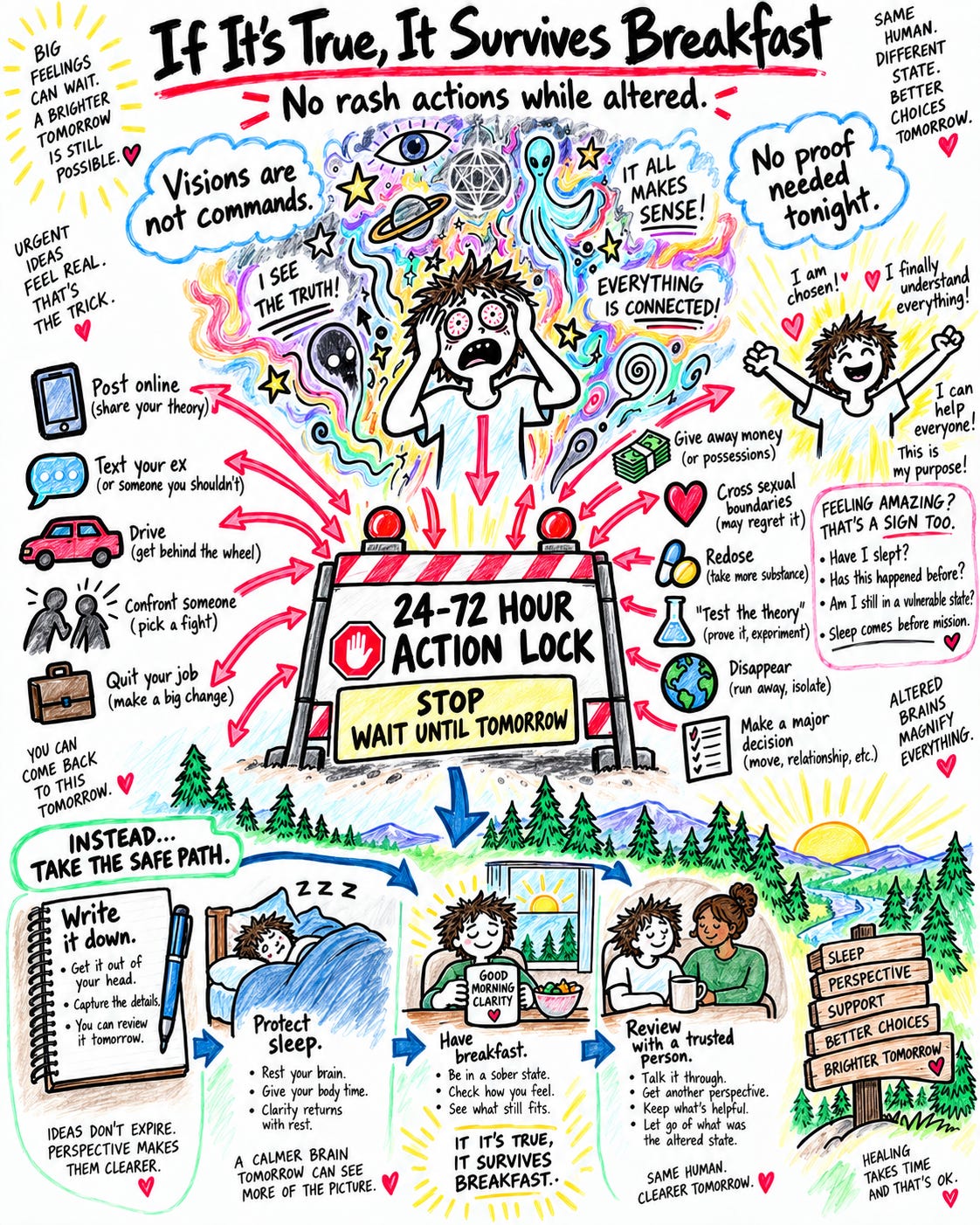
When the Trip Feels Amazing: Euphoric Certainty
The action lock matters especially when the state feels blissful: I am God. I am chosen. Everybody must hear this tonight. I finally understand everything. Bliss is not proof of safety, and it often makes grounding less welcome.
The danger may be action rather than panic: the 3 a.m. broadcast, confession, drive, grand purchase, sexual boundary-crossing, public prophecy, violent test of a theory, or “I never need sleep again” plan.
Two questions while glowing:
Have I slept? Sleep comes before mission.
Has this happened before, and how did it end? A recurring pattern with lost sleep, racing thoughts, pressured speech, or everyone saying you are not yourself needs grounded support before action.
The revelation will still exist after breakfast. If it is true, it survives sleep. If it cannot survive one night of rest, it was an emergency impulse wearing angel wings.
(Re)defining “Bad Trip”
Some people call shadow work a bad trip, especially when they had no intention of doing shadow work that day. Other bad trips seem unrelated to shadow work, although any negative experience can lead into it. Samsara offers no shortage of difficult experiences to process. It still makes sense to reduce present-moment trauma so we can address what was already there.
A bad trip does not prove that you are broken, punished, unspiritual, impure, or permanently damaged. It means the nervous system, meaning-making system, body, environment, memories, dose, or relationships became overwhelmed. The response is care rather than blame.
Spiritual ≠ “Getting Your Ass Kicked”
The triage above is meant to make trips useful. Some people believe they deserve suffering because of karma or self-hatred. Suffering by itself fixes nobody. Suffering that yields insight requires enough clarity of mind and heart to learn from it.
This is one side of the difference between spiritual bypassing and spiritual practice:
Bypassing reaches for an ultimate view—“we are all One,” “I don’t exist,” “this is all karma,” “everything is Love”—while ignoring the person shaking in the corner.
Practice says love is here, so we make the room safer, call for help when needed, stop pretending, and hold the experience without becoming it.
That is tripsitting, shadow work, and the path becoming practical.
The Other Bypass: Feeling Good Forever
A well-rounded trip should offer practical lessons and contact with suffering as well as freedom from suffering, lest we become “so spiritually high that we are no earthly good.” “Life is full of suffering” is Buddha’s First Noble Truth. Ignoring that side of life becomes dissociation or spiritual bypassing in the opposite direction, followed eventually by statements like “Everything is Love, including violence.”
Many people meditate or take psychedelics to feel good. I am definitely one of them, and Buddha also said meditation should generally feel good. My friend Eshwar, however, found that shadow work—bringing love and awareness to trauma-formed negative states and tendencies—made up about 99% of his path to heart-chakra awakening.
Modern people carry so much trauma—and some people did even in Buddha’s time—that shadow work and inner-child reparenting may need to come first, even before authentic liberation from the identity illusion.
When shadow work is bypassed in meditation and therapy, it may appear in ordinary life without explaining itself. I encountered a lot of it in my first two marriages, to my bewilderment. I wish everybody could keep shadow work inside the safer rooms of meditation, therapy, journaling, prayer, and honest conversation.
Sometimes the real-world smackdown is unavoidable for deeper learning.
Shadow work to me is neither BDSM nor “feeding your demons.” It means bringing loving awareness to the parts of the mind built in fear, pain, humiliation, rejection, and survival. Inner-child reparenting is central. Most negative mind-states aren’t philosophical errors. They are young parts still waiting for love, protection, permission, and an explanation nobody gave them.
Begin with my Inner Child Therapy guide and app, and my Self-Hypnosis guide and app.
Skip this inner work, and the trauma doesn’t vanish. It leaks into marriages, friendships, sex, money, spiritual communities, and the way reality itself is interpreted. I would love for everybody to do this in the safe room. Sometimes the curriculum arrives through heartbreak, divorce, betrayal, illness, or the morning you realize the enlightened persona was mostly a nice outfit.
Hang up the phone, get off the Healing Treadmill
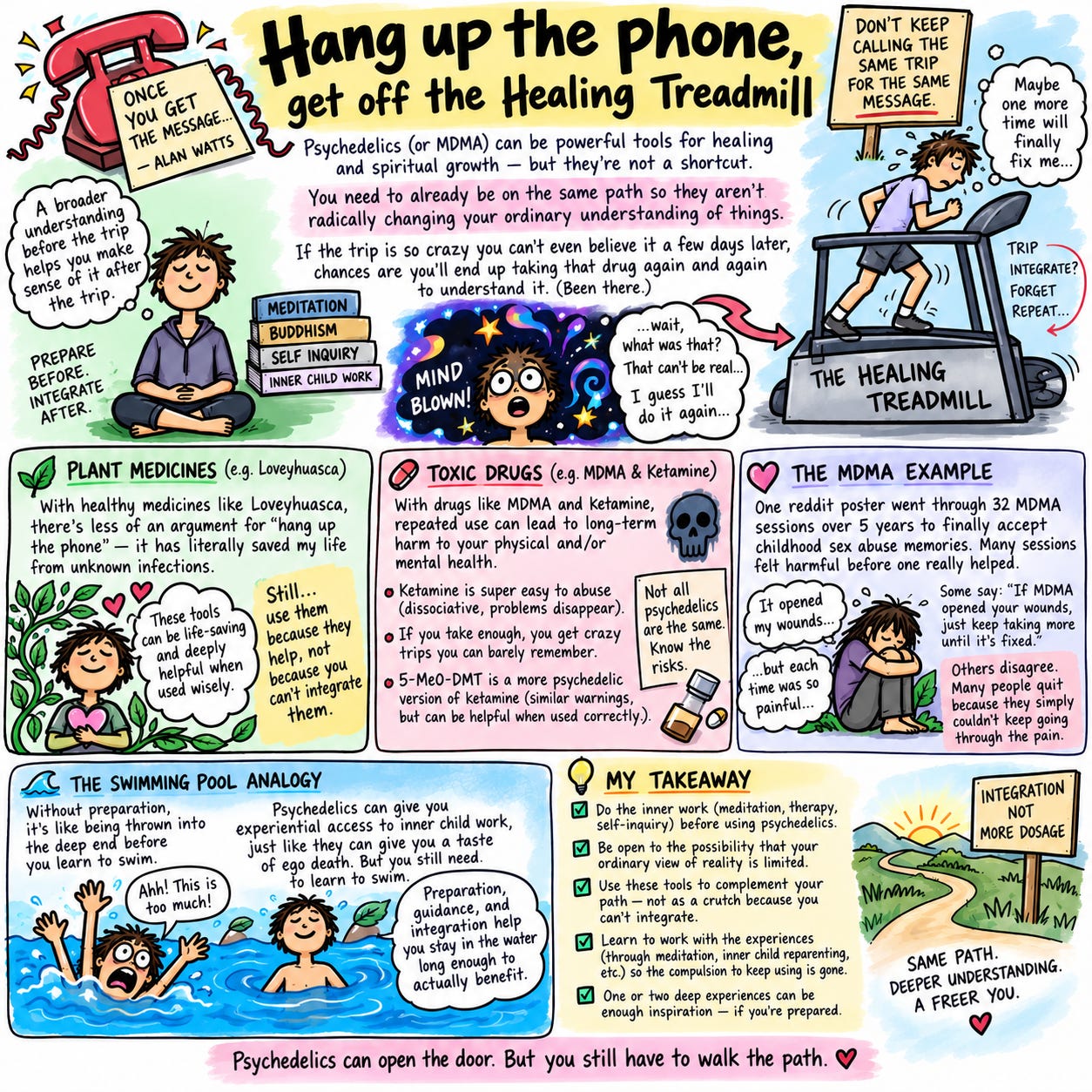
If you use psychedelics (or MDMA) to achieve a goal like healing or spiritual liberation, you need to already be on the same path so that they aren’t radically changing your ordinary understanding of things. If the trip is so crazy that you can’t believe it a few days later, chances are, like me, you’ll end up taking that drug again and again to understand it.
With healthy drugs like Loveyhuasca, which has literally saved my life on numerous occasions from unknown infections, there’s less of an argument for “Hang up the phone” as Alan Watts famously said you should do “once you get the message.” But what we shouldn’t be doing is feeling like we need to use these substances because we can’t integrate them.
That happened to me at first when I started with ayahuasca. The ego deaths were so far beyond my ordinary understanding of reality that I dismissed them each time within a week. Then I felt a compulsion to have another ego death soon after. Once I learned to meditate into the experience (and beyond) without ayahuasca, that compulsion was gone. If I had learned about Buddhism and if I could have accepted that my view of reality was limited prior to ayahuasca, then probably just one or two ego deaths would have been enough inspiration for me.
With toxic drugs like MDMA & ketamine, that can be a recipe for long-term harm to your physical, and/or mental health. Ketamine is super easy to abuse because it’s a dissociative psychedelic. All your problems are magically gone, and if you take enough, you get some crazy trips that you can barely remember later. 5-MeO-DMT is the more psychedelic version of ketamine. See my guide on that, because it shares a lot of the same warnings, altho I do think it has more potential to be helpful when used correctly.
Here’s a reddit poster who talks about going through tremendous pain with MDMA as she uncovered childhood sex abuse memories. It took her dozens of sessions that felt harmful before she finally had one that fully got her to accept what happened to her (and a huge somatic release which looked like a re-enactment of the abuse). So there are some people who argue that if MDMA opened up your wounds, just keep taking more MDMA until it’s fixed. Although on this thread, there are some who disagree with that simplistic advice. I know a few people who quit because they simply couldn’t keep going through the pain that MDMA brought up for them. And as the commenters on the first thread note, very few people would go thru that dozens of times hoping for something different to happen.
My perspective is that these people are not correctly preparing for the inner child reparenting that MDMA suddenly provides experiential access to. Because they are unprepared to make the best of the experience, and unprepared to integrate it after, it’s sort of like being thrown into the deep end of a swimming pool before you learn to swim. You flail around for a bit then terrified, you go back to holding on to the wall and begging to get out. It really will take a long time to learn to swim that way, for most folks. On the other hand, without MDMA or loveyhuasca, many people are unable to really do inner child therapy, because it sounds fake to them, just as ego death sounded fake to me before I experienced it. So I think these approaches complement each other greatly.
Why Bad Trips Tend to Happen
Sometimes focusing on what we want makes the blockage visible:

That frame can be useful. It cannot be the only frame.
A bad trip or destabilizing state may also come from dose, drug interactions, sleep deprivation, cannabis, hunger, dehydration, an unsafe setting, sexual or social pressure, unresolved trauma, panic loops, medical symptoms, psychosis-like symptoms, fasting, intense breathwork, meditation overload, retreat pressure, or simply too much too fast.
Every hard experience is not a profound lesson. Sometimes the lesson is to lower the dose, stop the practice, sleep, eat, choose safer people, and admit that the room is bad.
Cognitive distortions from Cognitive Behavioral Therapy (CBT) can create or prolong the crisis:
Catastrophizing: “This will never end.”
Emotional reasoning: “It feels true, so it must be true.”
Mind reading: “Everyone can see I am broken.”
Fortune-telling: “My life is ruined now.”
All-or-nothing thinking: “Either I am enlightened or I am doomed.”
Personalization: “This cosmic horror is specifically my fault.”
Spiritual bypassing: “Because everything is love, I don’t need boundaries, doctors, sleep, or consequences.”
Give the Session a Beginning and an End
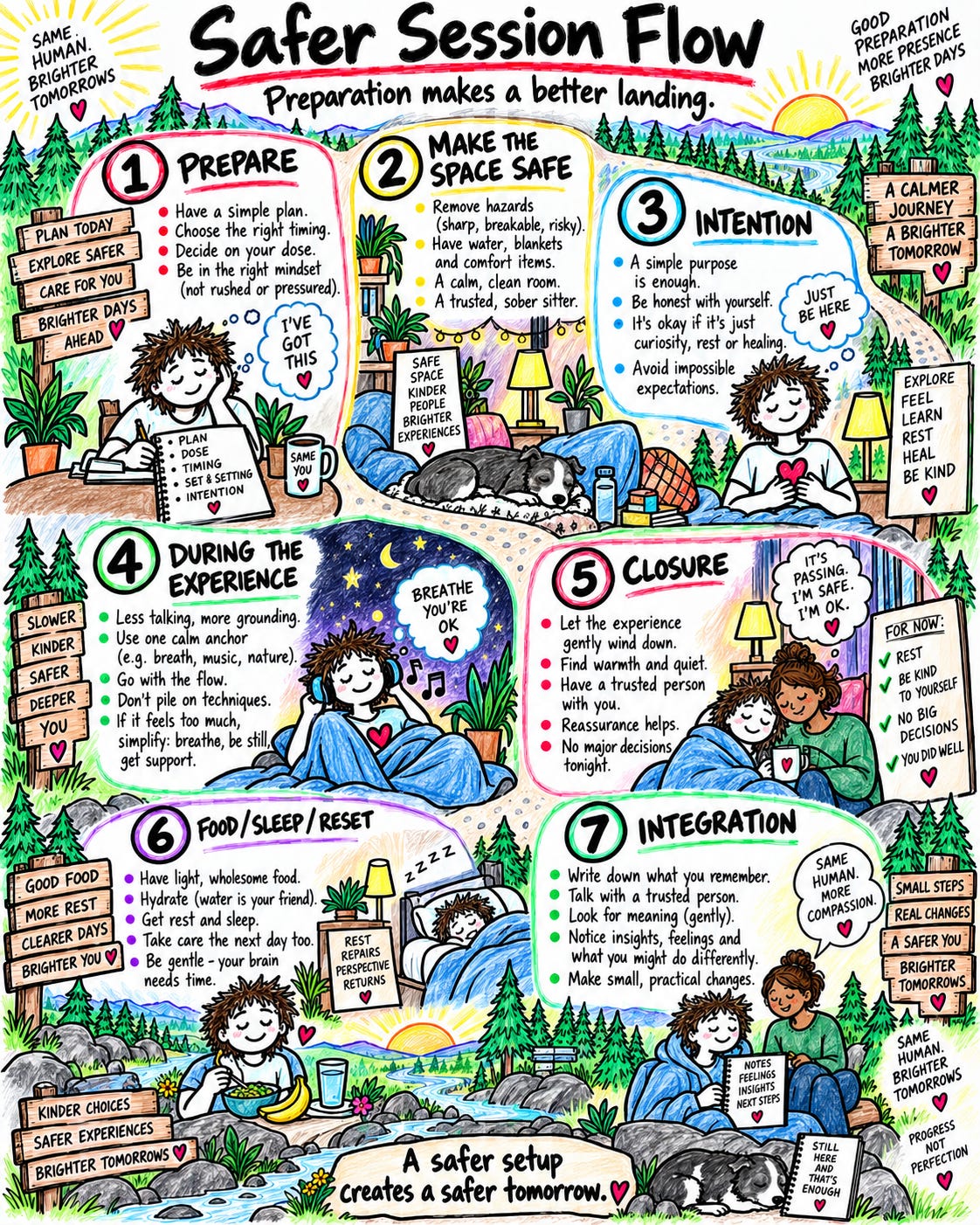
For planned altered-state work, think through the beginning, middle, and end before starting. A lot of prevention is boring: being rested, starting before everyone is exhausted, leaving time afterward, having food ready, and knowing how the session ends.
When you have a choice:
Rest and timing: don’t begin already depleted. When possible, begin earlier in the day so there is still time for the experience, food, ordinary contact, and sleep afterward.
Physical safety: know the substance and approximate dose, review combinations and medical concerns, prepare the room, and decide in advance what requires outside help.
Intention without a script: know what you are open to exploring without demanding a particular revelation, memory, emotional arc, or spiritual result.
Low-directivity support: the sitter protects safety and offers choices. They do not force music, touch, interpretation, confession, prayer, or insight.
Closure: stop adding stimulation, return to the room and date, eat and hydrate when safe, write down the basic facts, and let the body understand that the session has ended.
Integration time: leave the rest of the day and, when possible, the next morning free. Sleep and food come before turning the experience into a new life plan.
Preparation → physical safety → intention → low-directivity support → closure → sleep and food → next-day integration.
Use this sequence for planned sessions. Once somebody is already in trouble, return to the acute checklist instead of trying to improve the ceremony plan.
The Fear/Panic Loop
A common loop is fear trying to solve fear. Terror appears, and the mind answers it with metaphysics, diagnosis, conspiracy, spiritual certainty, or desperate action. That usually feeds the terror.
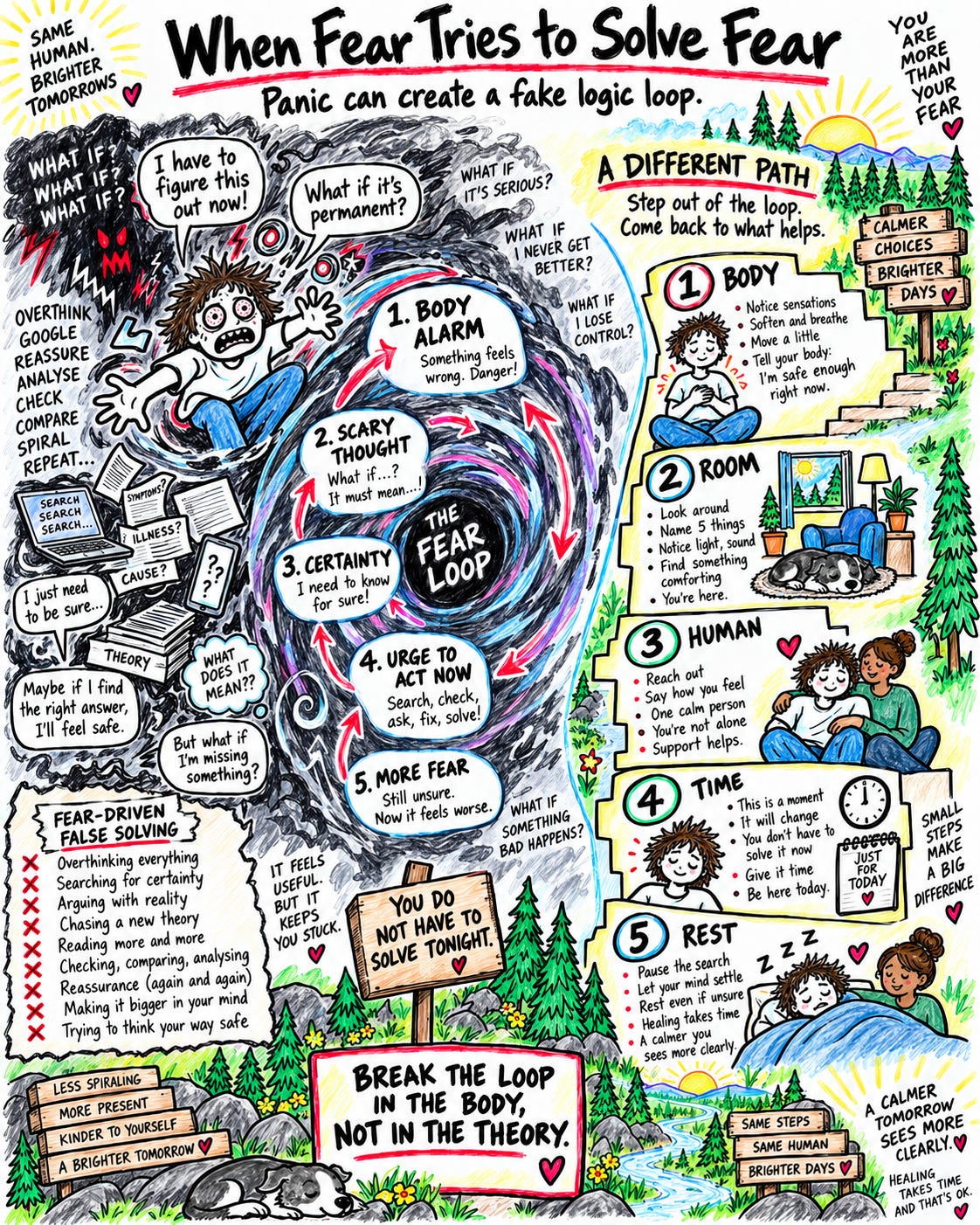
Loop breaker:
Name it: “This is fear trying to solve fear.”
Stop debating: no metaphysics, diagnosis, or life decisions while peaking.
Move down the ladder: body → room → human → time.
Repeat: “This is a wave. I don’t have to solve it while peaking.”
Dealing With Sorrow: Missing Versus Sending Love
I once found a pamphlet helpful on sorrow, although it was too “ultimate” and Advaita for my taste. I now think focusing on love is more helpful than focusing on missing somebody or something.
Missing hurts. Sending love feels good.
This sounds almost embarrassingly obvious, but it took me months of daily loveyhuasca after my ex-wife Bee left to understand it.
Missing is contraction: hunger, ache, self-reference, and the painful fantasy that love means needing the person to return. Sending love is different. Sending love is pleasure in itself, even when the person is gone. Love can bless without grabbing.
The difference is enormous.
The mistake people often make in love states is simply enjoying the love—or sending heart emojis to everybody. That is nice, but it is not the deepest utility.
The deepest utility is sending love to the places where love is missing.
Send love to the person you miss without demanding their return.
Send love to the part of you still waiting for them.
Send love to the inner child who believed somebody else had to rescue him.
Send love to the ashamed, angry, lonely, terrified, and exiled parts.
Hand on Heart and Gratitude 🫶🏿
A hand on the heart can change the direction of a trip, especially when the problem is emotional contraction, grief, fear, or loneliness. The point is not to manufacture loving thoughts. Give the body one simple signal: love is here.
Put one hand on the heart and the other on the solar plexus just below it, sending love to the inner child. Sometimes that shifts the whole field. Once love reaches the inner child, send it toward all beings suffering now. Recognizing that you are not the only one suffering can open awareness in a liberating way, with real heart magic.
Gratitude comes like icing on the cake. Being thankful for every lesson, difficult experience, reprieve, heart opening, and moment of compassion can create a deep connection with the sacred. Never force gratitude. Let it bubble up gently.
Touch, Consent, and Compassion
Self-touch is different from somebody else touching you. Compassion does not mean grabbing, hugging, restraining, stroking, or crowding. Ask first: “Would touch help, or would you rather have space?” Good support may be silent presence from six feet away.
When the person says stop, freezes, pulls away, or seems unsure, stop. Touch must remain nonsexual, consensual, and unrelated to the helper’s needs.
Demons, Jinn, Entities, and Shadow Forces
I have faced demons and jinn during psychedelic and exorcism-type situations. The most important thing I discovered was that fighting them did not help. Sending love did.
In one especially dramatic situation involving another person, the entity seemed to attack both of us psychically. I sent it love, and within a few seconds it left. The other person could not do that immediately. I had to show her, and it took hours of practice before it worked because she had never gone deeply into “Love Thy Enemy.”
I don’t have to settle whether these things are objectively real or internal formations because the response is mostly the same.
Hatred, fear, shame, pride, and rage make hooks. Love removes hooks.
The common mistake is fighting the terrifying thing with the energy it already consumes. Panic fights panic, hatred fights hatred, pride fights pride, and suddenly a small war is running inside consciousness.
Love is a better move, although it is difficult advice. Almost nobody can authentically love what terrifies them while they are terrified. Train before the emergency: send love to a frightening image, a hated person without approving what they did, your shame, your body, sickness, aging, fear, death, and the inner child. Practice being the space rather than the storm.
This is not passivity. It is becoming unhookable. A demon can fight hatred, feed on fear, argue with pride, and seduce grandiosity. Love gives it nothing to grab.
Safety rule
Even a completely real-feeling entity does not make decisions for your body. No entity may tell you to hurt yourself or another person, drive, jump, flee, accuse somebody, cross a sexual boundary, or make a life decision tonight.
When somebody is medically, physically, or psychologically too overwhelmed to reach love, stabilize first. Don’t teach nondual demonology to somebody who needs the lights down and a doctor.
Abuse Memories, Recovered Memories, and Certainty
Psychedelics can bring up true trauma, symbolic material, distorted fragments, fears, fantasies, archetypes, past-life narratives, and mixtures of all of them. Don’t dismiss what arises. Don’t treat intoxicated certainty as evidence either.
Don’t confront tonight
When you see or remember abuse, betrayal, murder, past lives, hidden crimes, or cosmic plots, write it down and get safe. Don’t confront anybody while intoxicated or destabilized. Return to it after sleep with a trauma-informed therapist, integration specialist, or grounded person you trust.
The experience may matter deeply. It may be psychologically true, symbolically true, literally true, partly true, or false in the form it first appeared. You don’t have to decide tonight.
Dealing With Shadow Thoughts
When we try to purify the mind, something natural and frightening may happen: the opposite becomes more visible, almost like Newton’s Third Law—every action arrives with an equal and opposite reaction.
Shadow thoughts and feelings are not inherently a problem. They co-arise naturally and do not need to be attached to, like shadows cast by objects in sunlight. I also notice them after excessive focus. The mind becomes stressed and seeks an exit from the pressure, often in the opposite direction from the focus.
Relax, unwind, unbind, and unweave the identity illusion, mind, and unified experience. My pamphlet on already-perfect goes further into this.
I am not repeating the simplistic Hermetic claim that opposites are required to understand anything. A hated baby does not feel love, and a loved baby does not feel hate. In the subconscious world of concepts, however, two sides are often considered together.
During a trip, don’t identify with every shadow thought, suppress it, confess it to everybody, or convert it into a permanent diagnosis. Notice: “A thought is here. A feeling is here. It is intense, but it is not the whole of me.” Then return to body, room, human, time, and love.
The Joker Poem
At the centre
of the spinning circle
sits the joker
with a mirror
in his hand,
reflecting all to everyone
to help them understand.
His face is fierce, yet gentle,
his eyes, they pierce you through,
you cannot escape his gaze
no matter where you go,
no matter what you do.
His smile is warm, he draws you in,
he is so calm, why are you
so confused by him?
Your thoughts are like a raging storm
between the whirling sky and sea,
nothing seems certain any more,
nothing’s how it used to be.
Once things were clear in black and white,
you thought you knew the wrong from right,
you drew the line, and cut it fine,
between the day and night;
but now your world is crumbling,
there’s nowhere you can call your own,
nothing’s solid anymore,
not even cities made of stone,
not even your own body,
not even flesh and blood,
not even skin and bone.
The sun and moon are falling on your head,
the stars are tumbling down,
flowers sing like angels,
in the winter town.
The dead are living, the living dead,
fire turns to water, water burns instead,
silence is so full of sound, time stands still,
you hear the earth turn round.
Your life flashes before you,
is that thunder, or the beating of your heart,
you don’t know if this is the end,
or something new about to start.
You don’t know if you’re dreaming
or if you are awake,
and as you go on spinning
you see the joker’s mirror
reflecting every move you make.
You show him good,
and he will show you evil;
you show him truth,
and he will show you lies;
you show him life,
and he will show you
how all that’s living dies.
You show him happiness,
and he will show you sorrow,
you show him yesterday,
and he will show you tomorrow;
you show him poverty,
and he will show you wealth;
you show him sickness
and he will show you health.
You fall as if forever, falling
spinning round and round,
tumbling into empty space,
without up or down
and thus you will go on falling
until you understand
how opposites arise mutually,
then you and the joker
will dance, hand in hand.
Then you will know the truth:
that all is of one taste;
then you and the joker
will have the same face.
— Unknown
After the Storm
Don’t rush to turn a hard experience into content. Sleep. Eat simple food. Drink water. Walk. Journal. Pray and meditate gently. Talk with one grounded person, rather than twenty chaotic people. Don’t make huge decisions, diagnose yourself from one intense night, or assume every vision was literal and every fear was false. Let the system settle.
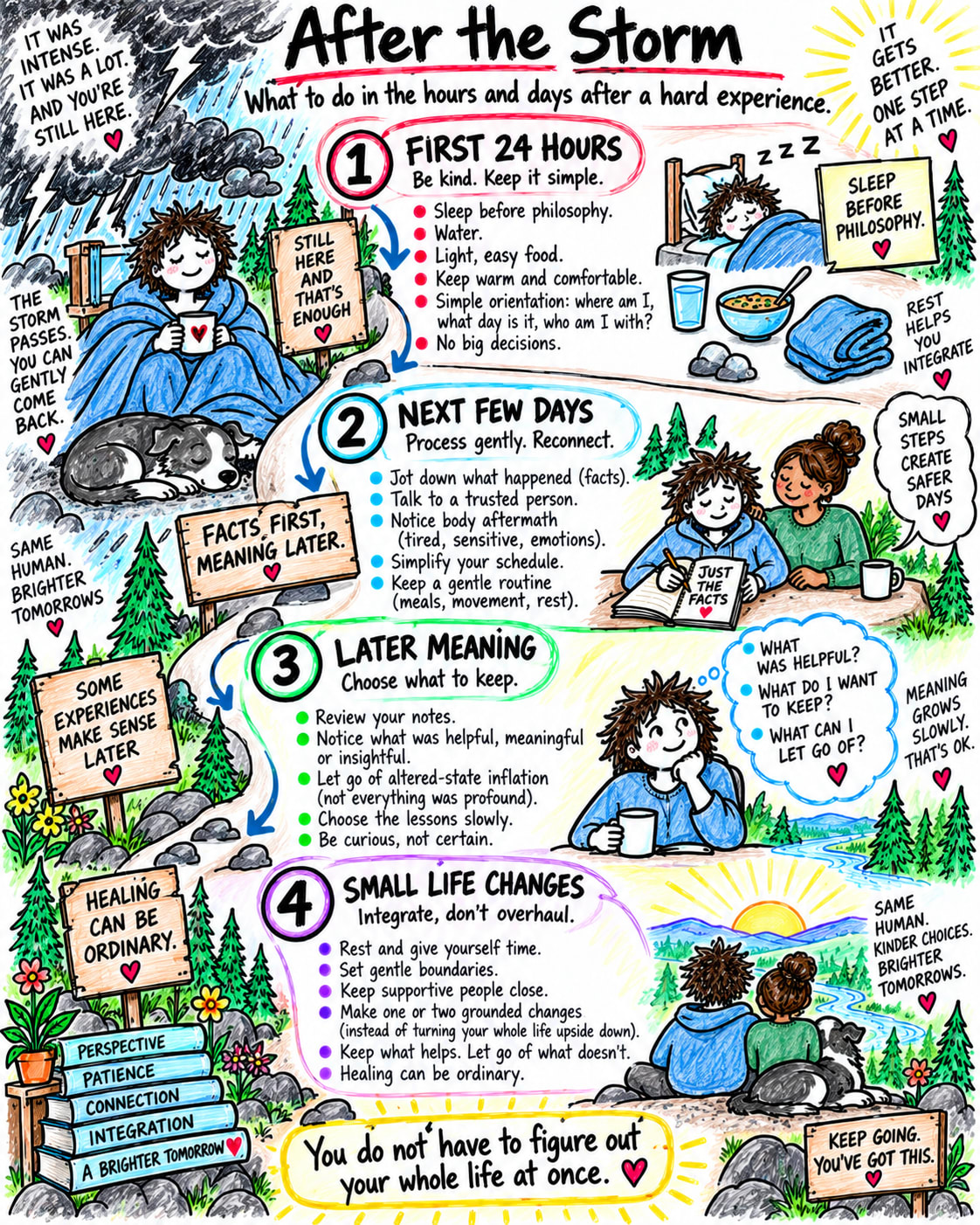
Minimum Viable Integration
First 24 hours: sleep, food, water, warmth, ordinary contact, and no big moves.
Next few days: write the facts—substance, dose when known, setting, events, triggers, what helped, and what made things worse.
Then: consider what the experience may have meant emotionally, spiritually, relationally, or practically.
Last: make small behavioral changes that reduce suffering and increase love.
What Kind of Aftermath Is This?
When symptoms linger, name the pattern rather than collapsing everything into “I’m broken.” Different patterns need different support.
Anxiety and fear: grounding, routine, reduced stimulation, CBT-style reality testing, and therapy when it persists.
Sleep disturbance and nightmares: sleep hygiene, no more substances, and professional help when severe or prolonged.
Derealization and depersonalization: ordinary-world grounding, exercise, nature, outside attention, less rumination, peer or family support, and therapy when needed.
Visual distortions or HPPD-like symptoms: reduce stress and substance use; seek professional support when symptoms interfere with life.
Social disconnection and shame: one or two safe humans, peer support, and no social-media crowdsourcing while raw.
Existential shock: write it down, slow down, and return to practical love before building a metaphysical system.
Trauma material: trauma-informed therapy or integration support, without immediate confrontation while destabilized.
Paranoia or psychosis-like beliefs: professional support quickly, especially when beliefs drive unsafe action.
Somatic hyperarousal: gentle movement, breathing, grounding, and medical care for severe, unusual, or worrying symptoms.
No “another ceremony will fix this” reflex.
Don’t take more psychedelics, cannabis, ketamine, intense breathwork, fast, push kundalini, deprive yourself of sleep, meditate or stretch to extremes, or schedule “another ceremony to fix it” while destabilized. Stabilize through sleep, food, routine, sober support, ordinary body, and ordinary world. Deep practice can wait until the floor is back.
Then ask what actually happened. What was medical or environmental? What was emotional? What was old trauma? What was fantasy? What was useful? What changed behavior? What needs therapy, an apology, rest, or plain practical action?
The fruit of insight isn’t how cosmic the story sounds. It’s whether suffering goes down and love gets more available.
Appendix: Additional Resources
Other alternatives to standard mental-health care are listed at alternativementalhealth.com.
U.C. Berkeley offers a free class, based partly on experimentally validated Buddhist teachings, about learning to be happy and helping others become happy.
The monk Ajahn Jayasaro gives useful guidance on shadow work in Buddhist teachings in the video below.
Additional Resources
If somebody is actively in trouble, use the checklist first. The resources below come afterward.
Have you ever wondered whether the stuff we see in visions is real or not? Here is my “answer.”
Free tripsitting hotline at The Fireside Project as well as ICEERS.org
The Hopkins/Griffiths protocol for psilocybin (enduring benefits), summarized by GordoTek.
Two manuals at: zendoproject.org/education/
“*The ZENDO Project Training Manual*” especially Appendix A: “How to Work With Difficult Psychedelic Experiences” (pages 13 - 17)
and
“*The Manual of Psychedelic Support*” …. 328 pages
“A comprehensive guide to setting up and running compassionate care services for people having difficult drug experiences at music festivals and similar events.”
------“A Method of Conducting Therapeutic Sessions with MDMA” by George R. Greer, M.D. & Requa Tolbert, M.S.N. Journal of Psychoactive Drugs
Excerpt:
“As much as possible, everything done or said in preparing clients to take this compound attempted to give this message”:
“You are consciously taking a medicine to open yourself to whatever teachings you may need at this time. Neither you nor we know what these teachings will be or how they may occur. We will provide a safe place for your explorations, and will be available to assist you with any difficulties; but all you learn that is real comes from within you – not from us, or from the medicine itself.”