
Somatic Modalities Strategic Sequencing Roadmap
Follow this before starting more mind-oriented therapy

Trauma healing is rarely a matter of simply revisiting painful memories. For many people, especially those with complex or developmental trauma, lasting recovery follows a sequence: first establishing safety and nervous system regulation, then releasing accumulated stress and survival responses, and only afterward engaging in deeper trauma processing.
It helps to also include the supplements for neurological de-armoring, especially at the EMDR stage for re-consolidating memories into low-fear, high empowerment forms.
This roadmap organizes several of the most effective body-based and trauma-focused modalities into a strategic progression—from stabilization and daily regulation through deep reprocessing and integration—while highlighting combinations that may work particularly well together. The goal is not to prescribe a rigid formula, but to provide a practical framework for understanding how different approaches can complement one another throughout the healing journey. And they are all useful in preparation for inner child therapy.
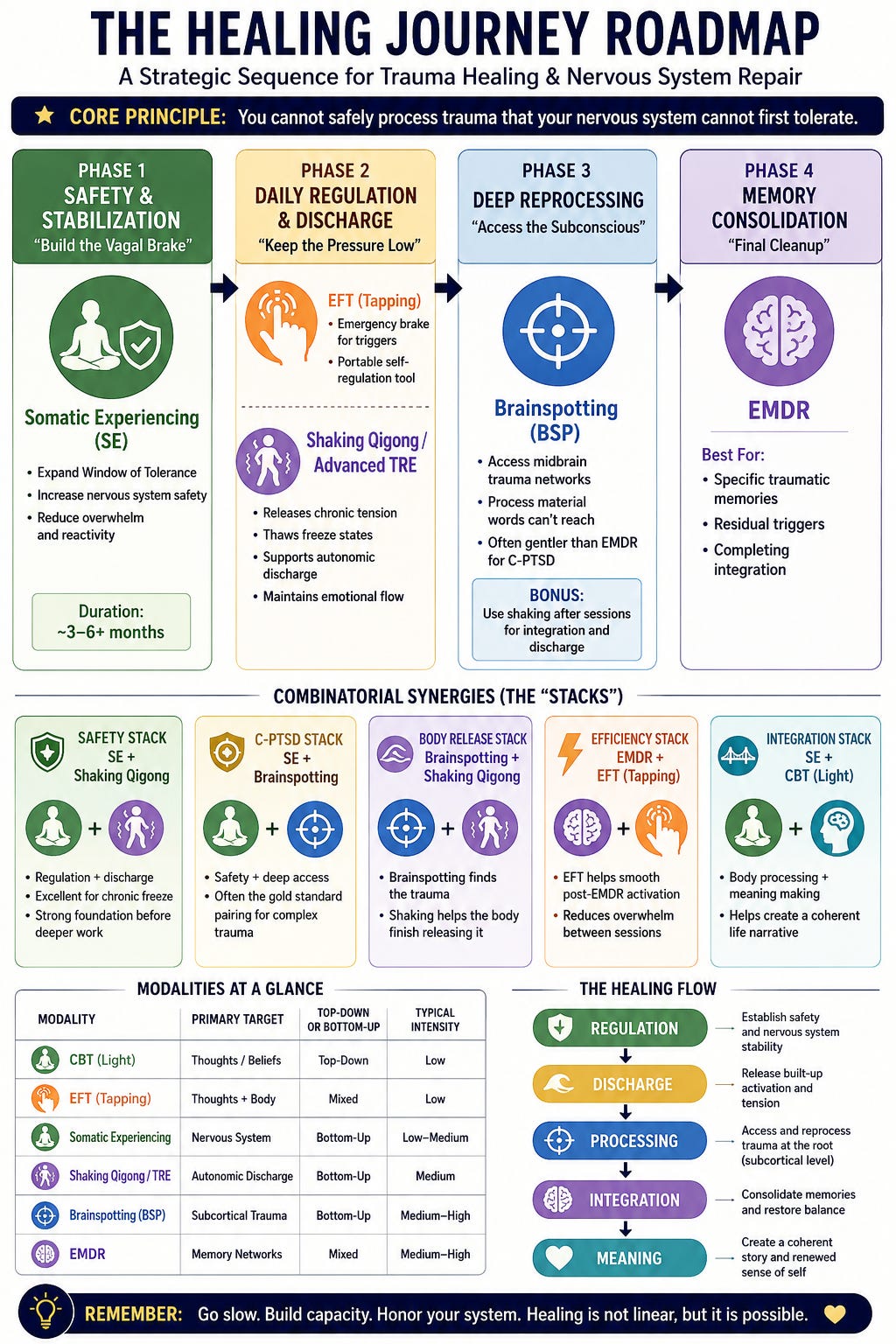
Phase 1: Resourcing & Stabilization (The “Vagal Brake”)
Primary: Somatic Experiencing (SE)
Goal: Expand the Window of Tolerance and establish nervous-system safety.
Why first: If the autonomic nervous system cannot return to regulation, deeper trauma work often becomes destabilizing.
Duration: Often 3–6 months (sometimes longer for severe developmental trauma).
Secondary: Gentle Shaking / Trauma Release Practices
Examples:
Basic Trauma Release Exercises (TRE)
Light neurogenic tremoring
Full shaking qigong class for $10/month! This worked a lot better for my friend Louka than basic TRE. If $10/mo sounds like too much, consider that some people spend thousands of dollars on guns/ammo so they can do a “cosplay” version of shaking therapy.
Biodynamic Breathwork and Trauma Release System (BBTRS) is a wonderful offshoot of Levine’s Somatic Experiencing. Here is a directory of trained and trusted BBTRS therapists. You can also find a list of other tips for trauma release on this reddit post.
Role: Body-led discharge of excess sympathetic activation. Watch a video about the theory on this.
Warning: Keep intensity low during this phase. The objective is regulation, not catharsis.
Phase 2: Triage & Daily Regulation
EFT (Tapping)
Goal: Portable self-regulation tool for real-world triggers.
Advanced Shaking Qigong / Shaking Medicine
Goal: Daily autonomic discharge and energetic decompression.
Mechanism (mainstream interpretation):
Repetitive rhythmic movement
Reduced muscular armoring
Increased interoceptive awareness
Potential vagal regulation
Tremor-mediated release of chronic tension
Mechanism (qigong interpretation):
Removal of energetic stagnation
Increased qi circulation
Dissolution of stored emotional charge
Best use:
10–45 minute regular practice
Non-verbal emotional processing
Chronic freeze patterns
Stress accumulation between therapy sessions
Not ideal as:
Standalone treatment for severe PTSD
Primary trauma-processing modality
Phase 3: Deep Subcortical Reprocessing
Brainspotting (BSP)
Goal: Access subcortical trauma networks.
Why now: The system has:
SE-created safety
EFT-created self-regulation
Shaking-created discharge capacity
At this point Brainspotting can often go substantially deeper without overwhelming the client.
Shaking Integration Sessions
After Brainspotting:
Allow spontaneous shaking/tremoring
Gentle qigong shaking
Walking meditation
This can help metabolize material that surfaces during BSP.
Phase 4: Targeted Memory Re-consolidation
EMDR
Goal: Resolve remaining discrete traumatic memories.
De-armor first: Begin experimenting with the supplements for neurological de-armoring. That protocol is especially beneficial at this EMDR stage for re-consolidating memories into low-fear, high empowerment forms.
Best suited for:
Specific events
Accident trauma
Assault memories
Military trauma
Distinct flashback targets
Less ideal than BSP for highly diffuse developmental trauma.
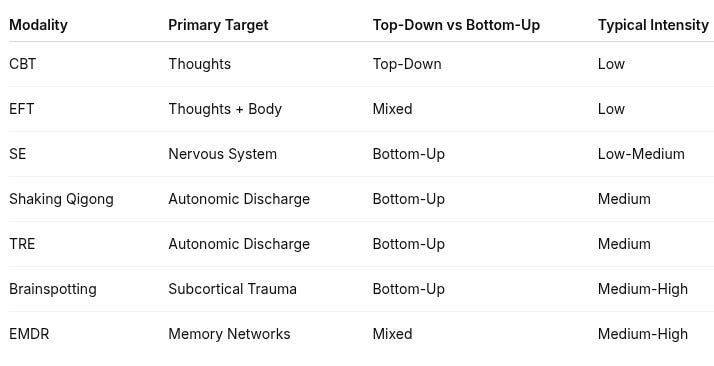
Where Advanced Shaking Qigong Fits Relative to Other Modalities
Combinatorial Synergies
The “Safety Stack”
SE + Shaking Qigong
SE teaches regulation.
Shaking provides ongoing discharge.
Many people with chronic freeze report this combination works better than either alone.
The “Body Release Stack”
Shaking Qigong + Brainspotting
Brainspotting identifies the trauma network.
Shaking helps complete defensive responses that were interrupted years earlier.
This is probably where advanced shaking systems have the strongest theoretical fit.
The “Integration Stack”
Brainspotting → Shaking → EFT
Brainspotting opens the material.
Shaking helps discharge activation.
EFT helps re-establish calm.
The “Full Nervous-System Stack”
Somatic Experiencing
Shaking Qigong / TRE
Brainspotting
EMDR (only if needed)
Light CBT for meaning-making
This sequence follows a fairly consistent principle seen across trauma research and clinical practice: regulation → discharge → processing → integration → narrative.
One caveat: some advanced shaking communities make very large claims about releasing decades of trauma, kundalini activation, energetic awakenings, or rapid healing. There is substantial anecdotal support for profound experiences, but the strongest evidence base currently remains with approaches such as Somatic Experiencing, EMDR, and Brainspotting. I would view advanced shaking qigong as a potentially powerful adjunct and accelerator rather than a replacement for skilled trauma therapy.
And now here’s a bit of an “advanced” bonus somatic hack stack!